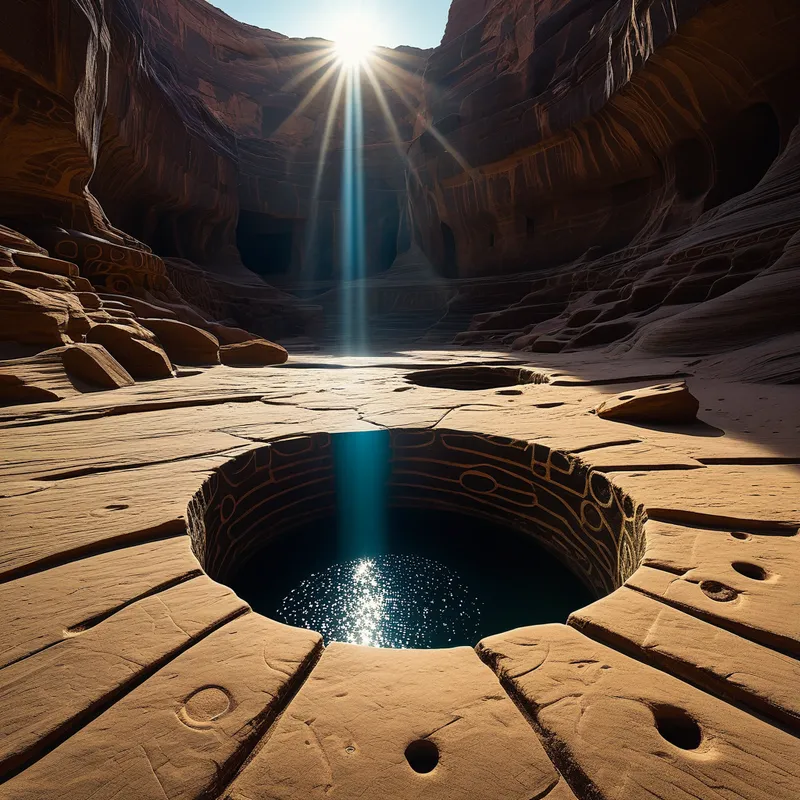
Sipapu Myth Meaning & Symbolism
The Hopi myth of the Sipapu tells of humanity's emergence from a dark underworld through a sacred portal into the Fourth World of existence.
The Tale of Sipapu
In the beginning, there was only Tokpella, Endless Space. And within it, the Creator conceived the First World. It was a place of perfect harmony, but it was not to last. Corruption crept in, a shadow upon the soul of that world. Seeing this, the Creator instructed the Kachinam to guide the few who still remembered the song of origin to a place of sanctuary. Through a great opening in the earth, they descended, leaving the First World to its fate.
They found themselves in the Second World, a land of blue twilight and gentle ways. For a time, they lived in peace, building and singing. But again, the people forgot. They forgot the journey, forgot the purpose, and turned their hearts to discord. The world grew heavy with the weight of their forgetting. Once more, the Kachinam came, their forms luminous in the gloom. "You must go deeper," they intoned. "You must seek the world that waits below." And so, through another portal in the floor of that blue world, the people descended.
The Third World was a land of red earth and abundant life, a vast subterranean realm. Here, they flourished. They built great cities, mastered crafts, and their numbers grew like the roots of a mighty tree. Yet, prosperity bred a greater darkness. Greed, sorcery, and war poisoned the land. The air grew thick with forgetting and fear. The people became lost in their own creations, deaf to the original vibration of the Creator.
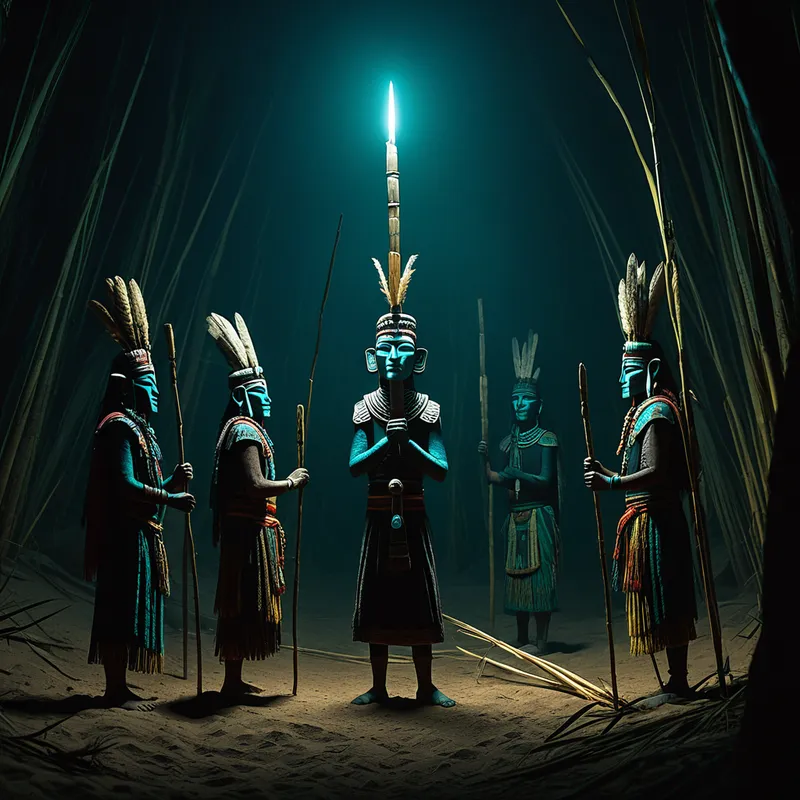
In the deepest dark, when hope itself seemed a memory, the Kachinam returned. Not with anger, but with a solemn grace. "This world is ending," they said. "But you are not. You are to be born again." They led the people to a place where a single, frail-looking Liyakba grew from the cavern floor. "This is your path," whispered a Kachina, its voice like wind through canyon walls. "You must climb. You must have faith in what you cannot see."
One by one, the people approached the reed. They placed their hands upon it, feeling its living pulse. They began to climb, upward into a narrow, vertical darkness. For days they climbed, a line of souls in the womb of the earth, hearing only their own breath and the creak of the living ladder. Above was utter blackness. Below, the red world they knew collapsed into chaos—fires, floods, the roar of a world dissolving.
Then, the one at the very top felt a change. A dampness. A coolness. Their hand broke through into open air. With the last of their strength, they pulled themselves out, collapsing onto solid ground. They opened their eyes to a blinding, glorious light. It was the sun of the Fourth World, Tuwaqachi. They had emerged through a small, water-filled hole—the Sipapu. They helped the others emerge, a people reborn, weeping at the sight of the vast sky, the distant mesas, the promise of a new beginning under the watchful eye of Tawa. They had journeyed through the womb of the earth and were now born into the world of dawn.
Cultural Origins & Context
The myth of the Sipapu is the central narrative of Hopi cosmology, belonging to the Pueblo peoples of the arid Southwest. It is not a mere story but a living map of identity, history, and obligation. Traditionally, this sacred history is recounted by designated knowledge-holders, often during winter ceremonies or in the context of initiations, where its truths are imparted incrementally and with great solemnity. Its transmission is oral, precise, and deeply tied to place—specifically to the Paayu area and the Grand Canyon, which the Hopi identify as the site of their emergence.
The myth functions as the ultimate origin story, explaining the Hopi's sacred covenant with this land, Tuwaqachi. It is a narrative of moral instruction, detailing the consequences of straying from Hopivötskwani. Each previous world's destruction is attributed not to divine caprice, but to human failure: forgetfulness, corruption, and imbalance. The Sipapu itself is ritually replicated in Hopi kivas (ceremonial underground chambers) as a small, round hole in the floor, symbolizing the very portal of emergence and the ongoing connection to the ancestral underworlds and the forces of creation.
Symbolic Architecture
The Sipapu myth is a profound allegory for the soul's journey through successive states of being. Each "World" represents not just a physical location, but a stage of collective consciousness, a paradigm of understanding that becomes outgrown or corrupted.
The journey is not a flight from evil, but a necessary ascent through the strata of one's own being, leaving behind outmoded selves.
The Underworlds symbolize the unconscious—fertile, creative, but potentially chaotic and entangling. The cities built in the Third World represent complex ego-structures and societal constructs that can ultimately become prisons. The reed, Liyakba, is the axis mundi, the slender thread of intuition, faith, or spiritual guidance that connects the depths to the heights. It is fragile yet resilient, a natural element offering salvation when all human-made things fail.
The act of emergence is the ultimate symbol of birth, not just physically, but psychologically and spiritually. It is the moment of awakening, of consciousness (the Sun) illuminating a new, more integrated plane of existence. The Sipapu, as the navel of the world, represents the point of transition itself—the wound, the opening, the sacred threshold where one state of being dies and another is born.
The Dreamer's Resonance
When the pattern of the Sipapu emerges in modern dreams, it signals a profound process of psychic emergence. The dreamer may find themselves in dark, labyrinthine basements, caves, or subway tunnels (the Third World), feeling trapped by circumstances of their own making—a job, a relationship, a belief system. A feeling of impending collapse or flood is common, reflecting the ego's recognition that its current "world" is unsustainable.
The appearance of a hole in the ground, a well, a drain, or a narrow vertical shaft marks the activation of the Sipapu archetype. This is the call to ascent. The dream may present a ladder, a vine, or simply the daunting opening itself. The somatic experience is crucial: the tightness of the passage, the fear of the climb, the uncertainty of what lies above. This is the body remembering the birth process, the primal squeeze of transformation. To dream of finally emerging into blinding light or a vast, new landscape indicates the culmination of this inner process—a hard-won shift in perspective, a release from an old, confining identity into a broader, more conscious state of awareness.

Alchemical Translation
For the individual on the path of individuation, the Sipapu narrative models the alchemical cycle of solve et coagula—dissolution and reconstitution. Our personal "Third Worlds" are the complex identities we construct: the successful professional, the devoted parent, the intellectual, the victim. These are not inherently negative; like the Hopi's subterranean cities, they are stages of development. But they become tombs when we over-identify with them, forgetting our deeper, more fluid nature.
The alchemical fire that destroys the old world is not punishment, but the fierce grace of reality itself, burning away what is no longer true.
The collapse of such a world is a crisis that feels like ruin—a depression, a failure, a loss. Yet, in the alchemical view, this is the essential nigredo, the blackening, the descent into the prima materia of the soul. From this dark chaos, the "reed" grows. This is the small, inner voice of intuition, the remembered fragment of a truer self, the therapist's question, the creative impulse, the moment of sincere prayer. It seems insubstantial, but it is the only tool for ascent.
Climbing the reed is the arduous work of therapy, meditation, artistic expression, or any disciplined practice that leads inward and upward simultaneously. It is trusting a process whose end cannot be seen. The final emergence through the Sipapu is the albedo, the whitening, the dawn of a new consciousness. One does not escape the underworld; one integrates it. The Sipapu remains open as a sacred touchpoint, a reminder that our current conscious standing is built upon—and remains connected to—all the depths we have traversed. We are forever beings of emergence, born and reborn through the sacred portal of our own transformations.
Associated Symbols
Explore related symbols from the CaleaDream lexicon: