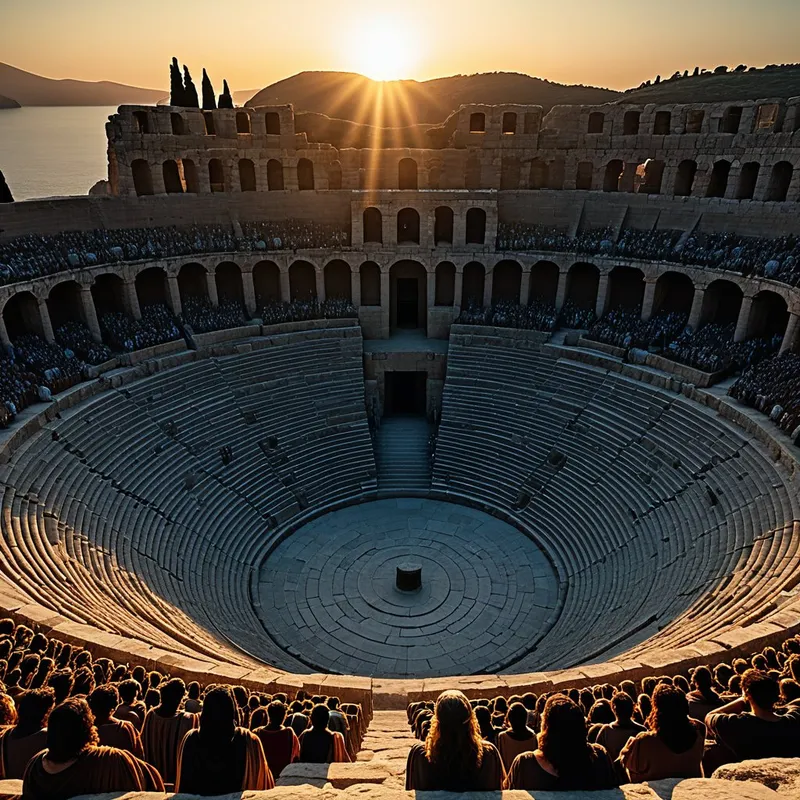
Catharsis Myth Meaning & Symbolism
The sacred process of emotional purification, where the soul's turbulent passions are cleansed through ritual, theater, and divine ecstasy.
The Tale of Catharsis
Listen. The air in the great stone bowl of the Theatre of Dionysus is thick, not with dust, but with the breath of five thousand souls. The sun bleeds into the west behind the Acropolis. A hush falls, a silence so profound it has weight. Then, a single flute pierces the twilight, a sound like a crack in the world.
From the skene, they emerge. Not men, but giants, their faces frozen in eternal agony or divine fury—the masks of Aeschylus or Sophocles. They are Oedipus, blind and howling his fate to an uncaring sky. They are Clytemnestra, her hands still wet with a king’s blood, defying the gods themselves. Their voices are not human; they are amplified, god-touched, rolling over the tiers of stone like thunder.
You, among the thousands, are no longer a cobbler, a potter, a farmer. You are a vessel. As the hero strides toward his terrible, foretold doom—the revelation of a forbidden marriage, the murder of a mother in revenge—a tightness coils in your belly. It is a familiar specter: your own unspoken rage at an unjust master, your own hidden grief for a lost child, your own terror of the chaos that lurks beyond the city walls. The chorus, a single body of swaying, chanting citizens, names the unspeakable. They give voice to the terror.
The tension builds, a psychic pressure. The hero’s hubris meets the immutable wall of Moira. There is no escape. The ax falls. The cry is torn from the masked figure, and in that same instant, it is torn from you. A great, shuddering sigh ripples through the theater—a wave of release. It is not applause. It is something older, more visceral. Tears stream down faces, not just of sorrow, but of a strange, profound relief. The dark thing inside, the pathos, has been witnessed, honored, and expelled into the sacred space. The air itself feels cleansed. As the actors depart, you sit in the gathering dark, hollowed out and strangely, peacefully, full. You have been to the altar and returned. You have undergone the ritual.

Cultural Origins & Context
This was not mere entertainment; it was a teletē, a rite of passage for the entire polis. The concept of catharsis finds its roots in pre-Dionysian purification rituals and medical theory. The physician Hippocrates spoke of purging the body of excess humors to restore balance. Aristotle, in his Poetics, later applied this principle to the soul, theorizing that tragedy, by arousing pity and fear, accomplishes the catharsis of such emotions.
The performances were central to the City Dionysia, a massive civic and religious festival. To attend was a civic duty. The stories were the shared nightmares and foundational traumas of the culture: the house of Atreus, the fall of Thebes. In witnessing these collective shadows enacted under the auspices of Dionysus—the god who dissolves boundaries—the community performed a vital psychic hygiene. It was a controlled explosion, a way to channel the chaotic, passionate, and destructive forces within human nature into a sacred container, thereby strengthening the social fabric by acknowledging the very forces that could tear it apart.
Symbolic Architecture
At its core, the mythos of catharsis is an archetypal drama of containment, pressure, and release. The theater itself is a symbolic krater, a mixing bowl where the individual soul and the collective psyche are stirred together.
The mask is the crucible where the personal "I" dissolves, allowing the transpersonal archetype to speak. In that dissolution, purification becomes possible.
The tragic hero represents the inflated ego, the part of us that believes it can outrun fate or defy the gods (the unconscious, natural law). Their downfall is the necessary humbling. The chorus symbolizes the communal body and the voice of fate or divine law—it is the containing vessel that comments on, and ultimately survives, the individual’s destruction. The emotional release experienced by the audience is not a dismissal of passion, but its sacred transformation. The dark pathos is not eliminated; it is transmuted from a private, festering poison into a shared, acknowledged element of the human condition, thereby losing its destructive autonomy.

The Dreamer's Resonance
When this mythic pattern stirs in the modern unconscious, it often manifests in dreams of overwhelming pressure and sudden release. You may dream of tidal waves you survive, of volcanoes erupting harmlessly into the sky, or of weeping so intensely it floods a room, only to find yourself cleansed afterward.
Somatically, this can correlate with the physical experience of a deep, involuntary sigh, a shudder, or the hot rush of tears that comes "out of nowhere" after a period of prolonged stress. Psychologically, you are in the skene, the backstage of your own psyche, where the masks of your various roles (the professional, the caregiver, the responsible one) are being set aside. The dream is the ritual space where the un-grieved loss, the unexpressed rage, or the unnamed fear—your personal pathos—is allowed to take the stage and play out its drama to its conclusion. The dream does not seek to solve the problem logically; it seeks to discharge the emotional charge, to perform the cathartic ritual your waking life may lack.

Alchemical Translation
The alchemical journey of individuation mirrors the cathartic process perfectly. The first stage, nigredo, is the blackening: the descent into the messy, chaotic, and painful emotional material—the recognition of your own tragic flaw, your shadow. This is the buildup of the tragic plot.
Catharsis is the separatio: the sacred violence that distinguishes the poison from the medicine, the neurotic symptom from the archetypal gold.
The ritual of the theater, or its modern equivalents in deep therapy or authentic art-making, provides the vas, the sealed vessel. Within this container of witness (the therapist’s holding presence, the page’s blankness, the canvas’s frame), the heat of attention is applied. The old, maladaptive story—"I must be perfect," "I am unlovable," "I am a victim"—reaches its crisis point. In the ensuing emotional release, the albedo, or whitening, occurs. The dross of identification is burned away. You are no longer only your grief; you are a being who experiences grief. You are no longer fused with your rage; you have a relationship to it.
This is the psychic transmutation. The raw, leaden emotion of helpless pity and fear is distilled into the gold of compassion (for self and other) and profound respect for the mysterious, often painful, laws of life. The individual ego, having been humbled and purged, re-integrates with a broader, more resilient consciousness. You leave the theater of your own transformation not "cured" in a simplistic sense, but whole—having integrated the tragic, passionate, Dionysian fragment of your soul back into the temple of the self.
Associated Symbols
Explore related symbols from the CaleaDream lexicon: