Ritual Transformation: The Sacred Architecture of the Psyche
The Somatic Echo
It begins not with a thought, but a tremor. A deep, cellular unease, a sense of profound dislocation that hums in the marrow. You wake not to panic, but to a heavy, ceremonial stillness, as if your entire being is holding its breath on the threshold of a sacred, unspeakable event. The body knows first: a weight in the chest like a stone altar, a hollowness in the gut that feels less like emptiness and more like a vessel being prepared. There is a gravity to this feeling, a solemn pull toward a center you cannot yet see. It is the somatic prelude to a death—not of the body, but of a configuration of the self. The mind will later scramble to narrate the dream, but the truth of ritual transformation is written first in the language of bone and blood, in the quiet, terrifying knowledge that you are both the sacrifice and the temple.
The Dreamer's Log
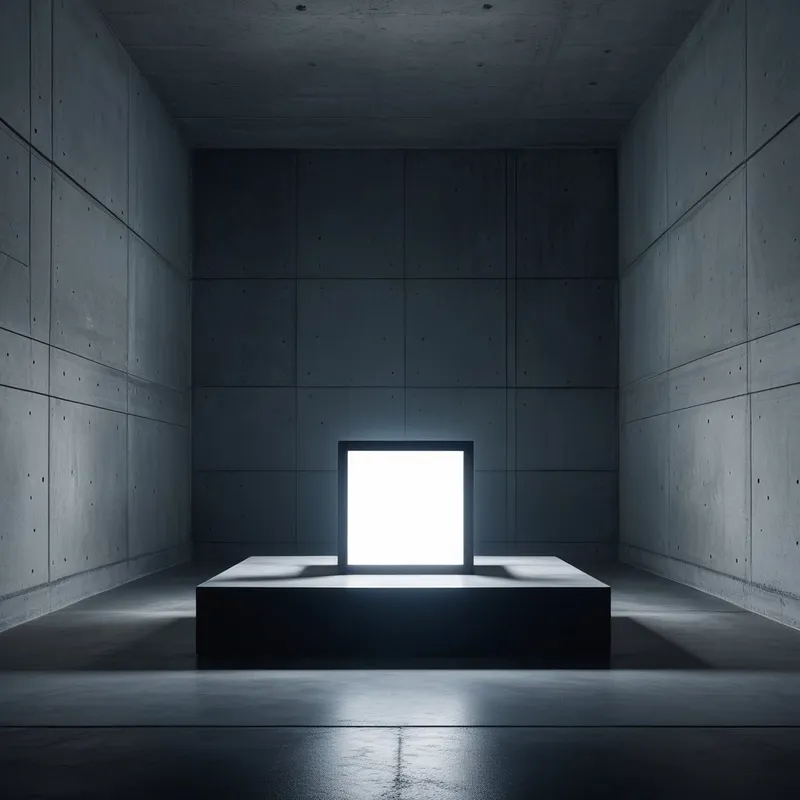
The dream is stark, almost severe. I stand in a room of smooth, grey concrete. In the center, on a low obsidian plinth, rests a perfect white cube. I know, with absolute certainty, that I must dissolve it. Not break it, but dissolve it into light. I place my hands above it, and a heatless energy begins to radiate from my palms. The cube doesn’t shatter; it begins to soften at the edges, becoming translucent, its substance turning to a shimmering vapor that rises and is absorbed into the ceiling, which is not a ceiling at all, but an infinite, starless night.
This is the alchemy of deconstruction: the conscious, willing dissolution of a rigid, crystalline identity (the cube) into its essential, boundless potential (light, vapor, the infinite).
The False Lead
This is not a dream of simple change or circumstantial bad luck. Do not mistake the ceremonial terror for anxiety about a job, a relationship, or a mistake. Those are the surface dramas. Ritual transformation operates at the level of psychic infrastructure. It is not about rearranging the furniture in the house of the self; it is about the house discovering its foundation is made of sand and choosing, in the dream-space, to undergo the terrifying, meticulous process of pouring new footings. The grief you feel is not for a lost object, but for a lost form. The fear is not of an external threat, but of the formless void that exists between the dissolution of the old structure and the emergence of the new.
Psychological Architecture
To understand this dream is to enter the silent workshop where the psyche rebuilds itself. Think of your personality not as a monolithic entity, but as a council—an internal family system of sub-personalities, each forged in response to old worlds. The Achiever, the Pleaser, the Hermit, the Critic: these are not flaws, but loyal parts that built fortresses to keep you safe. Ritual transformation occurs when the entire council agrees the fortress has become a tomb. The architecture must go.
This is the deepest Shadow work. It requires you to sit in council with these exiled parts, not as their dictator, but as their witness and eventual sovereign. You must thank the Rigid Controller for its service before you can dissolve its laws. You must honor the grief of the Orphan who learned to build walls before you can take a single stone down. The process is one of radical, compassionate de-identification. You are not destroying these parts; you are liberating the core energy trapped within their frozen, outdated roles. The ritual is the act of holding space for this internal unraveling, of allowing the old blueprints to burn so that something more organic, more true to your current ground, can emerge from the ashes.
Mythic Resonance
We see this eternal process in the myth of the Phoenix, but often misunderstand its comfort. The emphasis is not on the glorious rebirth, but on the necessary, total immolation. The bird does not simply molt a few feathers; it builds a nest of sacred spices and allows itself to be consumed by fire. The ritual is the willing surrender to the flame. Similarly, in the Norse tales, the god Odin does not gain the runes—the fundamental structures of reality and consciousness—through study or conquest. He hangs himself on the World Tree, Yggdrasil, pierced by his own spear, for nine nights. He offers himself to himself, in a ritual of agonizing suspension between worlds, to gain the knowledge that restructures perception. The ritual is the ordeal itself; the transformation is its inevitable yield.
Symbolic Nodes
- Empty Rooms, Altars, Plinths: The prepared, sanctified space for the work.
- Geometric Shapes Dissolving (cubes, spheres, pyramids): Rigid mental or emotional structures undergoing deconstruction.
- Purifying Elements (fire, water, white light): The agents of transmutation.
- Masks Falling Away or Melting: The shedding of persona.
- Being Guided by a Faceless or Hooded Figure: The unconscious Self orchestrating the process.
- Watching Your Own Body from Afar: The ego witnessing its own dissolution.
- Reciting Unknowable Words or Chants: Activating pre-verbal, archetypal programs.
Archetypal Resonance
The energy of Ritual Transformation is most potently channeled through The Magician Archetype. Not the stage illusionist, but the deep alchemist. The Magician’s domain is the hidden structure of reality, the fundamental laws that govern transformation. In the somatic echo, it is the Magician who senses the latent potential in that heavy stillness, who knows the altar-weight in the chest is a site of power, not just dread. This archetype provides the sacred template, the knowing that within the terrifying dissolution lies the secret of true sovereignty. Its shadow—the Manipulator or Illusionist—is the peril here: the temptation to perform a shallow, cosmetic ritual for quick relief, to manipulate the symbols without submitting to the genuine, ego-shattering process. The true Magician archetype demands you become the crucible, the ingredient, and the transmutation itself.
The Alchemical Process
Alchemy calls this stage Solutio—dissolution. But it is a specific, brutal form of dissolution. It is not being passively broken by life’s chaos. It is the active, conscious submersion of a solidified, outgrown form into the aqua permanens, the universal solvent of the unconscious. The intense psychological heat and pressure come from the tension of holding two impossible truths: you must fully become the rigid, crystalline structure (feel its necessity, its history, its pride) to truly honor it, and you must simultaneously hold the unwavering intent to let it dissolve. This is the fire. You grieve the loss of the familiar shape while cultivating a radical trust in the formless potential that remains. The terror is the ego’s protest at its own planned obsolescence. The transformation into sovereignty occurs the moment you shift from identifying as the structure to identifying with the conscious force that authorized its dissolution. You are no longer the cube; you are the will and the wisdom that chose to turn it to light.
The Integration Protocol
The work continues in waking life. Move from witness to participant.
Question 1: What "perfect, white cube" in my life feels sacred but suffocating? What rigid structure of identity, belief, or behavior do I know, in my bones, must soften and dissolve, not just be rearranged?
Question 2: Who in my internal family system—which protective part of me—is most terrified of this dissolution? Can I sit with that part, not to argue, but to hear its fears and thank it for its long vigil?
Question 3: If the essence of my current self were to become a vapor of pure potential, free to take any new form, what is the first, faint, most authentic impulse that stirs in that formless space?
Action 1 (Somatic Anchoring): For three minutes each morning, stand barefoot. Feel the weight of your body as that altar-stone. Breathe into the heaviness. Instead of trying to lighten it, imagine it rooting down, connecting to a deep, stable core below. You are not the weight; you are the ground that holds it.
Action 2 (Unstructured Glyph): Without planning, take a blank page and a dark pen. Let your hand move, creating a single, continuous, abstract symbol or glyph that represents the process of dissolution you feel. Don't draw a thing; draw a transformation. Let the line waver, break, scatter, or flow. This is a map of your internal ritual.
Action 3 (Elemental Release): Find a small, natural object—a stone, a twig, a leaf—that represents the old structure. Hold it, imbue it with your gratitude and release. Go to a moving body of water (a stream, the sea) or light a small, safe fire in a bowl. With clear intention, surrender the object to the element (place it in the water, burn it). Witness its physical transformation as a mirror of your inner one. Do not retrieve it.
Final Validation
The path of ritual transformation is not chosen by the conscious mind. It is a summons from the depths, and to feel its gravity is a sign of profound psychic integrity, not brokenness. It is terrifying because it is real. It asks everything because what it offers is the only thing that ultimately matters: a self not built on the borrowed blueprints of trauma and expectation, but forged in the sacred fire of your own essential becoming. The dream is the temple. You are the ritual. The sovereignty you seek is not a crown you wear, but the ground you finally, fully, stand upon.