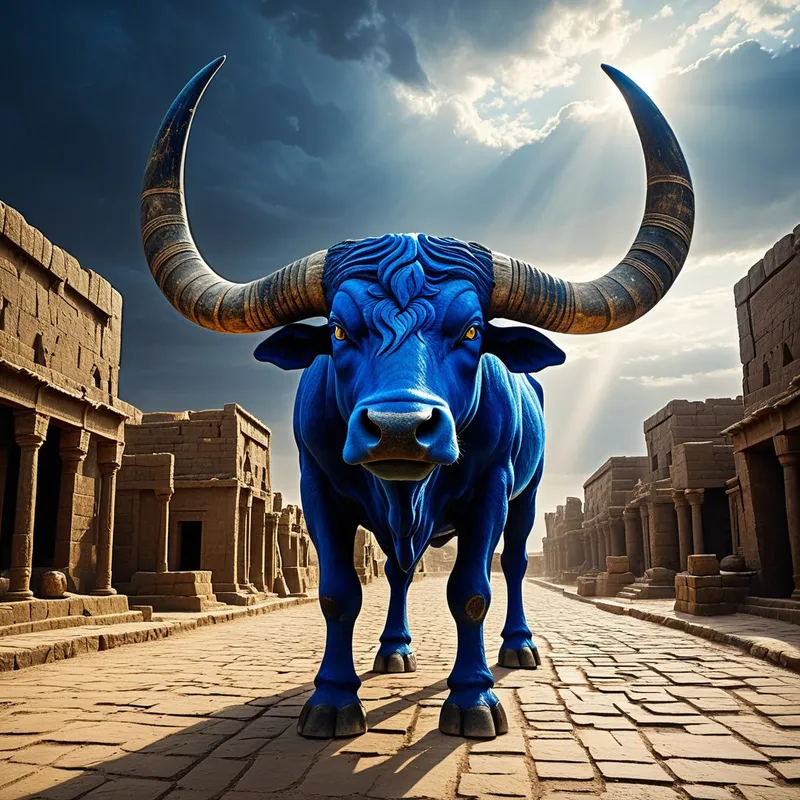
Bull of Heaven Myth Meaning & Symbolism
The goddess Inanna sends the celestial Bull of Heaven to punish Gilgamesh, triggering a battle that reshapes the world and the hero's soul.
The Tale of Bull of Heaven
Hear now the tale that shakes the pillars of heaven and earth, a story not of men, but of forces that shape destiny. In the golden city of Uruk, where the walls touch the clouds, King Gilgamesh walked. Two-thirds god, one-third man, his strength was a tempest, his will an unyielding mountain. Yet his heart was a locked chamber, his rule a heavy yoke upon his people. Their lamentations were a river that flowed upward, against gravity, until they reached the ears of the gods.
The cry came before Inanna, she who holds the Me, the tablets of cosmic law. From her celestial abode, she descended to Uruk, drawn by the fame of its king. She found Gilgamesh washing his long hair, oiled and gleaming like a lion after a hunt, in the splendor of his palace. She beheld him and her divine heart was seized. "Be my bridegroom, Gilgamesh," she proclaimed, her voice the promise of spring and the threat of the spear. "Give me your fruit, a gift of your vigor, and I will give you a chariot of lapis lazuli and gold, and kings will kneel at the scent of your cedar."
But Gilgamesh, the mountain, did not bend. He knew the stories of Inanna's lovers—the shepherd turned into a wolf, the gardener mourned and forgotten. He recited her litany of betrayals, his voice cold as river clay. He scorned her offer, her temple, her very divinity. "What would I have of you?" he thundered. "You are a door that warps in the rain, a palace that collapses on its king."
A silence fell, deeper than the Abzu. Inanna's beauty curdled into a fury that turned the air to copper. She did not weep; she ascended. Straight to the high heaven, to the throne of her father, An, she flew. Her rage was a physical shroud. "Father," she cried, a sound of breaking stars, "Gilgamesh has heaped insults upon me! Create the Bull of Heaven to kill him! If you do not, I will smash the gates of the Netherworld and raise the dead to outnumber the living!"
An, at first, refused. The Bull was a force of the sky, a bringer of seven-year droughts. To loose it upon the earth was to court catastrophe. But Inanna, in her terrible grief-rage, threatened to unmake the order of all things. Reluctantly, An placed the nose-rope of the celestial beast in her hand.
She led it down. The sky darkened as it descended, not as a cloud, but as an absence of light given form. The Bull of Heaven landed in Uruk with a impact that shattered bricks. Its breath was the sirocco, withering the green; a single snort opened a pit that swallowed a hundred men. At its first bellow, the earth split, and two hundred more fell into the crevice. A third bellow opened another pit. The city was being unmade, chasm by chasm.
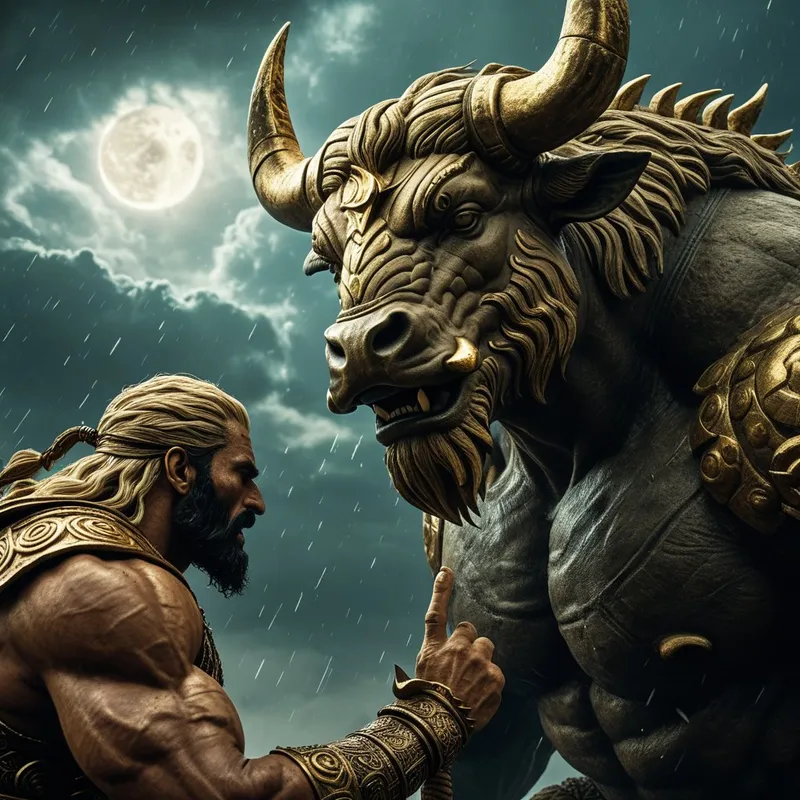
Then, from the chaos, two figures emerged: Gilgamesh, and his beloved brother, the wild man made civilized, Enkidu. They did not flinch. Enkidu, who knew the language of beasts, leapt upon the Bull, seizing it by its thick, celestial tail. Gilgamesh, like a master hunter, moved between the storm of its horns. He drove his sword deep into the sacred space behind its neck, where the spine meets the skull. The Bull, a constellation made flesh, crashed to the ground, its life-force shaking the city to its foundations.
In triumph, but in sacrilege, Enkidu tore a thigh from the fallen god-beast and hurled it into Inanna's face. "Had I caught you," he shouted, "I would do the same to you!" The goddess and her weeping priestesses looked on as the two friends washed their hands in the Euphrates, their laughter echoing over the corpse of a divine power. They believed they had conquered heaven itself. They did not yet know the price of a god's blood on mortal hands.
Cultural Origins & Context
This pivotal episode is recorded on Tablet VI of the Epic of Gilgamesh, a literary composition that evolved over a millennium, from Sumerian poems (c. 2100 BCE) to the standardized Akkadian version found in the library of Ashurbanipal (7th century BCE). It was not mere entertainment but a foundational text, recited by skilled scribes and perhaps performed in ritual contexts.
The myth functioned as a profound cultural negotiation. It explored the limits of royal power (the king versus the goddess), the fragile pact between humanity and the divine (the city versus natural catastrophe), and the dire consequences of transgressing cosmic boundaries. The Bull of Heaven itself was not a random monster; it was an instrument of An, the sky god, directly connected to fertility and weather. Its death symbolized a catastrophic rupture in the divine-human contract, explaining the very real threats of drought and famine in agricultural Mesopotamia. The story served as a cautionary tale about hubris, reminding the audience that even the greatest hero is subject to the decrees of the gods and the inescapable reality of consequence.
Symbolic Architecture
The Bull of Heaven is more than a weapon; it is the embodied wrath of the neglected Feminine, the unleashed power of instinct and nature that civilization seeks to control and often insults. Inanna represents the totality of life's forces—creative, erotic, destructive, and judicial. Gilgamesh's rejection is not of a woman, but of this totality, favoring a sterile, unchecked masculine will-to-power. He rejects the dance of opposites, the necessary union that brings wholeness.
The rejected goddess does not fade; she returns as the avenging bull. What we will not embrace in love, we will be forced to confront in battle.
The Bull, therefore, symbolizes the consequences of psychological one-sidedness. It is the repressed natural world, the denied emotional and instinctual reality, returning with cataclysmic force. Gilgamesh and Enkidu's victory is a pyrrhic one. They slay the instinctual, divine force, believing they have achieved mastery. Yet, in butchering the celestial bull, they sever their own connection to the animating life-force of the cosmos. The subsequent death of Enkidu is the direct, psychological consequence: the hero's vital, instinctual side (Enkidu) must perish when it has participated in the murder of its own source.
The Dreamer's Resonance
When this myth stirs in the modern psyche, it often manifests in dreams of confrontation with a massive, unstoppable animal force—a bull, a bear, a tidal wave of dark energy. The dreamer may be in a city (the ordered psyche, the ego) that is being systematically destroyed by this entity. This is not a nightmare of random fear, but a somatic signal of a deep psychological process.
The body feels it first: a tightening in the gut, a sense of impending, inevitable collision. Psychologically, the dreamer is at the point where long-ignored needs, repressed emotions (often related to love, creativity, or rage), or a denied aspect of their own nature have accumulated critical mass. The "Bull" is the archetypal shape of this accumulated pressure. The dream is the psyche's dramatic enactment of a truth the conscious mind has refused: you can no longer manage, suppress, or outthink this force. It must be faced, and the encounter will change the landscape of your life forever. The dream asks, What divine decree have you insulted? What part of life itself have you scorned?

Alchemical Translation
The alchemical journey modeled here is not the slaying of the beast, but the integration of its essence. The initial, heroic victory is a necessary but immature stage—the ego's defiant assertion of independence from overwhelming parental or instinctual complexes. The true transmutation begins with the fallout.
Individuation is not the killing of the bull, but the mourning of it, and the slow, painful understanding of why it had to die by your hand.
Gilgamesh's subsequent journey—his desperate, futile quest for immortality—is the true alchemical work. Having slain the divine instinct (the Bull) and lost his connection to it (Enkidu), he is thrown into the nigredo, the blackening, a state of utter despair and dissolution. He wanders the wastes, seeking an answer to death, which is really a search for meaning after his grand, destructive act of separation.
The myth maps the path from heroic inflation to human limitation. The Bull's death forces the hero out of the fortress of his ego and into the desert of his soul. The ultimate "gold" produced is not immortality, but wisdom: the realization of his own mortal limits and the value of the earthly city, the human community, he once ruled with such contempt. The psychic transmutation is from a god-like tyrant to a mortal king who has looked into the abyss. The integrated individual is not one who has conquered heaven, but one who has faced the celestial wrath their own actions summoned, endured the desolation that follows, and returned to build something lasting not from defiance, but from hard-won humility and connection. The Bull's power, once an external threat, becomes, through the ordeal, an internalized respect for the terrible and beautiful forces that govern life and death.
Associated Symbols
Explore related symbols from the CaleaDream lexicon: