
Buffalo Spirit Myth Meaning & Symbolism
A sacred story of a primordial being whose willing sacrifice creates a covenant of life, teaching humanity gratitude, reciprocity, and the spirit of abundance.
The Tale of Buffalo Spirit
Listen. In the time before time, when the world was new and the people were few, a great hunger walked with them. The game was shy, the berries scarce, and the cold wind whispered of endings. The people remembered a time of plenty, a memory carried on the breath of their elders, of a being so vast it was the walking land itself: the Buffalo Spirit.
They called him Pte Oyate, the Buffalo Nation. He was not one, but all. His rolling shoulders were the hills, his thick hide the prairie grass, his breath the warm wind from the south. He was the possibility of survival made flesh, but he remained distant, a dark shape on the far horizon of the spirit world.
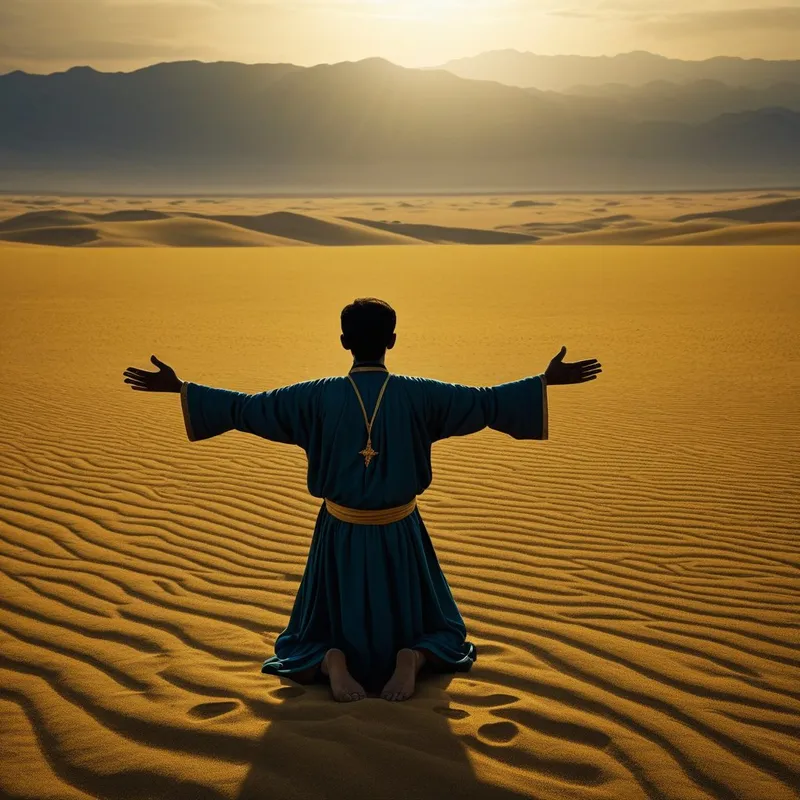
A holy person, a Wicasa Wakan, was chosen. With a heart heavy with the cries of the children, he climbed to a high place. For four days and four nights, he sang the songs of longing. He did not demand. He did not command. He offered only his people’s need, their humility, and their respect. He offered the smoke of semah, a fragrant plea carried to the sky.
And the land heard.
From the very direction of the prayer, the horizon began to move. Not as a herd, but as a single, immense wave of being. The Buffalo Spirit approached, and the earth trembled in a rhythm older than memory. He stood before the people, and his size blotted out the sun, not with shadow, but with a presence so complete it felt like a return to the womb of the world. His eyes were deep pools of patient knowing.
He spoke, not with a voice of air, but with a voice that resonated in the bone and the blood of every person, every animal, every blade of grass. “You have called with clean hearts. You remember the relationship. So I shall give myself to you.”
Then, the great Spirit did not fall. He invited. He lay down upon the earth of his own will, his great head facing the sacred directions. And from his side, from the very substance of his spiritual form, the first buffalo of this world emerged. Then another, and another—a river of life pouring forth from his sacrifice. His body dissolved not into death, but into transformation: his hair became the endless grasses, his bones the flint for tools and the sacred pipes, his blood the flowing streams. His spirit became the enduring law: the covenant.
He gave them everything—his flesh for food, his hide for shelter and clothing, his sinew for thread, his bones for tools. But with this gift came the sacred instruction, the binding thread of the covenant: “Take only what you need. Give thanks for all you take. Honor my spirit, and the well will never run dry. Forget, and the abundance will retreat back into the dream from which it came.”
Cultural Origins & Context
This profound narrative exists in various forms across many Plains tribes, including the Lakota, Dakota, Nakota, Blackfoot, and Arapaho nations. It is not merely a story of origin for the buffalo, but the origin of a sacred, reciprocal relationship that defined a way of life. The myth was the foundational scripture of a culture built upon the buffalo.
It was traditionally passed down orally by elders and holy people, often during specific ceremonies or in the intimate setting of a family tipi during the long winter nights. Its telling was not entertainment; it was an act of remembrance, a reinforcement of cultural and spiritual law. The story functioned as the ultimate ethical framework, governing hunting practices, social organization, and spiritual ceremony. The famed Wiwanyag Wachipi and other rituals are direct enactments of this covenant, a communal effort to give thanks and ensure the continued return of the buffalo—and by extension, all life-sustaining abundance.
Symbolic Architecture
The Buffalo Spirit is the ultimate archetype of the Generous Earth. It represents the totality of the ecosystem as a conscious, willing provider. Its sacrifice is not a one-time historical event, but a perpetual, ongoing process—the very cycle of life, death, and regeneration.
The true sacrifice is not loss, but the transformation of one state of being into another for the sustenance of the whole.
Psychologically, the myth maps the human confrontation with the source of our sustenance and our profound dependence on forces greater than ourselves. The Buffalo Spirit represents the unconscious itself—the vast, primal ground of our being from which our psychic energy, our instincts, and our vitality ("abundance") emerge. The people’s hunger symbolizes a state of psychic poverty, a disconnection from this inner wellspring. The holy person’s prayer represents the ego’s correct orientation: not one of entitlement, but of humble petition, acknowledging its dependence on the deeper Self.
The covenant is the core symbolic architecture. It represents the necessary psychological law: consciousness (the people) must be in a relationship of respect, gratitude, and conscious reciprocity with the unconscious (the Buffalo Spirit). To take without acknowledgment is to invite psychic famine—depression, ennui, a loss of meaning and vitality.
The Dreamer's Resonance
When this myth stirs in the modern dreamscape, it often manifests not as a literal buffalo, but as a profound encounter with a source of nourishment. One might dream of a vast, benevolent landscape that feeds them; a gigantic, nurturing animal; or a figure of immense generosity offering a life-changing gift.
The somatic experience is key. The dreamer often awakens with a feeling of profound gratitude, fullness, or awe. Conversely, if the dream touches on the broken covenant, they may feel a gnawing emptiness, anxiety about resources, or dream of a retreating, inaccessible source of plenty. This pattern signals a critical phase in what Jung called the individuation process: the ego’s necessary realignment with the nourishing powers of the deep psyche. The dream asks: From what or whom do you truly receive your life? And how do you honor that source?

Alchemical Translation
The alchemical journey modeled by the Buffalo Spirit myth is the transmutation of entitlement into gratitude, and of consumption into sacred relationship. For the modern individual, the "great hunger" is often spiritual or emotional: a craving for meaning, connection, or vitality in a fragmented world.
The first stage is the recognition of our hunger and the humble prayer—the active seeking, the therapy session, the meditation practice, the creative act that calls out to the deeper Self. This is the nigredo, the acknowledgment of need.
The approach of the Buffalo Spirit is the albedo—the illuminating arrival of insight, healing, or inspiration from the unconscious. It feels like a gift, a sudden abundance of psychic energy.
The alchemical gold is not the gift itself, but the transformed consciousness that receives it with reverence.
The sacrifice and transformation are the rubedo. This is the most challenging part: allowing the received gift (the insight, the healing, the new opportunity) to be "broken down" and integrated into the fabric of our daily lives. We must let the old, isolated ego-structure "die" to make way for a self that is in covenant. We use the gift not just for ourselves, but to nourish our community and our world, completing the circle.
Finally, the enduring covenant is the cauda pavonis, the peacock’s tail—the ongoing, conscious practice of gratitude and reciprocity. It is the daily acknowledgment that our life is sustained by a thousand invisible sacrifices, and our responsibility is to live in a manner worthy of that gift. In this way, the myth of the Buffalo Spirit becomes not a tale of the past, but an eternal blueprint for living in sacred, sustainable relationship with the profound source of all being.
Associated Symbols
Explore related symbols from the CaleaDream lexicon: