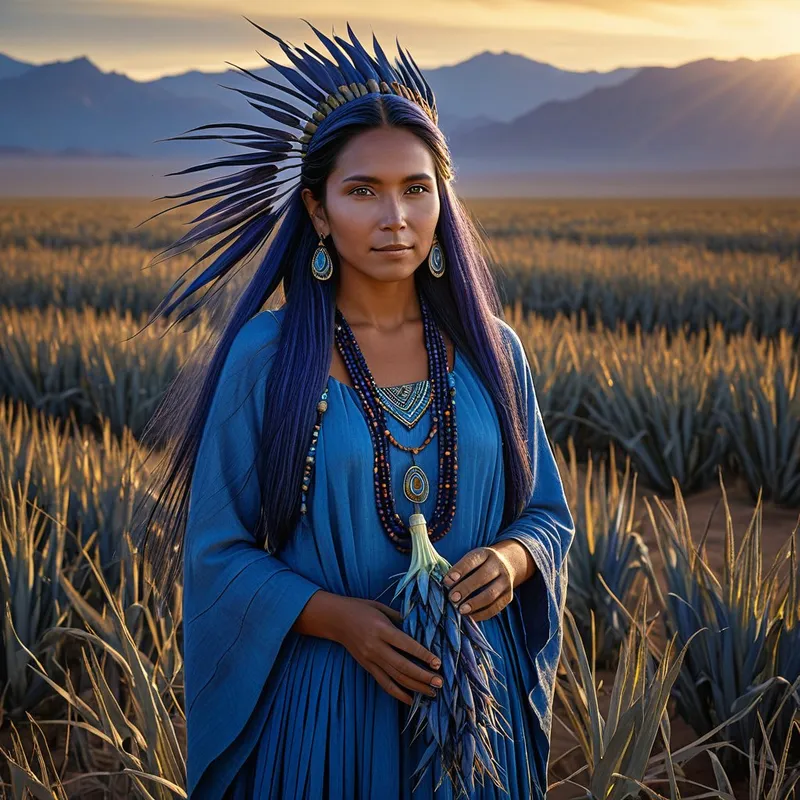
Blue Corn Maiden Myth Meaning & Symbolism
A Hopi myth where a sacred being sacrifices her form to become the first blue corn, establishing a covenant of life, death, and renewal for the people.
The Tale of Blue Corn Maiden
In the time when the world was still soft from dreaming, the Hopitu Shinumu lived in a land of stark beauty and harsh truth. The sun was a relentless father, the rain a shy and distant mother. The people knew hunger as a constant companion, a hollow echo in the belly that mirrored the dry arroyos.
Then, she came. She was not born; she emerged. From the place where the first light touches the mesa at dawn, a woman appeared. Her skin held the cool, profound hue of a summer twilight sky just before the stars emerge. Her hair was the silken tassel of the corn, dark and fine. They called her Blue Corn Maiden. Where she walked, the parched earth seemed to sigh with relief. A grace followed her, a quiet promise. She lived among the people, her presence a balm, yet the hunger remained—a deep, ancestral ache.
The wise elders and the Kikmongwi saw her true nature. They understood she was not merely a woman, but a walking prayer, a being of sustenance made flesh. In a solemn council beneath the vast, star-strewn blanket of the night, they faced a terrible and beautiful truth. To truly save the people, the Maiden could not stay as she was.
With hearts heavy as river stones, yet resolved as the bedrock of the mesa, they spoke to her. They did not command; they revealed. They showed her the cycles: the seed must break open in the dark earth, the caterpillar must dissolve within its chrysalis, the cloud must surrender itself to the earth as rain. They spoke of the covenant—that life feeds life in an endless, sacred exchange.
Blue Corn Maiden listened. She looked into the faces of the children, saw the hope flickering in the eyes of the elders. She felt the yearning of the land itself. A profound stillness settled upon her, a stillness deeper than sorrow, brighter than fear. It was the stillness of absolute choice.
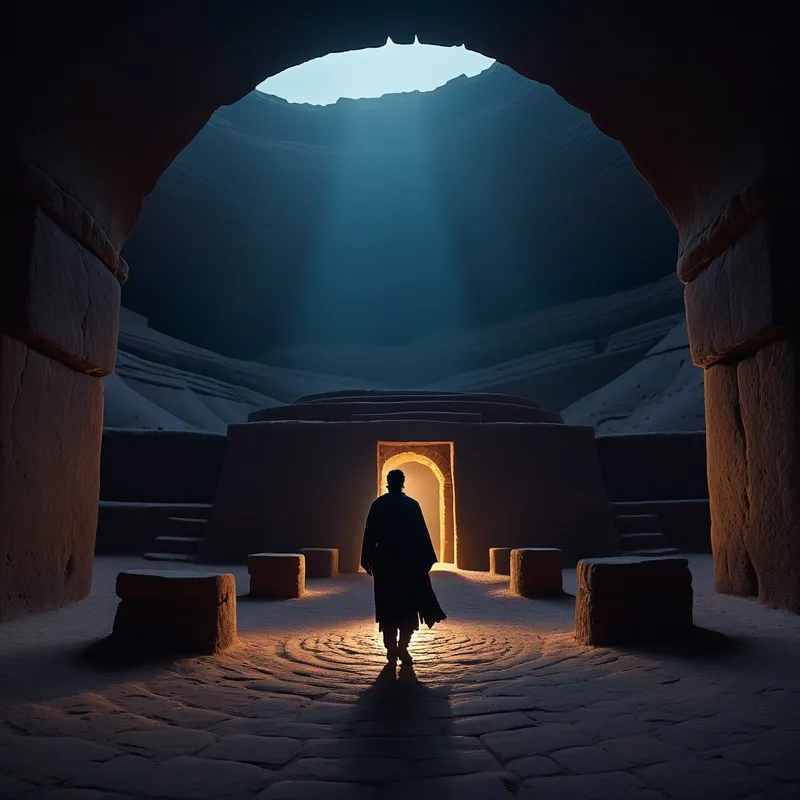
Without a word of protest, she turned and walked towards the kiva, the ceremonial heart of the village, the womb of the earth. The people followed in a silent procession, the only sound the whisper of their feet on the ancient dust. At the kiva entrance, she paused, a silhouette against the dark opening. She looked back once, her eyes holding the color of deep, life-giving water. Then, she descended into the darkness.
They sealed the kiva. Days passed. The air grew thick with anticipation and grief. Then, on the morning when the horizon bled peach and gold, the chief unsealed the entrance. The scent that rose was not of death, but of rich, damp soil and something sweet and earthy. There, in the center of the sacred space, where Blue Corn Maiden had lain down, a single, vibrant plant had sprung from the earth. Upon it grew ears of corn unlike any seen before—their kernels a miraculous, deep, nourishing blue.
She had not died. She had transformed. She had kept the covenant.
Cultural Origins & Context
The story of Blue Corn Maiden is a foundational narrative of the Hopi people, whose name, Hopitu Shinumu, reflects a worldview centered on humility, cooperation, and reverence for natural law. This myth is not mere folklore; it is a cosmogonic map and a moral compass. It was traditionally passed down orally, often by elders and cultural knowledge-keepers within the context of specific teachings or during ceremonial periods, embedding the lesson not just in the mind, but in the heart and community memory.
Its societal function is multifaceted. Primarily, it establishes the sacred origin of blue corn (sakwapqa), which is not just a staple food but a central spiritual entity in Hopi life. The myth codifies the principle of reciprocal exchange with the spiritual world: for life to be sustained, something of profound value must be willingly given. It also reinforces key Hopi values—sacrifice for the community, respect for the feminine principle as a source of life and nourishment, and the understanding that true sustenance requires a sacred, transformative process. The myth teaches that survival is not a right, but a relationship.
Symbolic Architecture
At its core, the myth is a profound allegory for the cycle of life, death, and rebirth, not as a violent catastrophe, but as a conscious, sacred act. Blue Corn Maiden represents the archetypal Feminine as Nourisher. She is the spirit of the grain, a deity found in many world cultures (Demeter, Persephone, the Corn Mother), who must undergo a hieros gamos, or sacred marriage, with the underworld (the kiva) to release her generative power.
The deepest nourishment is never simply taken; it is always born from a sacred surrender.
The kiva is the symbolic womb of the earth and the crucible of transformation. It is the dark, fertile void where form dissolves so that new, more resilient form can emerge. The blue color of the corn is highly significant. Unlike the more common yellow or white, blue symbolizes depth, the spiritual, the life-giving waters from the underworld, and endurance. It is the color of the distant rain-bearing cloud and the deep sky that holds the promise of dawn.
The elders represent conscious awareness and cultural wisdom—the part of the psyche that understands painful but necessary truths of existence. They do not force the transformation but guide the Maiden (and by extension, the community) to recognize and accept her destiny within the great cycle.

The Dreamer's Resonance
When this myth pattern stirs in the modern dreamer, it often signals a profound somatic and psychological process of necessary sacrifice for future growth. One might dream of a cherished part of oneself—a talent, a relationship, a long-held identity—walking willingly into a dark, enclosed space or dissolving. There is a tone of deep melancholy, but not of horror.
Somatically, this can feel like a hollowing out, a quiet ache in the core, or a sense of being "planted" or immobilized. Psychologically, it is the process of the ego surrendering a treasured possession or self-concept so that a broader, more nourishing identity can form. The dreamer is in the kiva-stage: a period of incubation, depression, or introversion where the old "maiden" (a youthful, individual form) is breaking down to become "corn" (a generative, communal sustenance). It is the psyche preparing to feed its own future from the substance of its present form.
Alchemical Translation
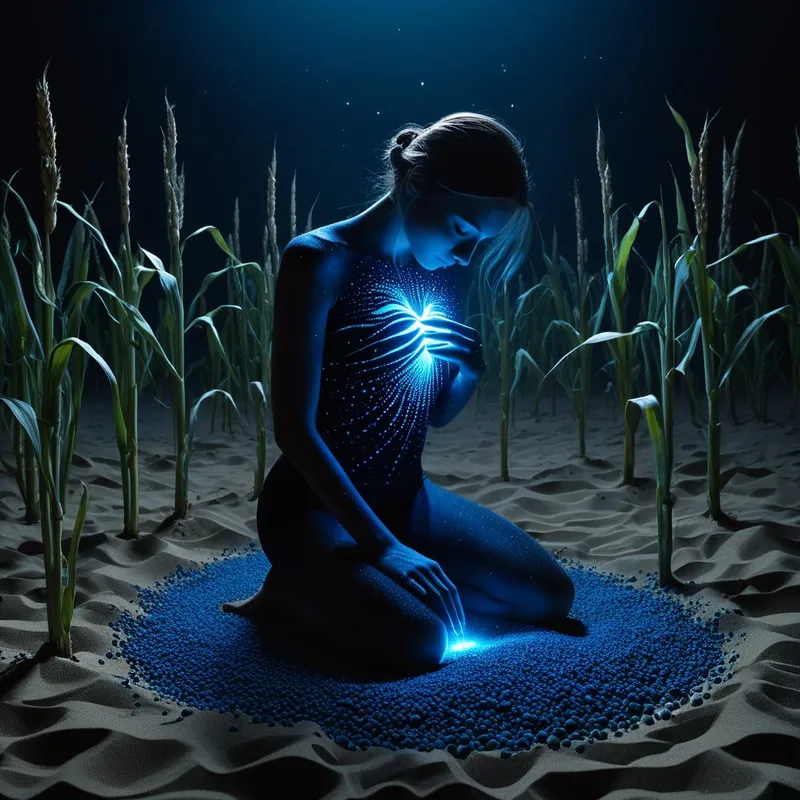
For the modern individual navigating the path of individuation, the myth of Blue Corn Maiden models the alchemical stage of mortificatio or nigredo—the blackening, the dissolution. This is not a failure, but the essential first step in the opus, the great work.
The Self does not grow by mere accumulation, but through cycles of sacred dissolution and recombination.
We are all, in various ways, Blue Corn Maiden. The "blue" aspect is our unique, soul-level essence—our deepest values, talents, and core spirit. The "maiden" state is when that essence is contained in a form that is beautiful but ultimately unsustainable, perhaps too personal, too fragile, or not yet capable of nourishing the wider "community" of our total psyche and life.
The alchemical process demands we heed the "elders"—our own inner wisdom and the unavoidable truths of our life stage. We must consciously choose to descend into our own inner kiva (a period of introspection, therapy, solitude, or crisis) and allow that cherished self-image to decompose. The goal is not annihilation, but transmutation. The ego-maiden sacrifices her current form so that the soul-corn can be born. What emerges is no longer a vulnerable, individual identity, but a resilient, generative substance—a wisdom, a creative output, a mature capacity to nurture oneself and others—that is deeply, authentically colored by our original essence (the blue). We become sustenance for our own journey.
Associated Symbols
Explore related symbols from the CaleaDream lexicon: