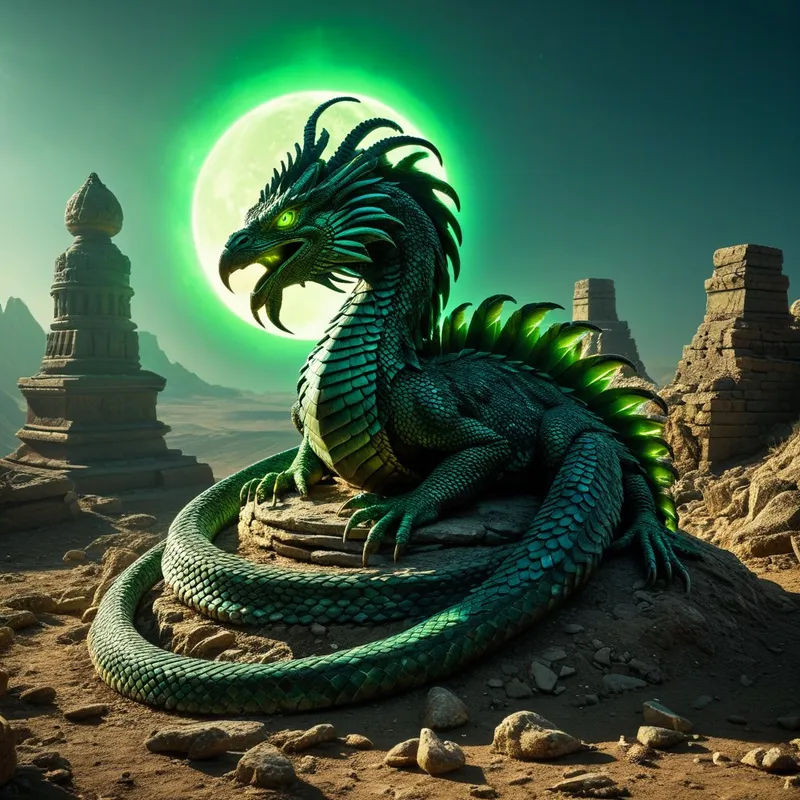
Basilisk Myth Meaning & Symbolism
A creature born of serpent and rooster, whose gaze turns all to stone, embodying the primal poison that must be confronted to achieve wholeness.
The Tale of Basilisk
Hear now the tale not of a beast, but of a birth. It begins not in a forest or a cave, but in the silent, dusty heart of a workshop where the air smells of salt and metal. An egg, laid not by a hen but by a serpent, was placed in the nest of a toad under a cold, waning moon. There it incubated, not with warmth, but with a slow, geological patience, fed by the damp breath of the earth and the venom of despair.
When the shell cracked, it did not chirp. The sound was the dry rustle of scales on stone. From the yolk of black bile emerged a creature that should not be: the body of a great, coiling serpent, crowned with the head of a rooster, its comb a bloody crest, its beak sharp as a scythe. This was the Basilisk, the King of Serpents. Its first breath poisoned the air; the toad shriveled into a lump of jet. Where it crawled, the grass blackened and died, leaving a trail of glassy slag.
Its power was not in fang or claw, but in the eye. To meet its gaze was to be answered with a truth so absolute it allowed for no life. The fluid dance of being ceased. The merchant on the road, the bird in the sky, the stream bubbling over rocks—all were transfixed, translated from flesh and flow into cold, permanent stone. The Basilisk did not hate; it simply was, and its being was a verdict. It moved through the world like a slow, inevitable conclusion, turning the vibrant, chaotic kingdom of life into a silent, ordered garden of statues. The land became a gallery of final moments, a monument to the end of process.
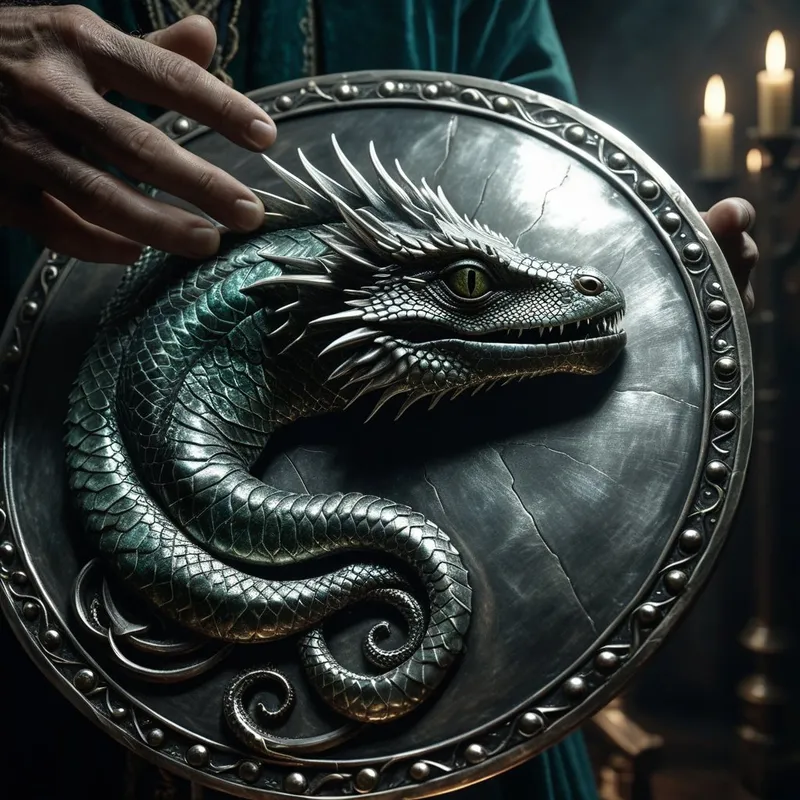
None could face it. Armor was useless, for the gaze seeped through vision itself. Courage turned to crystalline memorials of fear. The kingdom lay paralyzed under a curse of perfect stillness. The resolution came not from a warrior, but from a mirror. A lone figure, face shrouded, approached not with a sword, but with a shield of polished silver. They did not look at the beast, but at its reflection. They advanced backward, a dance of indirection, until the shield was held aloft. The Basilisk, seeing its own terrible countenance reflected in the burnished metal, met the only force equal to its own: itself. Its gaze, turned inward, enacted its own law. With a sound like a mountain cracking, the creature of absolute poison was frozen by its own principle, becoming a twisted statue of jade and obsidian, a monument to its own end. The poison remained in the earth, but the gaze was broken.
Cultural Origins & Context
The myth of the Basilisk is not a folktale of the people, but a speculative myth of the laboratory. It emerged from the manuscript culture of medieval and Renaissance alchemists, those philosopher-artisans who worked at the intersection of proto-chemistry, spirituality, and psychology. It was passed down not in taverns but in cryptic texts like the Atalanta Fugiens, illustrated with emblematic woodcuts where the Basilisk often appears.
Its societal function was deeply introspective. For the alchemical culture, which saw the outer work (opus externum) as a mirror for the inner work (opus internum), the Basilisk was a dire warning and a crucial symbol. It was a story told by adepts to novices, a narrative map of a specific psychic danger on the path to the Philosopher's Stone. It codified the understanding that the transformative process was not only about gaining power but about confronting the lethal byproducts of one's own spiritual ambition.
Symbolic Architecture
The Basilisk is the embodied Shadow in its most concentrated, autonomous, and destructive form. It is not merely hidden weakness, but the latent poison that is created when life force (symbolized by the rooster, herald of the sun and spirit) is corrupted by the chthonic, instinctual realm (the serpent and the toad). It is the psychic toxin born of spiritual pride, repressed trauma, or unintegrated instinct.
The gaze that turns to stone is the moment of identification with a rigid, absolute truth—a trauma, a complex, a fixed idea—that stops the flow of the soul.
The petrification is a perfect symbol for psychological fixation: depression, obsession, or fanaticism, where the fluid process of becoming is arrested. The landscape of statues is the inner world of a psyche dominated by complexes, where dynamic possibilities have become frozen monuments to past injuries. The mirror, and the figure who wields it, represent the principle of conscious reflection. The hero here is not the ego, but the observing Self that can turn the destructive power of the complex back upon itself through insight, thereby neutralizing its autonomous, life-denying force.
The Dreamer's Resonance
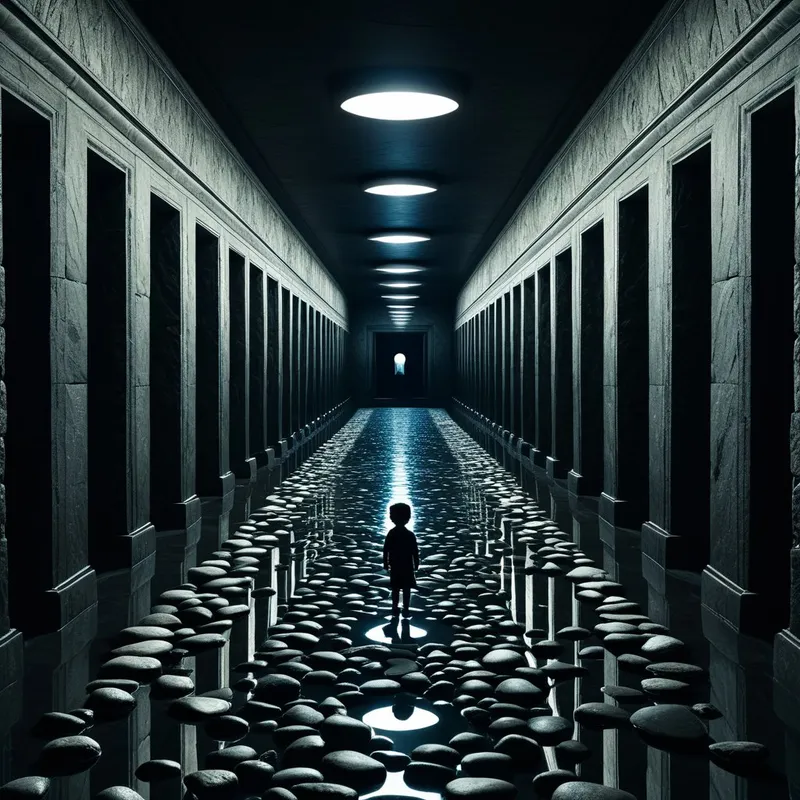
When the Basilisk slithers into modern dreams, it heralds a profound encounter with a petrifying complex. The dreamer may not see the creature directly, but will feel its effects: dreams of being paralyzed, of environments turning to cold stone, of being watched by something that induces utter dread. Somatic sensations upon waking may include a stiff neck, a feeling of being "frozen" in fear, or a cold dread in the stomach.
This is the psyche signaling a confrontation with a core pattern that has the power to halt one's psychological development. The Basilisk-dream occurs when an individual is on the cusp of a significant growth step, but is faced with an internalized "truth"—"I am unlovable," "I must be perfect," "The world is utterly hostile"—that threatens to stop the process dead. The dream is both a warning of the danger and an indication that the material is now ripe for integration. The poison has risen to the surface.
Alchemical Translation
The myth models the process of individuation as a hazardous distillation. The first matter, the prima materia of the psyche, is full of latent poisons. The alchemical work inevitably brings forth these toxins—the Basilisk is born from the work itself, from the unnatural combination of elements under pressure.
The triumph is not in slaying the beast, but in using its own nature against it. This is the principle of similia similibus curantur (like cures like). The rigid, petrifying complex must be met not with flexible emotion (which it would freeze), but with the equally rigid, mirror-like clarity of conscious observation.
The transmutation occurs when the poison, fully faced and reflected upon, loses its autonomous, projecting power and becomes a fixed part of the inner landscape—a statue in the garden of the self, rather than the ruler of the wasteland.
The venom of the Basilisk, once integrated, is understood as a necessary, if terrible, part of the whole. In the highest interpretation, this venom is the very nigredo that, when consciously contained and worked with, becomes the catalyst for the final creation of the gold. The modern individual's journey is thus mirrored: we must dare to hatch our own darkest potentials, to look at the petrifying truths we carry, and by reflecting them with the shield of honest self-awareness, transform their life-negating power into the foundational stone—no longer a prison, but a cornerstone—of a more conscious existence.
Associated Symbols
Explore related symbols from the CaleaDream lexicon: