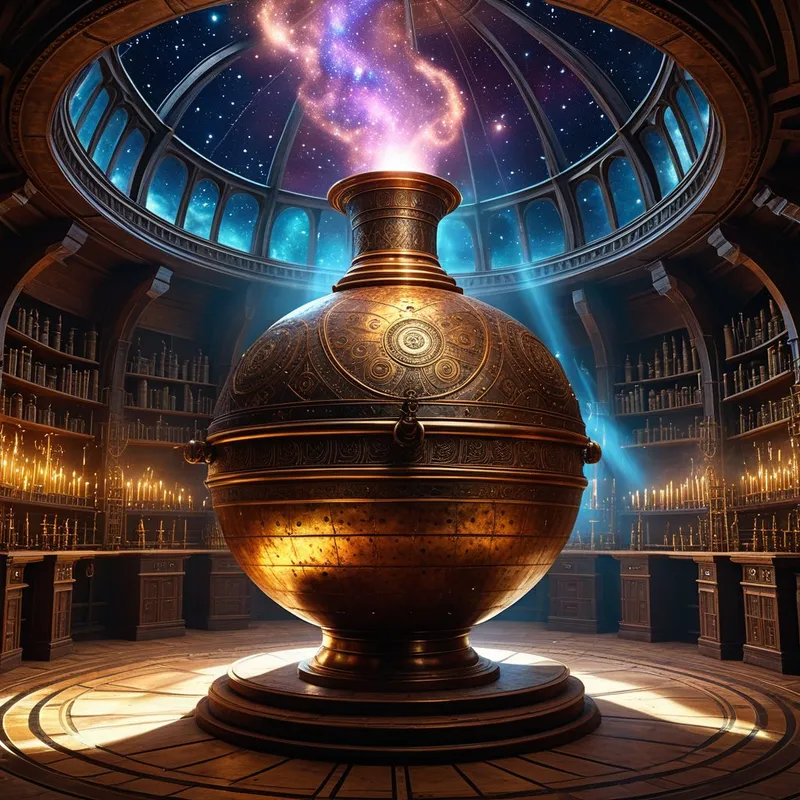
Alembic Myth Meaning & Symbolism
The sacred vessel of transformation, where base matter is dissolved, purified, and reborn as gold, mirroring the soul's journey through chaos to enlightenment.
The Tale of Alembic
Listen, and hear the tale of the Vessel that Dreams. In the time before time was counted, when the world was a broth of potential, the Great Artisan, Spiritus, walked the chaotic plains of Materia Prima. Here, all things were one thing—a glorious, terrible muddle of stone and star-stuff, of sorrow and song, of leaden despair and golden promise. Spiritus saw the beauty in the chaos, but also the longing for distinction, for the hidden song within the stone to be sung aloud.
And so, from the ribs of the earth and the breath of the sky, Spiritus forged the first Alembic. It was not merely a tool, but a living womb of becoming. Its belly, the cucurbit, was forged from the patience of mountains, wide and receptive. Its head, the caput, was shaped from the clarity of a winter sky, tapering to a single point of focus. Between them ran the ambix, the channel, a path of destiny.
Into this vessel, Spiritus gathered the world’s confusion: the heavy grief of forgotten things, the bright shards of broken hopes, the murky waters of instinct, and the dusty ore of unlived lives. This was the Nigredo, the blackening. The vessel was sealed, and the fire of Sulfur was lit beneath it.
A great groaning filled the laboratory of the world. The contents raged, dissolving into a uniform, seething darkness. This was the solve, the rending apart. For an age, there was only turmoil within the glass. Then, a change. From the chaos, a spirit began to rise. It was the Mercury, a silver ghost, weeping upward as vapor. It climbed the ambix, a soul in flight from the dissolution of its body. In the cool caput, it wept its essence—clear, distilled, and pure. This was the coagula, the gathering.
Drop by luminous drop, the Aqua Vitae fell into a waiting phial. What remained in the cucurbit was no longer chaos, but a quiet, dignified dross—the known and integrated shadow. And the Aqua Vitae? It held a new sun within it, a promise of Rubedo. The Alembic had done its work. It had held the chaos without breaking, guided the spirit without forcing, and delivered essence without claim. It stood empty, silent, and ready, forever the sacred vessel between what is and what may be.

Cultural Origins & Context
The myth of the Alembic is not a story told around fires, but one whispered in the silent spaces between breath and thought, practiced in the clandestine laboratories of medieval and Renaissance adepts. It belongs to the Ars Magna, the Great Work. This culture was not a nation, but a transnational fraternity of seekers—part proto-scientist, part mystic, part artist—who used the language of chemistry to cipher the operations of the soul.
The myth was passed down not through epic poetry, but through cryptic texts like the Atalanta Fugiens and the illustrated pages of the Splendor Solis. Its tellers were the alchemists themselves, who saw in their physical apparatus a divine analogy. The societal function was deeply subversive and interior: it provided a coded map for personal transformation in an age of rigid dogma. It promised that the divine was not out there, but locked within the base matter of one’s own life and psyche, awaiting the correct, patient process to be liberated.
Symbolic Architecture
The Alembic is the archetypal container for the ordeal of becoming. It is not the hero, but the stage upon which the hero’s journey—of the matter within it—unfolds. Its symbolic architecture is a perfect model for any transformative process.
The Cucurbit (the body) represents the vulnerable, containing vessel of the self or the situation. It is the crucible of lived experience where the raw materials of life are gathered. The Caput (the head) symbolizes consciousness, intellect, and the point of distillation where insight is crystallized from experience. The connecting Ambix (the channel) is the path of sublimation, the often-narrow and difficult ascent from unconscious turmoil to conscious understanding.
The Alembic teaches that the self must become both the container for chaos and the conduit for spirit. To hold the tension of opposites without shattering is the first act of wisdom.
The process within—Nigredo, Albedo, Rubedo—maps the universal psychological passage through despair, purification, and integration. The fire is the unavoidable suffering or intense focus that initiates change. The rising vapor is the volatile spirit of insight, emotion, or memory that must be separated and examined. The resulting Aqua Vitae is the distilled essence, the core truth or renewed spirit retrieved from the ordeal.

The Dreamer's Resonance
When the image of an alembic or its process arises in a modern dream, it signals that the dreamer is in the active, often uncomfortable, phase of psychic transmutation. This is not a dream of action, but of process.
Somatically, one might dream of feeling pressurized, heated, or of being in a confined space that is somehow necessary. Psychologically, it indicates the solve stage: old identities, compulsive behaviors, or unresolved complexes are breaking down. The dream-ego may feel dissolved, lost in a dark, uniform soup of emotion (the Nigredo). This is frequently accompanied by anxiety or depression in waking life—not as pathology, but as symptom of the dissolution.
A dream of the vapor rising, or of collecting luminous drops, marks a shift to the coagula. It suggests the beginning of insight, the separation of a previously entangled complex from the bulk of the personality. The dreamer is distilling a new understanding from a past experience. The vessel itself, if intact, affirms the dreamer’s resilience; if cracking, it warns of the need for better psychological containment or support during this vulnerable time.

Alchemical Translation
For the modern individual pursuing individuation, the Alembic myth provides a non-linear, compassionate model. Our lives are the cucurbit. Into it goes the "prima materia" of our crises, our relationships, our failures, and our passions—the lead of our existence.
The first step is the courageous application of the fire: conscious attention. We must "heat" our patterns, sit with our discomfort, and allow the old, solid certainties to dissolve into the blackness of doubt and unknowing (Nigredo). This is the dark night of the soul, essential and unavoidable.
The goal is not to avoid the blackening, but to consent to it, to find the vessel strong enough to hold the dissolution of what you once believed was you.
From this stew, through reflection (the cooling caput of consciousness), specific insights and feelings rise. A grief long buried surfaces as tears (the Aqua Vitae of that sorrow). A forgotten talent whispers as a new idea. This is the distillation of spirit from matter. We collect these essences—these clarified understandings and purified emotions.
Finally, we integrate. The dross left behind—the acknowledged flaws, the accepted limitations—is not discarded but recognized as part of our foundation. The distilled essence, the Aqua Vitae, is then recombined with a new awareness, creating not a purified, sterile self, but a more complex, authentic, and "golden" one—the philosopher's stone of a personality that has found its own unique value. The Alembic thus models the ultimate alchemy: turning the base metal of suffering and confusion into the gold of conscious, embodied wisdom.
Associated Symbols
Explore related symbols from the CaleaDream lexicon: