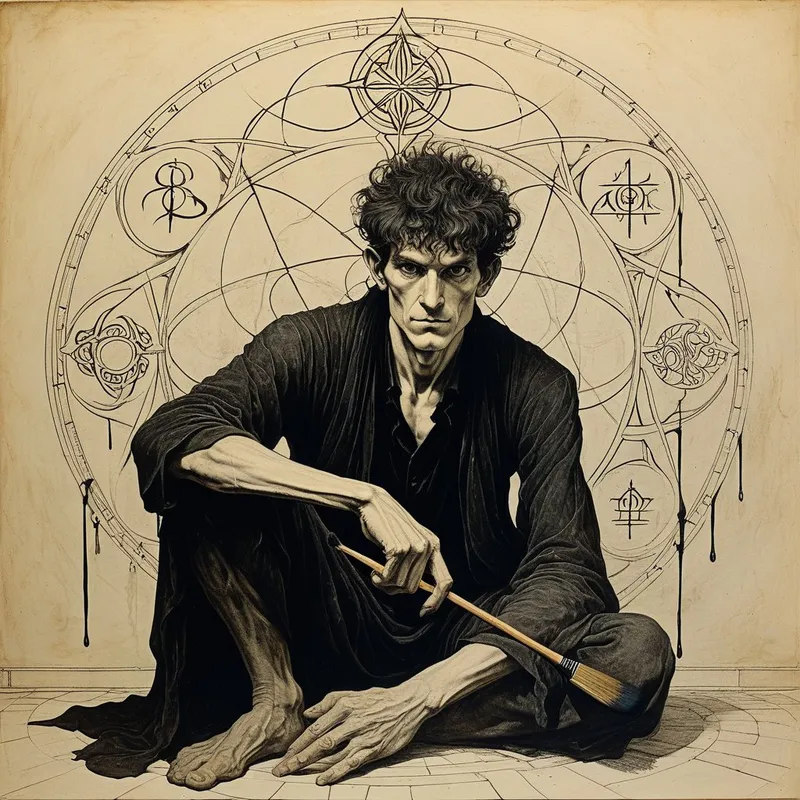
Austin Osman Spare Myth Meaning & Symbolism
The myth of the artist-magician who rejected all systems to forge his own reality from the raw, forgotten chaos of the self.
The Tale of Austin Osman Spare
Listen, then, to the tale that is not a tale, but a whisper passed through the smoke of back-alley pubs and the ink-stained margins of forbidden books. It begins not in a time of gods, but in the soot-choked throat of a London that had forgotten its own magic.
There was a man, or perhaps a vessel, named Austin Osman Spare. From his youth, he was a conduit. His hands did not merely draw; they excavated. While the world built empires of reason and brick, Spare dug downwards, through the pavement, through the clay, into the soft, wet soil of something older. He found the faces there—not of angels or demons from grand grimoires, but of the Zos and the Kia, the gods of his own cellar, the grinning, leering, weeping visages of everything polite society had shoved into the attic and locked away: childhood shames, animal hungers, the raw id of the city itself.
The great temples of the day—the Ordered Lodges, the Rosicrucian Societies with their complex hierarchies—beckoned. They offered him robes, titles, a place in their gleaming pantheon. He walked their marble halls, saw the intricate maps they had drawn of the heavens, and laughed a sound like breaking glass. Their magic was a palace built upon a glacier, beautiful and doomed, sliding slowly away from the fiery core of things. He turned his back on the palace. The conflict was not with a dragon, but with the very idea of the map.
His rising action was a descent. He retreated to the cramped kingdom of his studio, a cave of paper and peeling paint. Here, he enacted his rebellion not with sword, but with line. He developed the Sigil. It was not invocation, but evocation from within. A desire, stripped of its word-clothing, twisted into a graphic scream, fed with the voltage of passion, and then—the crucial, heretical act—cast into the fire of forgetfulness. He taught that the gate to power was not remembrance, but a specific, willed amnesia. Let the seed fall in the dark soil, not be clutched in the anxious hand.
The resolution was not a victory parade, but a dispersal. He did not found a church; he planted a virus. He left behind no dogma, only a method—a Zos Kia Cultus of one. He became the patron saint of the alleyway magician, the punk sorcerer, the solitary dreamer in a council flat. His myth resolves in a question that hangs in the air like incense smoke: What if the only true temple is the ruins of your own conditioning, and the only god worth worshipping is the unformed chaos of your deepest, most authentic self?
Cultural Origins & Context
This is a 20th-century foundation myth, born from the collision of late Victorian occultism and the early tremors of modernist disillusionment. Spare was a historical figure, an artist of considerable technical skill who moved in circles that included Aleister Crowley. The "myth" of Spare was not passed down through ancient oral tradition, but catalyzed in the 1970s and 80s by the nascent Chaos Magic movement.
Pioneers like Peter J. Carroll and Ray Sherwin rediscovered Spare’s work, particularly his book The Book of Pleasure. They saw in his rejection of all systems the ultimate system: a meta-system for creating personal magic. In the cultural crucible of punk, postmodern theory, and a growing distrust of grand narratives, Spare was resurrected not as a guru, but as an exemplar. His life story—the brilliant prodigy who refused the golden chains of every established order—became the perfect mythos for a culture that defined itself by pragmatic anarchism and psychological immediacy. The myth functions as a permission slip and a declaration of independence for the individual practitioner.
Symbolic Architecture
Psychologically, the myth of Spare maps the rebellion of the authentic Self against the collective Persona and the rigid structures of the Superego. The ordered occult lodges symbolize the internalized "shoulds"—the complexes, cultural expectations, and inherited beliefs that claim authority over the individual's inner life.
The true self is not found in the cathedral of inherited belief, but in the cellar of personal, unmediated experience.
Zos represents the totality of the bodily and instinctual being, while the Kia is the undifferentiated awareness behind it—a symbol of the pure, non-egoic consciousness Jung might call the Self. The act of creating a Sigil is a profound symbolic act: it is the translation of a conscious, linguistic desire (ego) into a non-linguistic, glyphic form (unconscious), its charging an investment of libido, and its "forgetting" the crucial act of surrendering it to the autonomous processes of the psyche. It is a ritual of trust in the intelligence of the unconscious.
The Dreamer's Resonance
To dream in the pattern of the Spare myth is to undergo a process of deconstruction. One might dream of being in a vast, oppressive library (the weight of tradition) and beginning to tear pages from books to make a new, personal collage. Or of using one's own blood or shadow to draw on the walls of a sterile, institutional room. The somatic feeling is often one of simultaneous anxiety and exhilarating release—the terror and thrill of dismantling a structure you once believed was holding you up.
These dreams signal a psychological moment where the dreamer's innate creativity or unique personal truth is straining against internalized dogma. It is the psyche's workshop for disintegration, where the symbols of external authority are being actively broken down to be recycled into something self-authored. The mood is not peaceful, but productively chaotic, focused on the act of unmaking as the necessary prelude to a more authentic making.
Alchemical Translation
The alchemical journey modeled here is the Nigredo—the blackening, the dissolution—taken not as a tragic stage, but as the primary and most liberating operation. In classical individuation, one often integrates aspects of the unconscious to build a stronger ego. The Sparean path suggests a more radical transmutation: using the ego's will to deliberately dismantle its own fortifications, to court the chaos of the unconscious not to rule it, but to merge with its creative potential.
Individuation is not the building of a better castle for the ego, but the willful flooding of its moats so the wild land may reclaim the stones.
The "Philosopher's Stone" in this model is not a static state of perfection, but the method itself: the adaptive, protean ability to create, use, and discard belief-systems and symbolic operations at will. The triumph is fluidity over fixity. For the modern individual, this translates to the psychological work of identifying "inherited sigils"—the unconscious, binding beliefs absorbed from family, culture, or trauma—and applying the Sparean method: bringing them to consciousness, re-shaping them, and through acts of introspection and release, "forgetting" their compulsive power to let a new, self-determined reality crystallize in the void left behind. It is the magic of radical self-authorization.
Associated Symbols
Explore related symbols from the CaleaDream lexicon: