Ariadne's Thread Myth Meaning & Symbolism
A princess's gift of a thread guides a hero through a monstrous labyrinth, becoming an eternal symbol of finding one's way through inner darkness.
The Tale of Ariadne's Thread
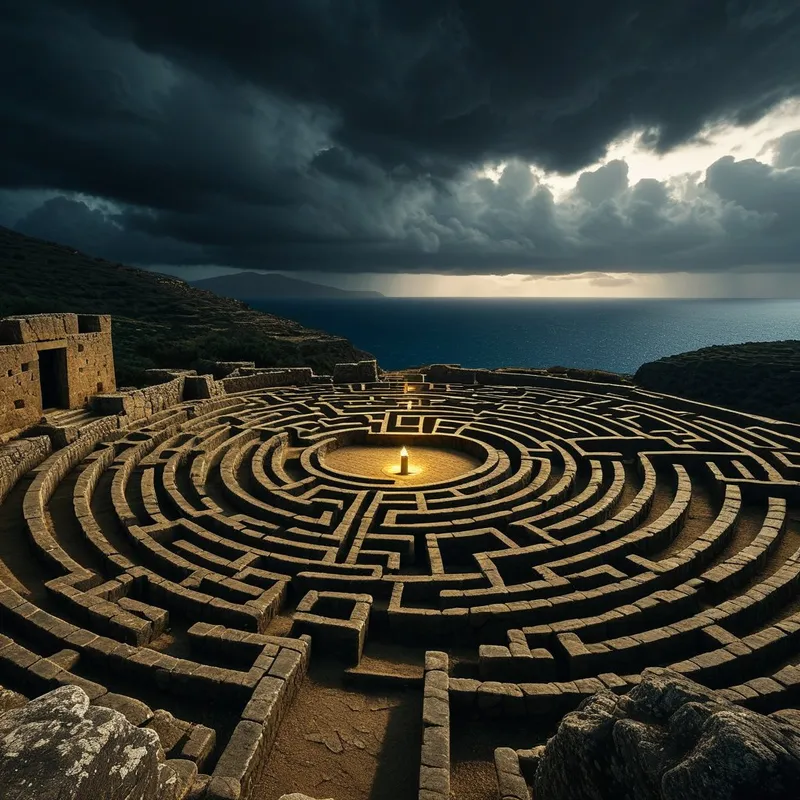
Hear now the tale of the dark heart of Crete, and the thread that pierced it. In the palace of King Minos, a shame grew in the stone, a monstrous secret born of divine wrath and mortal pride. Deep beneath the dancing floors, the master-craftsman Daedalus built not a room, but a swallowing place—the Labyrinth. Its walls were cunning and cruel, a brain of stone designed for one purpose: to hold the Minotaur, the bull-headed son of the queen, a creature of rage and hunger fed on Athenian flesh.
To this island of dread came the tribute ship from Athens, bearing seven youths and seven maidens, a sacrifice to sate the monster and the king’s vengeance. Among them stood Theseus, prince and would-be liberator, his heart a drum of defiance. He would enter the maze not as prey, but as hunter.
But the maze is a mind that forgets. It twists hope into despair. Theseus knew he could conquer the beast with his sword, but the greater enemy was the Labyrinth itself—the endless, identical corridors that would make a tomb of his courage.
Watching from the sunlit colonnades was Ariadne. When her eyes met the doomed prince’s, fate spun on its axis. She saw not just a victim, but a possibility—a thread of her own escape from the gilded cage of her father’s court. Love, or perhaps a deeper cunning, moved her. In the secret dark, she found the hero and offered him not a weapon, but a way: a simple ball of thread.
“Fasten this end to the stone at the entrance,” she whispered, her voice the only soft thing in that hard place. “Unwind it as you go deep. Let it be your memory, your breath made tangible. It will remember the path your feet forget.”
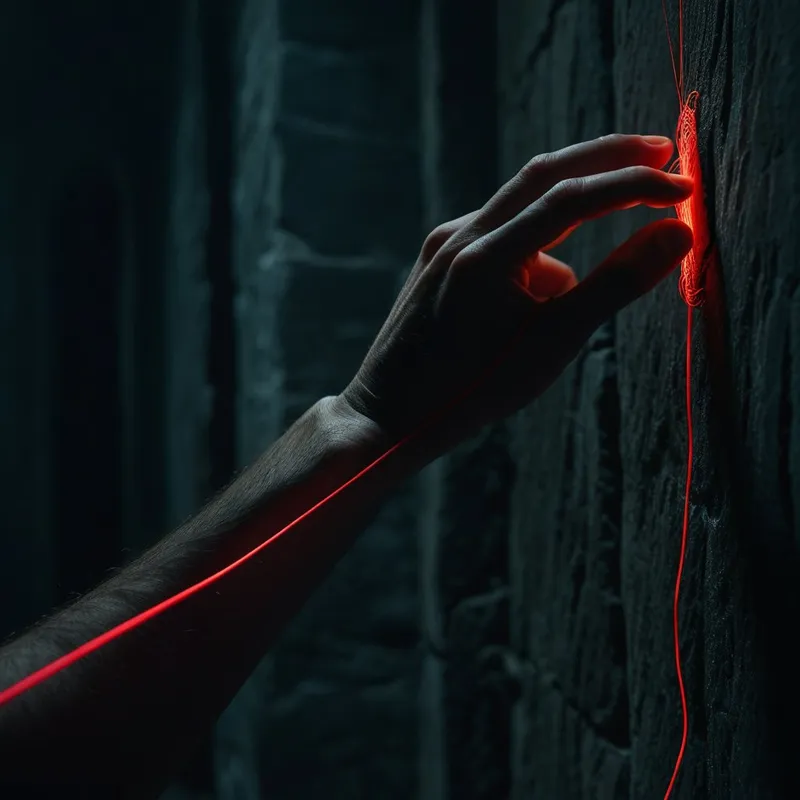
Into the consuming dark Theseus went, the red thread humming from the spindle in his hand, a slender artery of hope connecting him to the world of light. The stone sighed cold breath. Shadows mocked with the shape of corners. The roars of the beast echoed, directionless, from every stone. But behind him, the thread lay, a faithful, silent witness. It did not fight; it recorded. It did not shine; it connected.
In the foul-smelling heart, he found the monster and did what heroes do. But the greater victory came after. Exhausted, bloodied, in the pitch black, he had one task: to turn and follow the thread home. To trust the delicate, continuous line laid down by his own journey, by Ariadne’s foresight. Hand over hand, he retraced his fate, the thread pulling him back from the underworld of the maze, until he stumbled into the shocking brightness of day, Ariadne’s waiting hand, and the promise of a ship to freedom.
Cultural Origins & Context
This core narrative is woven from the epic poetry of the Homer and the later, more detailed compilations of mythographers like Pseudo-Apollodorus. It was not a singular, canonical text, but a living story told and retold. In the oral tradition of bards and the dramatic stagings of Athenian playwrights, the tale served multiple societal functions.
It was a foundational etiological myth for Athens, explaining its dominance and its complex relationship with Minoan Crete. Theseus’s triumph symbolized Athenian courage and intelligence overcoming an older, more monstrous, and perhaps more matriarchal power. The story was performed in rituals and festivals, embedding the values of cunning (metis) over brute force, and the necessity of divine or feminine aid (theos or thelus) for the hero’s success. Ariadne’s thread was the tangible symbol of that aid—a practical solution born from a place (the princess, the lover) that the purely martial hero could not access alone.
Symbolic Architecture
The myth’s power lies in its stark, perfect symbols. The Minotaur is not merely a monster; it is the embodied trauma, the shameful, half-animal secret at the center of a family (Minos’s line) and a kingdom. The Labyrinth is the convoluted, defensive psyche built to contain that secret—a structure of repression, confusion, and isolation where one can be forever lost.
The thread is not the way out; it is the remembered record of the way in. Salvation lies in having the courage to trace your own footsteps back through your darkness.
Theseus represents the conscious ego, the part that decides to confront the inner chaos. But he is impotent without Ariadne’s gift. Ariadne symbolizes the connective, guiding principle of the soul—often associated with the anima in a man’s psychology. She is intuition, relationship, and the means of navigation. The thread itself is the supreme symbol of continuity. It is the therapeutic process, the journal entry, the breath in meditation, the fragile but persistent link to consciousness and reality when one descends into the disorienting depths of the unconscious.

The Dreamer's Resonance
When this myth patterns a modern dream, the dreamer is in a state of profound psychic navigation. You may dream of being in a complex building, an endless forest, or a shifting cave system—the modern labyrinth. The feeling is one of anxiety, of being trapped with a looming, unknown threat. The monster may be a shadowy figure, a feeling of dread, or an overwhelming task.
To dream of finding or being given a thread, a string of light, a trail of breadcrumbs, or even a recorded voice is the emergence of Ariadne’s function. It signals that the psyche is generating its own guidance system. The somatic experience is often a shift from panicked paralysis to focused, tactile action—the feeling of the thread in the hand. This dream marks the critical transition from being lost in a problem to beginning to map it. The dream-ego is learning to create a traceable record of its journey into its own shadows, ensuring it can return, integrated, not shattered.

Alchemical Translation
The alchemical process mirrored here is the individuation journey. The first step is nigredo—the descent into the blackness, the confrontation with the Minotaur of one’s unresolved pain, anger, or primal instinct. This is a necessary dissolution of the old, naive ego (the Athenian tribute victim).
Ariadne’s intervention represents the crucial, often overlooked stage of coniunctio—the union with the complementary psychic principle. The hero cannot integrate the shadow alone; he must first unite with the guiding soul. The thread is the product of that union: a conscious, living connection between the exploring ego and the grounding self.
The labyrinth is the spiral of the psyche; the thread is the axis mundi at its center. To follow it is not to escape the self, but to revolve around the true self until the center holds.
The return journey, following the thread, is the albedo—the whitening, the illumination. One is not the same as when they entered. They have faced the beast and are now retracing their path with new awareness, integrating the experience. The final sacrifice—often, in the full myth, Ariadne’s abandonment on Naxos—speaks to the painful truth that some guiding forces are for a phase of the journey, not its entirety. Their gift remains, woven into the soul’s fabric, even as the journey moves to new shores under new guidance (like Dionysus). The triumph is not slaying the monster, but forging the thread that makes the labyrinth navigable, transforming a prison of stone into a traversable landscape of the soul.
Associated Symbols
Explore related symbols from the CaleaDream lexicon:
- Wire
- Patch
- Embroidered Patch
- Charm Bracelet
- Frayed Sitar Strings
- Ornament
- Shattered Bookmark
- Forgotten Spool
- Dreamcatcher Swing
- Silk Cord Necklace
- Fidget Spinner
- Tangled Yarn
- Unraveling Thread
- Frayed Rope
- Dotted Line
- Shell Bead
- Nettle Fiber Cord
- Basket Weaving
- Honeysuckle Tendril
- Beadwork Bracelet
- Macrame Plant Hanger
- Chaotic Attractor
- Indexical
- Filament
- Unraveling