Arachne's Loom Myth Meaning & Symbolism
A mortal weaver's hubristic challenge to the goddess Athena results in a contest of divine artistry and a fateful, transformative punishment.
The Tale of Arachne's Loom
Listen, and hear the tale of threads and pride, of a mortal hand that dared to weave a truth the heavens wished to hide.
In the land of Lydia, there lived a girl named Arachne. She was not born of noble blood or divine favor, but her fingers held a magic all their own. From the humblest wool and flax, she conjured tapestries that stole the breath. The nymphs would forsake their forest glades to watch her work. The shuttle danced in her hand like a living thing, and the loom sang a song of creation under her touch. Her fame spread like perfume on the wind, and soon, foolish voices began to whisper, “Not even Athena, patron of weavers, could match her skill.”
Arachne, her heart swelling with the poison of their praise, did not silence them. Instead, she declared it aloud: “Let the goddess herself come down from Olympus! Let her contest with me. If I lose, I will pay any price.”
The air grew cold, and the sweet scent of olive oil filled the humble workshop. There stood Athena, but not in her glorious, armored form. She was an old woman, back bent with years, her eyes sharp as needles. “Child,” she rasped, a final warning woven into her voice, “heed an old crone’s advice. Yield your claim to the goddess. Seek her forgiveness for your reckless tongue.”
Arachne did not even look up from her warp. “She is afraid,” she said, her voice clear and hard. “She fears a mortal’s skill. Let her come, or let her admit my victory.” At this, the disguise fell away like a discarded cloak. Athena stood revealed, radiant and terrible, her aegis gleaming. “She has come,” the goddess said, and her voice was the sound of a thousand looms. “You shall have your contest.”
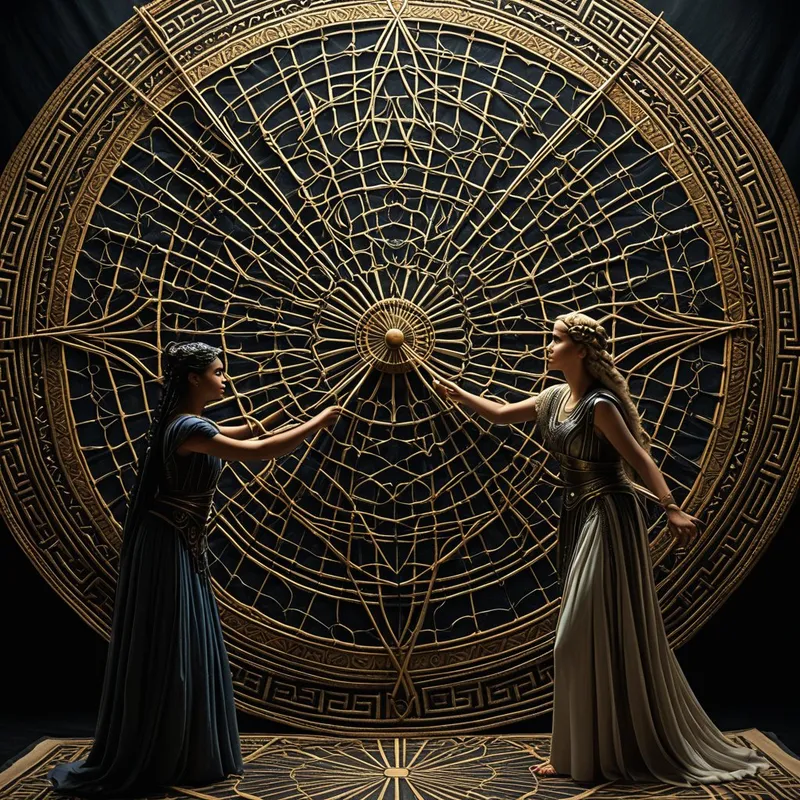
Two looms were erected side by side. The tension in the room was a thread pulled taut to breaking. They began. Athena’s hands moved with divine, unerring grace. She wove the vast, awe-inspiring tapestry of the gods’ majesty. At its center, she depicted her own victory over Poseidon for the patronage of Athens, the olive tree springing to life. In the four corners, she placed vivid warnings: mortals who had dared to challenge the gods, now transformed into mountains or birds, their hubris frozen for eternity.
But Arachne’s tapestry… it was a masterpiece of a different order. It burned with a different truth. She wove the secret loves and deceptions of the Olympians. There was Zeus as a bull, a swan, a shower of gold, his divine power a mask for desire. There was Dionysus born from a mortal’s thigh, Apollo pursuing a fleeing nymph. Each scene was flawless, the colors so vibrant they seemed wet, the expressions so alive they seemed to breathe. It was not merely skillful; it was insolently, devastatingly perfect. It held a mirror to the gods, and the reflection was one of petty passions and deceit.
The contest was over. Even Athena, in the cold furnace of her rage, could find no flaw in the technical mastery of Arachne’s work. But the subject was an unforgivable blasphemy. The goddess’s fury was a silent, shattering thing. She tore the glorious, accusing tapestry to shreds. Then, with her shuttle of boxwood, she struck Arachne once, twice, three times upon the brow.
A pain unlike any other pierced Arachne’s soul—a shame so profound it hollowed her out. She could not bear the weight of the goddess’s gaze, nor the world’s. Seizing a rope, she fashioned a noose to hang herself from a rafter. A final, mortal defiance.
But Athena’s voice stopped her. “Live on, defiant one. Hang forever, you and all your descendants.” As she spoke, a bitter liquid sprinkled from her hand. At its touch, Arachne’s body shrank and contorted. Her hair fell out. Her head became tiny, her fingers lengthened into many jointed legs. She was a spider, condemned to swing from a thread of her own spinning, weaving her beautiful, intricate webs for all time, a perpetual reminder of her skill and her sin.
Cultural Origins & Context
This potent myth comes to us from the Roman poet Ovid, in his epic Metamorphoses. While Ovid was Roman, he drew heavily on Greek mythological sources, and the tale of Arachne is deeply embedded in the Greek worldview. It functioned as a powerful cultural cautionary tale. In a society where the boundary between the human and the divine was absolute and perilous, the myth reinforced the supreme virtue of eusebeia and the fatal danger of hubris.
Told by bards and later written by poets, it served artisans and citizens alike. For craftspeople, it was a reminder that their skill (techne) was a divine gift, not a possession to boast of. For all, it illustrated the catastrophic consequences of challenging the established, divine order. The transformation into a spider was not merely a punishment but a poetic, brutal justice: the weaver becomes the thing that weaves eternally, her art reduced to instinct, her glorious tapestries to traps for flies.
Symbolic Architecture
At its heart, this myth is an archetypal collision between the perfection of Form and the audacity of Truth. Athena represents the established, divine order—the sanctioned narrative, the official history, the wisdom that upholds structure and hierarchy. Her tapestry is majestic, pedagogical, and self-justifying.
Arachne represents the raw, unvarnished creative spirit that seeks not to glorify power, but to depict reality, however uncomfortable. Her loom is the instrument of shadow-work, weaving the repressed contents of the collective psyche.
The spider, then, becomes one of mythology’s most profound symbols of fate and autonomous creation. Spinning from its own substance, it creates a world of geometric beauty that is also a lethal snare. This is the dual nature of the obsessive creator: the art that consumes the artist, the brilliant insight that isolates, the personal truth that can entrap one in a web of one’s own making. The transformation is not an annihilation of skill, but its eternalization in a diminished, instinctual form—a haunting portrait of genius cursed to repeat its pattern forever, divorced from conscious recognition.
The Dreamer's Resonance
When the motifs of Arachne’s Loom appear in modern dreams, they signal a profound confrontation with the shadow of one’s own creative power. To dream of weaving a magnificent, revealing tapestry suggests the dreamer is integrating difficult personal or familial truths into their self-narrative. It is an act of psychological courage, of giving form to what has been hidden.
Conversely, dreaming of being trapped in a web, or of a loom that controls the weaver, points to a state of creative entanglement. The dreamer may feel ensnared by their own talent, reputation, or a compulsive need to produce, where the joy of creation has been replaced by the anxiety of performance. The somatic feeling is often one of constriction—a tightness in the chest or throat, mirroring the literal hanging in the myth. It is the psyche’s signal that a brilliant capability has become a prison, and a re-negotiation with one’s inner “goddess” of discipline and form is urgently needed.

Alchemical Translation
The alchemical journey modeled here is the nigredo of the creative soul. Arachne begins in the prima materia of raw, unclaimed talent. Through discipline (her renowned skill), she achieves a brilliant, conscious expression (her glorious tapestry). This is the stage of inflation—she identifies wholly with her skill, believing it makes her equal to the archetype itself (Athena).
The necessary catastrophe is the goddess’s wrath—the shattering of this identification. The tearing of the tapestry is the mortificatio, the humbling of the ego. The transformation into the spider is the descent into the instinctual, unconscious realm. Here, the skill is not lost but re-fused with the deep, autonomous processes of life.
The individuation path asks us not to avoid Arachne’s fate, but to undergo its essence consciously: to have the courage to weave our shadow-tapestry, to endure its inevitable tearing by internal and external critics, and to willingly descend into the “spider-state”—not as a curse, but as a retreat into the unconscious womb of creativity.
From there, we can spin again, not from a place of hubristic challenge, but from a grounded connection to the deep, pattern-weaving Self. We learn to weave our destiny with humility, acknowledging that the thread comes from a source greater than our conscious ego, and the pattern is part of a web far larger than our own loom. The artist is transformed from a defiant challenger of gods into a servant of the weaving itself, creating from a place of integrated skill and instinct, no longer fearing the shears of the divine, because they have become part of the pattern.
Associated Symbols
Explore related symbols from the CaleaDream lexicon: