The Unfinished Cathedral: Artistry as Psyche’s Imperative
The Somatic Echo
Before the image of a brushstroke or the echo of a chisel, the dream of artistry announces itself in the body. It is a peculiar, pressurized hum in the marrow of the bones—a sense of potential mass that has no current shape. The hands feel restless, not with anxiety, but with a ghostly memory of a gesture not yet made. There is a tightness behind the sternum, not of fear, but of containment, as if a vital, hummingbird-quick energy is held behind a thin membrane. The breath becomes shallow, anticipatory, as if you are standing before a vast, blank canvas that is not outside of you, but is the very field of your own unlived life. This is the somatic signature of the creative daimon knocking from within, a pressure that is both promise and demand.
The Dreamer’s Log
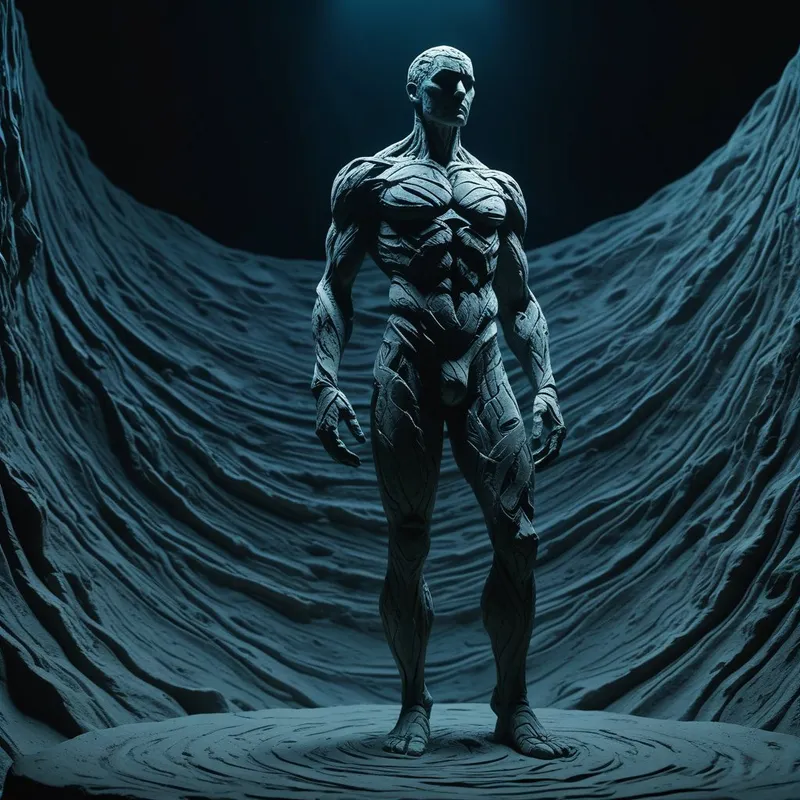
The dreamer stands in a cavernous, dusty studio, lit by a single shaft of moonlight. Before them is a colossal, half-formed sculpture of a human figure, emerging from a raw block of clay. Their hands are caked in the material. They are not carving away; they are pressing, pulling, gouging the form outward from the center. A profound silence reigns, broken only by the wet, yielding sound of the clay and the dreamer’s own heartbeat.
This is the alchemy of self-creation: the conscious, messy, and deeply intimate act of giving form to the formless essence of one’s own being.
The False Lead
An artistry dream is not a simple message to “take up painting” or a literal prophecy of artistic fame. To interpret it as a career suggestion is to mistake the cathedral for the scaffolding. It is not about external validation or the production of a commodity. The shadow of this misreading is the belief that if you cannot produce a “beautiful” or “skilled” external object, the dream has failed, or you have. This is the voice of the inner critic masquerading as a pragmatist, selling you the false lead of product over process. The dream is concerned with the act itself—the primal, often messy, always vulnerable process of making the internal, external.
Psychological Architecture
The architecture here is one of becoming. In the depth psychological frame, the raw clay, the blank page, the silent instrument—these are symbols of the prima materia, the unorganized totality of the psyche, which contains both our golden potential and our leaden shadows. The act of artistry in dreams is the ego’s courageous agreement to engage with this totality. It is Shadow work of the most visceral kind: you must put your hands into the dark, moist, ambiguous earth of yourself. You must embrace the parts that feel ugly, misshapen, or too tender to expose. The “artistry” is the individuation process itself—the lifelong project of crafting a coherent Self from the multitude of inherited scripts, buried traumas, and exiled passions. You are both the sculptor and the stone, the author and the character being written. The terror lies in the responsibility; the grief, in the necessary destruction of old forms to make way for the new.
Mythic Resonance
We see this eternal process in the figure of Pygmalion, the sculptor who fell in love with his own creation, Galatea, who was then brought to life by Venus. The myth is often simplified as a story of wish-fulfillment, but its deeper resonance is the psyche’s ability to invest lifeless matter (unconscious content) with such focused libido and love that it becomes animate, a living part of the soul. Conversely, the tale of Daedalus, the architect of the Labyrinth and creator of wings, speaks to the double-edged nature of artistry. His creations are masterful, but they serve containment (the Minotaur’s prison) and lead to tragic flight (Icarus’s fall). The artist’s power is sovereign, but it is not immune to the consequences of its own design, a reminder that what we form in our inner world creates the structure of our reality.
Symbolic Nodes
- Unfinished Sculptures/Paintings: The evolving Self, work-in-progress, the acceptance of imperfection.
- Tools (Brush, Chisel, Pen) in hand: Agency, the focused application of consciousness to shape one’s reality.
- Blank Canvases/Empty Stages: Pure potential, the terrifying and exhilarating moment before commitment.
- Malleable Materials (Clay, Wax, Water): The psyche’s plasticity, the capacity for change and re-formation.
- Forgotten or Ruined Studios: Neglected creative spirit, abandoned aspects of the self waiting for reclamation.
Archetypal Resonance
The core energy of the artistry dream is the fierce, generative, and sometimes obsessive drive to bring something new into existence from the raw materials of imagination and experience. This is the pure essence of The Creator Archetype. Its somatic echo is that pressurized hum of potential—the Creator’s restless energy seeking a channel. Its alchemical potential is the transmutation of chaos (the blank page, the raw stone) into cosmos (a meaningful form). The shadow of this archetype—the Self-Centered or Mad Scientist—emerges when the act of creation becomes severed from connection, leading to perfectionism, narcissistic attachment to the product, or the manipulation of life into unnatural, isolating forms. The artistry dream, at its healthiest, calls the Creator forth to build bridges between the inner and outer worlds, not walls.
The Alchemical Process
The alchemy of artistry is Coagulation—the process of bringing a scattered, volatile, or liquid state into a solid, coherent form. The prima materia is the swirling chaos of your unlived life, your unspoken truths, your unmourned losses, and your unbirthed joys. The heat and pressure are applied through conscious attention and deliberate action. The heat is the friction of your focus against the resistance of inertia and fear. The pressure is the courageous decision to make a mark, any mark, upon the void. This is not a gentle process. It requires sitting in the discomfort of not knowing, of making “ugly” intermediate forms, of destroying what you just built because the truth of the material demanded it. You must dissolve the old identity (the lead) to access the raw substance, then subject it to the fire of your own authentic feeling until the gold of your essential nature begins to gleam through the form. The sovereignty gained is not over others, but over the very means of your own becoming.
The Integration Protocol
Question 1: Where in my waking life do I feel that same pressurized hum of potential—the restlessness that precedes creation? What form is it begging to take, and what am I afraid it might reveal?
Question 2: If my current life were a work-in-progress, what part feels most like the unfinished, rough-hewn section of the sculpture? What quality (e.g., tenderness, strength, wildness) is trapped in that unformed block?
Question 3: Who or what has been the inner critic—the voice that says “it’s not good enough” or “this is selfish”? Can I see this critic as a misguided protector, and what is it trying to protect me from?
Action 1 (Somatic Reclamation): For five minutes, sit quietly and bring your awareness to your hands. Feel their weight, temperature, and potential for touch. Without any goal, move them slowly through the air as if they were pushing against a resistant, malleable substance. Breathe into the sensation. This grounds the creative impulse in the body, reclaiming it from abstraction.
Action 2 (Chaos Canvas): Take a large piece of paper and any medium (charcoal, mud, coffee, ink). Set a timer for three minutes. With your non-dominant hand, and without any intention to make “art,” allow your hand to move across the paper. Follow impulses for marks, smudges, and lines. When time is up, observe. Do not judge. This ritual bypasses the critic and makes direct contact with the primal, form-seeking energy of the psyche.
Action 3 (Studio of the Real): Choose one small, tangible aspect of your life that feels “unfinished” or “unformed”—a neglected corner of a room, a strained relationship, a half-learned skill. Dedicate one hour to engaging with it not as a chore, but as a creative act. Arrange the space, write one honest sentence, practice the first three notes. Approach it as a sculptor approaching clay: with curiosity and a commitment to shaping, not fixing.
Final Validation
It is profoundly difficult to stand before the raw material of your own soul and accept the mandate to form it. The vulnerability is immense; the possibility of “failure” or exposure can feel paralyzing. This resistance is not a sign that you are not an artist, but proof that you are engaging with the real work. The dream of artistry is not a condemnation of what you have not yet made. It is a profound validation of the creator that already exists within you—the part that knows, in its bones, that a life is not found, but forged. Your sovereignty lies not in crafting a masterpiece for the gallery of the world, but in having the courage to pick up the tools, get your hands dirty, and begin the only creation that truly matters: the authentic, ever-evolving shape of your own being.