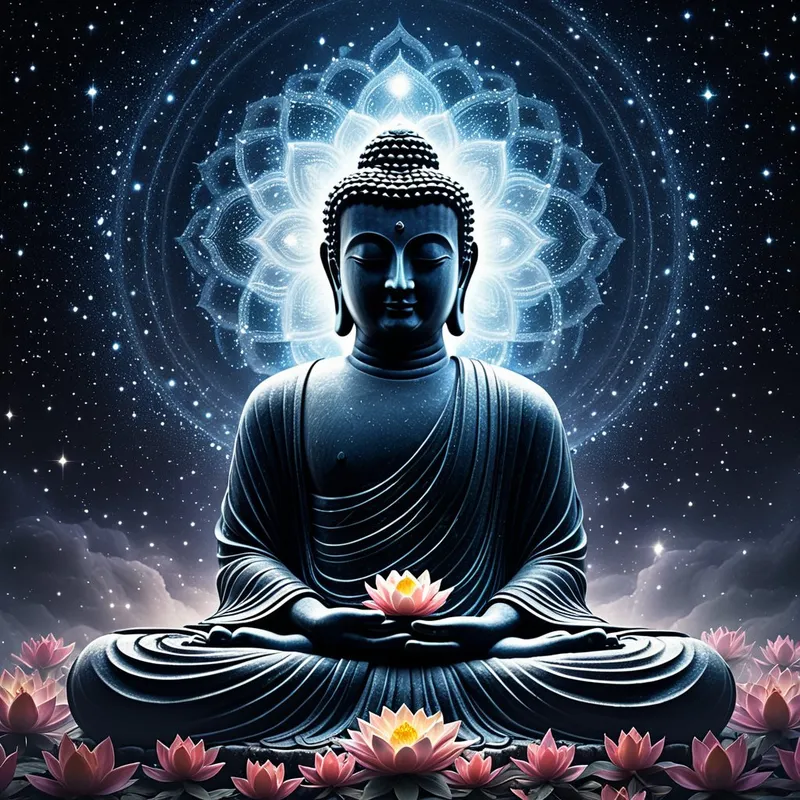
Aniccia Myth Meaning & Symbolism
The foundational truth that all conditioned things, from stars to sorrows, are in a state of constant, inevitable flux and dissolution.
The Tale of Anicca
Listen. Before the first thought, before the first name, there is the hum. It is not a sound you hear with ears, but a vibration felt in the marrow of mountains and the sap of the youngest shoot. It is the hum of becoming and unbecoming.
In the beginning, there was no story of Anicca, for it was the beginning, the middle, and the end of every story. The great Mount Meru did not simply stand; it was a slow, roaring avalanche upward, its peaks crystallizing even as its roots dissolved into the molten dark. The oceans breathed—inhaling continents, exhaling mist—their salty depths a churning memory of every river that had ever wept into them. Stars were not fixed jewels, but momentary blossoms of furious light in an infinite, dark garden, blooming only to scatter their pollen of dust across the void.
Then came the beings who could forget. They crawled from the mud, took shape, and named the world. “This is a tree,” they said, touching bark that was already surrendering to fungus. “This is my child,” they whispered, holding a form that was a river of cells flowing from one moment to the next. “This is my self,” they thought, clinging to a flickering pattern of memory and sensation. They built kingdoms of stone and love, believing them eternal. They carved their stories into pillars, hoping to make the hum stop.
But the hum cannot stop. It is the silent teacher in the crumbling of the grandest gate, the grey hair in the monarch’s beard, the coolness of a fever finally broken. It is the crack in the beloved clay cup, the empty space in the bed, the forgetting of a once-vivid dream by noon. It sang through the laughter of children that deepens and fades, through the vibrant green leaf that blushes gold, then lets go without a sound.
One prince, Siddhartha, heard this hum above all others. He walked from his palace of painted permanence and sat beneath the Bodhi tree. There, he did not fight the hum. He listened. He watched the dance of Pratityasamutpada—how this, because of that, arises; how this, ceasing, makes that cease. He saw the cosmic wheel turn, not as a tragedy, but as a truth. He saw the liberation not in stopping the wheel, but in seeing its spin clearly. When he rose, he was the Buddha, and his first teaching was of this everlasting truth: All compounded things are subject to Anicca. To understand this is the beginning of the end of suffering. The story had finally found its teller, but the tale itself is older than time, written in the fading of every sunset.
Cultural Origins & Context
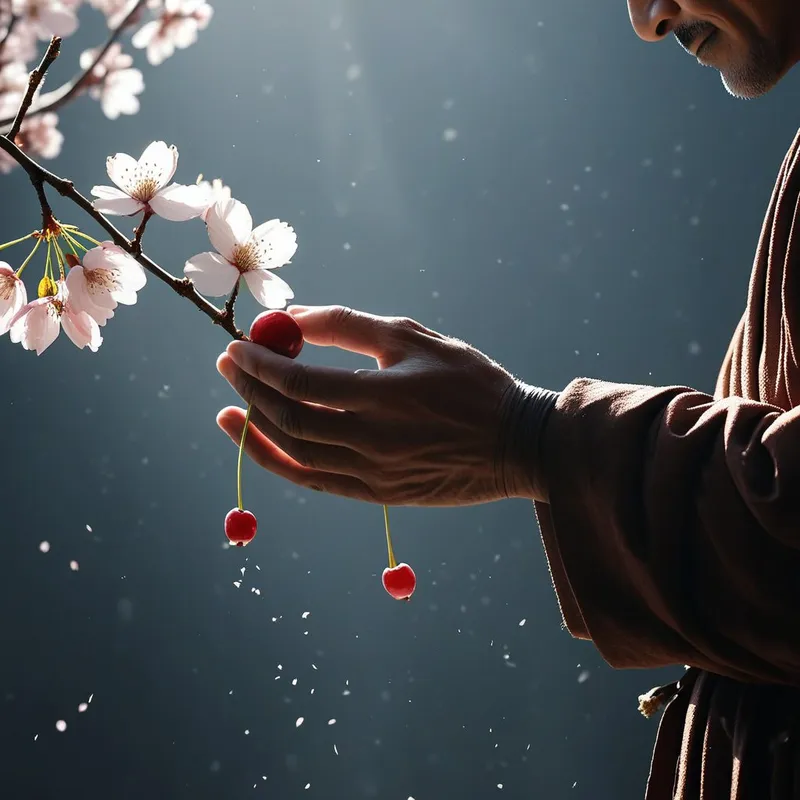
Anicca is not a myth in the sense of a narrative about gods and heroes, but rather the foundational, non-negotiable reality upon which the entire edifice of Buddhist thought is constructed. Its “cultural origin” is the moment of the Buddha’s enlightenment itself, circa 5th century BCE in the Gangetic plain of ancient India. It emerged not as folklore, but as a radical, experiential insight presented as the first of the Tilakkhaṇa.
It was passed down orally for centuries within the Sangha, not by bards for entertainment, but by monks and nuns as a core subject of meditation (Vipassanā or insight meditation). Its primary “societal function” was therapeutic and liberatory. In a culture deeply engaged with philosophies of eternity (ātman) and cyclic time (samsara), the teaching of Anicca was a profound shock to the system—a direct counter to clinging (upādāna) and ignorance (avijjā). It was woven into sermons, debates, and mindfulness exercises, designed not just to be understood intellectually, but to be realized in the direct observation of breath, sensation, thought, and all phenomena.
Symbolic Architecture
Psychologically, Anicca represents the death of the illusion of control. The ego, the sense of a permanent, separate self, is a psychic structure built upon the denial of this fundamental law. It seeks to carve out a territory of permanence—my identity, my achievements, my relationships—in a universe that is inherently fluid.
The symbol of Anicca is not a destroyer, but a great liberator. It dissolves the prison of fixation to reveal the open sky of process.
The “hero” of this myth is not a person, but the quality of mindful awareness itself. Its great ordeal is to turn and face the flux without flinching, to bear witness to the dissolution of all it holds dear, including the concept of a witness. The “villain” is ignorance, the desperate, addictive compulsion to freeze the flow, to say “this is me, this is mine, this is forever.” The resolution—Nibbāna—is not an escape from change, but a profound reconciliation with it; a state of being where one is no longer at odds with the nature of reality.
The Dreamer's Resonance
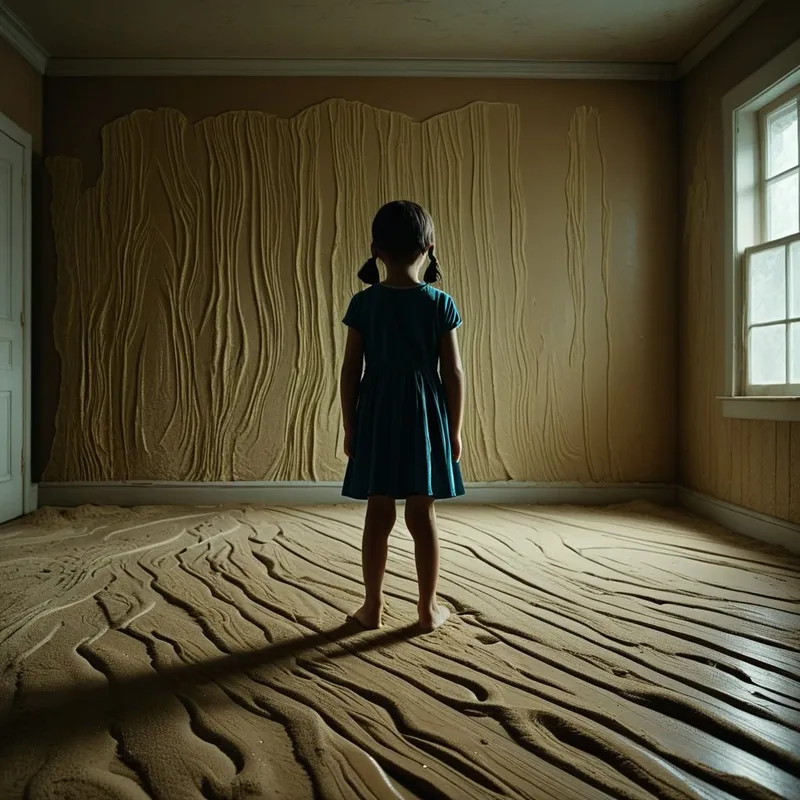
When this mythic pattern stirs in the modern unconscious, it often manifests in dreams of profound transition and loss of solid ground. Common motifs include: houses with rooms that change or vanish, melting landscapes, clocks with no hands or running backward, meeting deceased loved ones who then fade, or trying to hold water in one’s hands.
Somatically, the dreamer may be processing a deep, often unacknowledged, psychological process of letting go. This could relate to a life stage (youth, a relationship, a career), a self-image, or a long-held grievance. The dream is not merely predicting loss; it is initiating the psyche into the truth of Anicca. The unsettling, liminal quality of such dreams is the ego’s resistance meeting the soul’s deeper knowing. The anxiety felt upon waking is the friction between our desire for permanence and the reality of flux. These dreams are an invitation to release our grip, to feel the grief of what passes, and in doing so, to discover what remains when clinging ceases—a vast, compassionate presence that is not subject to birth and decay.
Alchemical Translation
The individuation process, the journey toward psychic wholeness, is fundamentally an alchemy of Anicca. It requires the conscious dissolution of outworn personality structures—the rigid personas, the cherished complexes, the childhood coping strategies—so that a more authentic Self can emerge. We are asked to become the Buddha under our own Bodhi tree, observing the rise and fall of our inner phenomena without identification.
The alchemical fire is the heat of conscious attention applied to our own suffering. The prima materia is our clinging. The gold is the freedom found in letting things be as they are.
First, we must see the impermanence in our own psyche: the temporary nature of moods, the shifting sands of self-opinion, the way a passionate conviction can cool into indifference. This is the nigredo, the blackening, the disillusionment. Then, we must consciously participate in the dissolution—releasing attachments, forgiving old wounds, allowing identities to die. This is the albedo, the whitening, the purification. Finally, we integrate this truth, not as a cold fact, but as a living wisdom that brings lightness, resilience, and deep appreciation for the precious, fleeting moment. This is the rubedo, the reddening, where the heart opens within the space left by what has been let go. We transmute the lead of our resistance to change into the gold of graceful participation in the endless, creative dance of life and death.
Associated Symbols
Explore related symbols from the CaleaDream lexicon: