
Bodhi Tree Myth Meaning & Symbolism
The story of the Buddha's unshakable resolve beneath the sacred fig tree, where he confronted the cosmos within to become the Awakened One.
The Tale of the Bodhi Tree
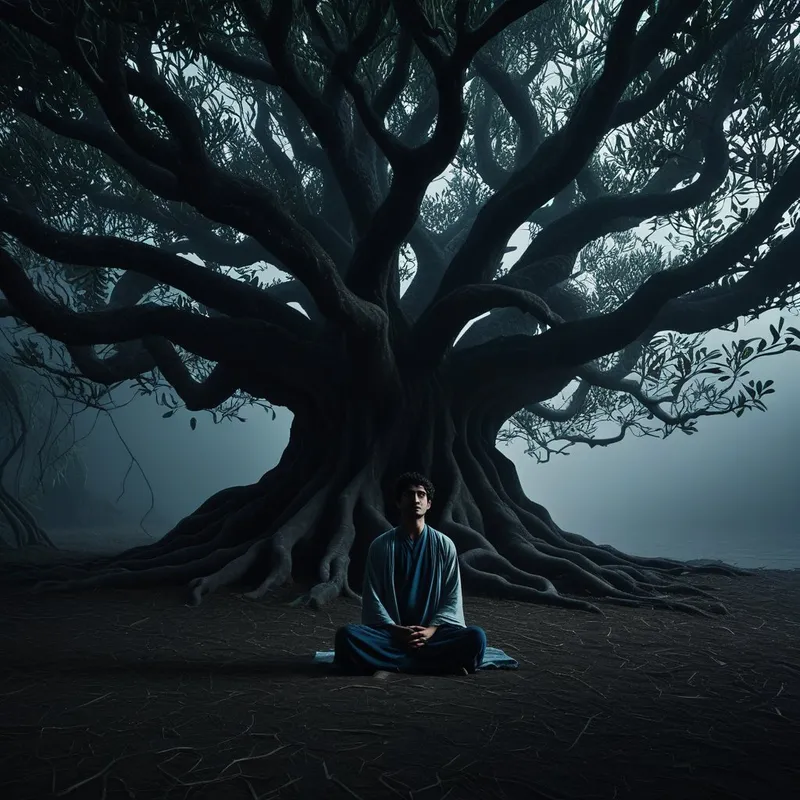
The world was heavy with sleep. Not the gentle rest of night, but the profound, cosmic slumber of ignorance, where beings tumbled through endless cycles of birth and sorrow, mistaking the dream for the dreamer. In the deep heart of the night, under a sky pregnant with stars, a man sat. He was not a king here, though he had been. He was not an ascetic here, though he had been that too. He was simply Siddhartha, a seeker with a resolve as hard as diamond, seated upon a throne of kusha grass at the foot of a great, silent Aswattha tree.
He had made a vow. A vow that shook the foundations of the heavens and stirred the depths of the underworld. “Let my skin, my nerves, my bones wither away. Let my life’s blood dry up. Until I have seen, until I have known, I will not move from this spot.” The earth itself, it is said, bore witness, trembling seven times.
Then came the assault. Not from armies, but from within and without, summoned by the lord of the realm of desire, Mara. First, a storm of sensual delight. Mara’s daughters, embodiments of craving, danced with forms of exquisite beauty, whispering promises of pleasure eternal. The seeker’s mind remained unmoved, a clear lake reflecting but not disturbed by the passing forms.
Enraged, Mara unleashed his legions. The air thickened with horrors. Monstrous shapes, wielding weapons of fire and ice, hurled mountains of doubt, spears of fear, and torrents of loathing. They were the personified armies of his own past: regrets, attachments, and the terror of annihilation. The grass around him was torn, the sky blotted out by the fury of the attack. Yet, Siddhartha’s posture did not falter. His touch to the earth was his witness. “This very earth,” he murmured, and the ground thrummed in response, a testament to his countless lifetimes of virtue.
Defeated in direct combat, Mara issued his final, insidious challenge. “Who will bear witness to your enlightenment? What have you done to deserve this seat?” In that moment, the seeker reached down and touched the soil with his right hand. The Earth Goddess, Vasundhara, arose. From the very ground, water streamed forth, washing away the demonic host, bearing witness to the immeasurable compassion and discipline cultivated over aeons. Mara slunk away, vanquished.
The cosmos held its breath. The attacks ceased. In that profound, victorious peace, as the morning star glimmered on the horizon, Siddhartha’s gaze turned inward, through the layers of illusion, to the very nature of existence. He saw the endless chain of cause and effect, the arising and passing of all conditioned things. And in seeing it, he was freed from it. The sleeper awoke. The seeker was no more. The Buddha sat beneath the tree that would henceforth be known as the Bodhi Tree.
Cultural Origins & Context
This narrative is the axial myth of Buddhism, crystallized in the Pali Canon several centuries after the historical event it describes. It is not merely a biography of a man, but the foundational drama of a worldview. Passed down orally by monastic communities, the tale served multiple vital functions. It established the literal and spiritual location of the awakening—the Mahabodhi Temple complex in Bodh Gaya—as the navel of the Buddhist world.
For early followers, the story was a liturgical map of the path. It externalized the internal battle every practitioner faces: the confrontation with Mara, who represents not an external devil, but the totality of psychological and existential resistance to liberation—doubt, fear, pride, and sensual desire. The myth provided a template for perseverance, teaching that the culmination of the spiritual journey is not a gentle revelation but a fierce, all-or-nothing confrontation with the deepest structures of the self. It transformed a historical figure into an archetype of potential, showing that awakening is an achievable, if monumental, human task.
Symbolic Architecture
The Bodhi Tree is far more than a botanical backdrop; it is the central, living symbol of the myth. It represents the axis mundi, the world pillar connecting heaven, earth, and the underworld. It is at this crossroads that the human confronts the cosmic.
The tree is not a shelter from the storm, but the still point within the storm. Its roots drink from the dark waters of the unconscious, while its branches reach for the light of pure consciousness.
Siddhartha’s unwavering seat beneath it symbolizes the establishment of an unshakable center of consciousness. He does not fight Mara with anything but his own cultivated presence. The grass throne and the earth-witness signify groundedness—enlightenment is not an escape from reality, but a profound, embodied intimacy with it. Mara’s armies are the projected contents of the unintegrated psyche: our personal and collective shadows, our addictions, and our nihilistic despair. The triumph is not their destruction, but their recognition as insubstantial phantoms that hold power only when believed to be real.
The moment of touching the earth (Bhumisparsha Mudra) is the ultimate symbolic act. It is the invocation of embodied truth over abstract argument, of lived experience over theoretical claim. It declares that the ground of being itself—the reality of interconnected, cause-and-effect existence—is the only witness needed.
The Dreamer's Resonance
When this myth stirs in the modern dreamer, it often manifests not as a literal tree, but as a pattern of profound inner crisis and potential breakthrough. To dream of being assailed by chaotic forces while trying to remain centered—perhaps in a storm, or amidst social or professional turmoil—can echo the battle with Mara. The “tree” in the dream may appear as a pillar of light, a steadfast piece of furniture, a quiet room, or even one’s own spine felt with unusual clarity.
This dream signals a somatic and psychological process of holding the tension. The ego is under immense pressure from unconscious contents—repressed emotions, life transitions, spiritual urgings, or existential dread—that threaten to overwhelm it. The psyche is staging its own version of the Bodhi Tree vigil. The dream asks: Can you stay seated? Can you touch the earth of your own reality, your body, your breath, and not be swept away by the internal drama? The resolution in the dream, if it comes, is rarely a dramatic victory, but more often a sudden, quiet peace, a dawn of understanding, or simply the continued act of enduring.

Alchemical Translation
For the individual on the path of individuation, the Bodhi Tree myth models the ultimate alchemical operation: the unio mentalis, the union of the mind, achieved in the solitary vessel of the self. The seeker (the ego) enters the vas (the vessel), represented by the sacred space under the tree—the container of meditation, therapy, or deep introspection.
The enlightenment under the Bodhi Tree is the psychic moment when the conscious mind, having endured the full assault of the personal and collective unconscious, no longer identifies with its contents. It becomes the silent, witnessing space in which all phenomena arise and cease.
The “noble silence” the Buddha entered is the state where the internal dialogue ceases, and one perceives the process of perception itself. Psychologically, this is the transcendence of the ego-complex, not by annihilation, but by seeing through its constructed nature. Mara’s temptations are the prima materia, the base lead of our complexes and neuroses. The fierce resolve is the applied heat of attention. The resulting “awakening” is the gold of a consciousness that has metabolized its shadow and is no longer enslaved by it. The individual is transformed from a bundle of reactions (Siddhartha the seeker) into a grounded, compassionate witness (the Buddha). The tree, then, is the symbol of the fully realized psyche—rooted in the body and the earth, open to the transcendent, and providing shade and shelter for all who approach.
Associated Symbols
Explore related symbols from the CaleaDream lexicon: