Abraham's Visitors Myth Meaning & Symbolism
Three mysterious visitors arrive at Abraham's tent, promising a son to his aged wife Sarah, revealing the sacred contract between human hospitality and divine revelation.
The Tale of Abraham's Visitors
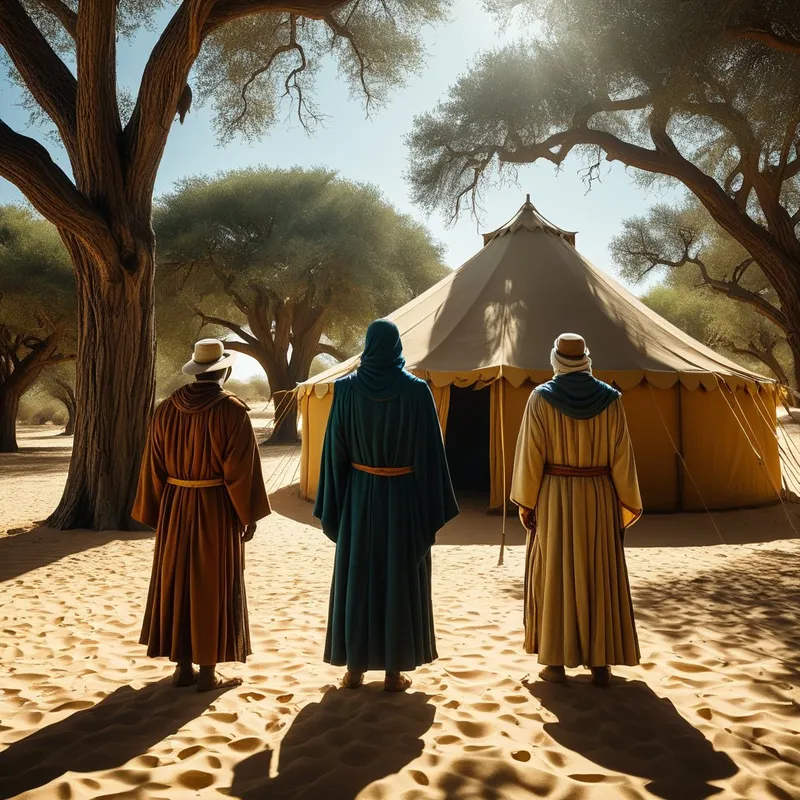
The heat at the Oaks of Mamre was a physical weight, a shimmering veil that made the horizon dance. The air was still, thick with the scent of dust, baked earth, and the faint, dry perfume of the great trees. In the heart of that stillness, under the punishing eye of the sun, an old man sat in the entrance of his tent.
Abraham was ninety-nine years old, and the weight of his years was the weight of a promise unfulfilled. A promise from the very voice of the Elohim that his descendants would be as countless as the stars. Yet his tent was quiet, his wife Sarah’s womb was barren and had been for decades. The promise was a scar on his soul, beautiful and aching.
He lifted his eyes.
Three men stood there.
They had not been on the horizon a moment before. They simply were, materialized from the heat haze. They were travelers, dressed for the desert road, yet there was a terrifying stillness about them. No dust clung to their robes. Their eyes held the depth of a night sky untouched by time.
A bolt of pure, instinctual knowing shot through Abraham’s aged frame. This was no chance meeting. He did not see deities; he saw guests. And in his world, the law of the desert was absolute: the guest is sacred.
He ran. The old patriarch, forgetting his years, hurried from the tent entrance and bowed low to the ground. “My lords,” he said, his voice rough with urgency, “if I have found favor in your sight, do not pass by your servant. Let a little water be brought, and wash your feet, and rest yourselves under the tree. Let me bring a morsel of bread, that you may refresh yourselves.”
“Do as you have said,” they replied. Their voices were like a single chord.
What followed was not mere hospitality; it was a frenzy of sacred duty. Abraham rushed to Sarah. “Quick! Three measures of fine flour! Knead it, and make cakes!” He himself ran to the herd, selected a tender and good calf, and gave it to a servant, who hastened to prepare it. He brought curds and milk and the meat, and set it before them. He stood under the tree while they ate, a servant attending the presence of a mystery.
Then one of them spoke, his words cleaving the ordinary afternoon. “Where is Sarah your wife?”
“She is in the tent.”
The visitor did not raise his voice, yet it carried like a proclamation. “I will surely return to you about this time next year, and Sarah your wife shall have a son.”
Sarah was listening at the entrance of the tent, behind him. She heard the words. And she laughed. A silent, inward laugh of bitter irony. After I am worn out, and my lord is old, shall I have pleasure?
Then the one who had spoken—now unmistakably the voice of YHWH Himself—said to Abraham, “Why did Sarah laugh? Is anything too wonderful for the YHWH?”
Terror and awe washed over Sarah. She denied it. “I did not laugh.” But the voice was gentle, final. “No, but you did laugh.”
The visitors rose. Abraham, now understanding the terrible gravity of his guests, walked with them to see them on their way. Their gaze turned toward Sodom. And as they departed, walking into the fate of cities, the impossible promise hung in the air of Mamre, a seed planted in the dust of reality.

Cultural Origins & Context
This narrative, found in the Book of Genesis, is a cornerstone of the Torah. It exists within the oral and written traditions of a nomadic pastoral society where survival depended on intricate networks of kinship and covenant. In such a world, hospitality (hakhnasat orchim) was not mere etiquette; it was a supreme virtue, a sacred duty that maintained the fragile social and cosmic order. The stranger could be an angel, a demon, or a king in disguise. To fail in hospitality was to risk divine wrath.
The story functions on multiple cultural levels. It etches into the communal memory the origin story of Isaac, the crucial heir through whom the Abrahamic Covenant would flow. It also establishes a profound theological principle: the divine chooses to engage with humanity through encounter, often in disguised, humble form. The story was told and retold to reinforce ethno-religious identity, to underscore the faithfulness of God to His promises against all odds, and to codify hospitality as a foundational religious act.
Symbolic Architecture
At its core, this is a myth of revelation through relationship. The three visitors are a profound symbol, often interpreted in later theology as a mysterious manifestation of the Trinity in the Old Testament, but in its original context, they represent the multifaceted, yet unified, presence of the Divine. They are the theophany that comes not with thunder on a mountain, but as a traveler in need of water.
The divine does not announce itself with fanfare to the prepared temple; it arrives, dusty and anonymous, at the door of the unprepared heart.
The tent of Abraham is the human psyche itself—a temporary dwelling in the wilderness of existence. The heat of the day symbolizes a life plateau, a period of stagnation and barrenness where the great promises of the soul seem like cruel jokes. Abraham’s frantic hospitality is the critical, active response of the ego to the approach of the numinous. He does not understand, but he acts according to his highest virtue.
Sarah’s laughter is the pivotal human moment. It is not mockery, but the defense mechanism of a psyche that has made peace with its limitations. It is the bitter laughter of the realist confronted with the absurdity of hope. The divine question, “Is anything too wonderful for the YHWH?” directly challenges the closed system of the possible, forcing the psyche to confront the reality of the miraculous as a category of existence.

The Dreamer's Resonance
When this myth pattern stirs in the modern unconscious, it often manifests in dreams of unexpected guests. Three figures arriving at one’s home. A knock at the door of the dream-house at an inopportune time. There is a somatic quality of urgency, a need to prepare, to offer something, even amidst confusion.
Psychologically, this signals that a core, perhaps long-dormant, promise of the Self is seeking incarnation. The “guests” are new psychic contents—insights, potentials, or calls to a new life stage—that feel alien yet demand attention. The dreamer’s reaction is key: Do they, like Abraham, engage in fervent, if confused, hospitality (integration)? Or do they, like Sarah initially, hide and laugh in disbelief (resistance and repression)?
The laughter itself is a crucial somatic marker. It may appear in the dream, or the dreamer may wake with a feeling of ironic incredulity. This points to a deep-seated conflict between a cynical, adapted self-image (“I am too old for this, it’s impossible”) and the insistent, life-giving promise from the deeper Self. The dream is an invitation to let the guests in, to set a place at the table for the impossible.
Alchemical Translation
The alchemy here is the transmutation of barren certainty into fertile mystery. Abraham’s journey models the first step of individuation: the active cultivation of an inner attitude of hospitality. This is the capax Dei—the capacity for the divine. We must prepare the fine flour and the tender calf of our best energies to host the unknown.
Sarah’s process is the nigredo, the darkening. Her laughter is the confrontation with the shadow of hopelessness, the part of us that has sealed the womb of potential. The divine confrontation—“Why did you laugh?”—is the separatio, forcibly distinguishing the cynical ego from the believing soul.
The promise of a child is the promise of the nascent Self, the new consciousness that can only be born from the union of human readiness and divine grace.
The culmination is not in the moment of the promise, but in its silent gestation. After the visitors leave for Sodom, Abraham and Sarah are left alone with the word. The psychic work now is the mortificatio and putrefactio—the waiting, the doubt, the slow, inner dissolution of the old identity (“barren couple”) to make space for the new (“parents of nations”). The myth tells us that the miraculous birth happens “at the appointed time.” In the alchemy of the psyche, this is the law of right timing, the kairos, when the inner and outer conditions finally align to midwife the impossible into being. We are asked not just to believe, but to host, to listen, and finally, to carry the promise to term.
Associated Symbols
Explore related symbols from the CaleaDream lexicon: