
Imperial Purple Myth Meaning & Symbolism
A myth of divine discovery where a god's hound stains its mouth with a rare sea-snail dye, gifting Rome the ultimate symbol of sacred power and imperial authority.
The Tale of Imperial Purple
Hear now, a story not of swords clashing, but of a color that conquered the world. It begins on the forgotten edge of the sea, where the Phoenician coast meets the wine-dark Mediterranean. The air is thick with salt and the cries of gulls. Here walks Hercules, not in his lion skin, but in a moment of divine leisure, his mighty hound, a beast of tireless energy, ranging ahead along the tideline.
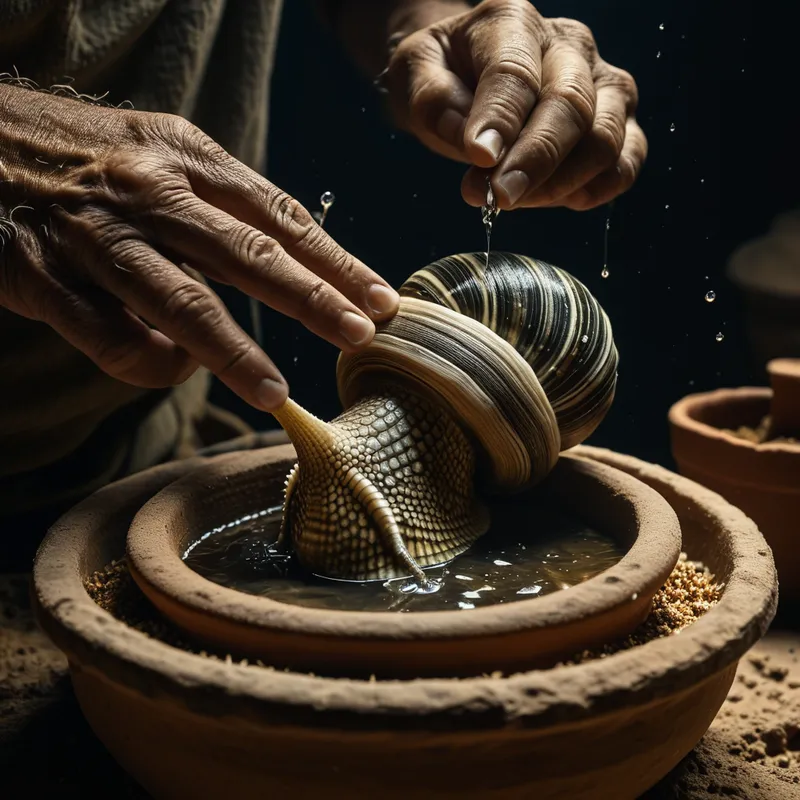
The hound snuffles at a rocky pool, its nose twitching at a scent both alien and compelling. There, clinging to the wet stone, is a creature of the deep: a Murex brandaris, its shell a fortress of spines. The dog, driven by instinct or celestial whim, seizes the snail in its jaws. There is a crunch, a release. Not of blood, but of something more astonishing.
From the broken creature flows not red, but a liquid the color of a fading twilight, of a deep bruise kissed by the sun. It stains the hound’s muzzle not with gore, but with glory. The beast returns to its master, panting, its lips and tongue dyed a magnificent, impossible purple. Hercules stares. This is no ordinary stain. This is a message from the deep, a secret of the sea given form. He follows the hound back to the carnage of shells, to the rock pool now swirling with this potent hue.
He sees the potential. With hands that strangled the Nemean Lion, he now gathers the spiny creatures with a new purpose. He experiments, learning the snail’s bitter secret: that the precious fluid is not the creature’s blood, but a milky excretion from a gland, a liquid that is initially colorless. Only when exposed to air and sunlight does it perform its miracle, transforming through a spectrum of hues before settling into that deep, resonant purple that seems to drink the light. It is an alchemy witnessed by a god, a recipe written in crushed shells and seawater. He presents this discovery to the nymph Tyrus, for whom the city would be named. The knowledge passes from divine hands to mortal ones, from the shore to the loom, from a god’s curiosity to an empire’s obsession.
Cultural Origins & Context
This myth, attributed to the Roman scholar Pliny the Elder in his Natural History, is less a sacred scripture and more an etiological legend—a story crafted to explain a profound and valuable reality. The reality was purpura, Tyrian purple, the most coveted dye of the ancient world. Its historical production centered in the Phoenician city of Tyre, a process so noxious (from rotting shellfish) that dye-works were placed downwind of settlements, and so labor-intensive that it required tens of thousands of snails to produce a single gram of dye.
The myth served a crucial societal function. It sanctified the mundane and brutal economics of dye production by giving it a divine origin. By having Hercules—the archetype of strength, labor, and civilization-bringer—as its discoverer, the dye was imbued with the qualities of heroic effort and divine favor. It transformed a foul-smelling industrial secret into a donum deorum, a gift of the gods. This narrative was told not around campfires, but in the forums and villas of the elite, reinforcing the idea that their supreme status was not merely purchased, but ordained, woven into the very fabric of the cosmos. The myth justified the sumptuary laws that reserved this color for the senatorial class and, later, exclusively for the Emperor—the ius purpurae.
Symbolic Architecture
The myth of Imperial Purple is a dense symbolic matrix where biology, power, and the sacred collide.
The most profound power is often born from a rupture, a breaking open of a hidden vessel to release a secret that transforms the world.
The Murex snail is the perfect symbol of the guarded self. Its spiny shell represents psychological armor, the defended ego, the protected inner sanctum of the unconscious. The precious dye is not its life-blood (the conscious identity), but a secreted substance, analogous to the latent potential of the psyche—the undiscovered talents, the repressed memories, the creative spirit. This treasure is only accessible through violation, through the “crunch” of effort, crisis, or deep introspection.
The color itself is alchemical. It is not a primary color but a complex, hard-won composite. Its production mirrors the process of individuation: starting with a base, unconscious material (the colorless secretion), exposing it to the air of consciousness and the light of understanding, and through a patient, transformative process, achieving a unique and enduring hue of being. Purple sits between red (passion, blood, life) and blue (spirit, heaven, the divine). Thus, Imperial Purple symbolically bridges the earthly and the celestial, the mortal body and immortal authority, representing the incarnation of divine right in human form.
The Dreamer's Resonance
When this myth stirs in the modern dreamer, it rarely appears as a classical tableau. Instead, one might dream of finding a strange, iridescent stain on one’s clothing that cannot be washed out, symbolizing an emerging identity or responsibility that feels both glorious and inescapable. One might dream of laboring in a vast, smelly workshop, endlessly processing obscure objects to extract a tiny drop of something precious—a direct metaphor for the grueling, often isolating work of personal growth or creative endeavor.
The somatic sensation is key: a feeling of being stained or dyed by an experience. This is the psyche processing a transformative event that has fundamentally altered the dreamer’s “color”—their core vibration or role. The conflict in the dream often revolves around the cost: the mess, the smell (psychological discomfort), the sheer number of “shells” that must be broken (old defenses, habits, patterns) to produce a meaningful change. To dream of wearing purple robes might not indicate grandeur, but a deep anxiety or awe about stepping into a position of authentic authority, of fully owning one’s hard-won individuality.
Alchemical Translation
The journey from crushed snail to imperial robe is a masterclass in psychic transmutation. For the modern individual, the “Tyrian shore” is the liminal space of the unconscious, where our instinctual, creature-self resides. The “hound of Hercules” is that driven, seeking function of the psyche—our curiosity, our ambition, our restless energy—that, often by accident or following a deep impulse, breaks open a protected part of ourselves.
The individuated Self is not found in purity, but in the dignified ownership of one’s unique and costly color.
The initial “stain” is the first, often shocking, awareness of this inner potential. It can feel messy, accidental, even destructive. The alchemical work begins with the conscious decision to “gather the snails”—to engage systematically with the source of this potential, no matter how spiny or defended. This is the laborious inner work: introspection, shadow-work, and the patient “rotting” and processing of psychic material (the foul-smelling vats of the dyer).
The final, glorious toga praetexta or imperial cloak is the symbol of the achieved Self. It represents the point where the individual has fully integrated this hard-won essence into their being. They are no longer simply stained by their experience; they are clothed in it. They have transmuted the secret of the deep, broken self into the visible garment of sovereign identity. The myth teaches that true authority—the archetype of the Ruler—is not seized from without, but dyed into the soul from within, through a sacred, costly, and transformative process whose origin is always, mysteriously, divine.
Associated Symbols
Explore related symbols from the CaleaDream lexicon: