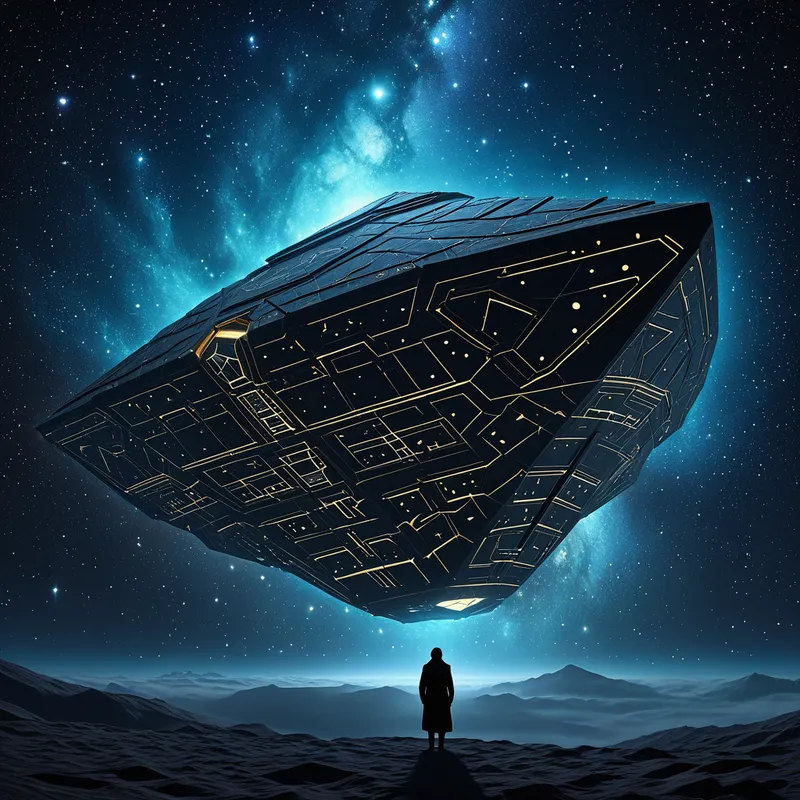
The Uncharted Territory: The Dream Theme of Exploration
The Somatic Echo
Before the mind conjures a map, the body knows the territory. It is a low hum in the solar plexus, a subtle static charge along the skin—not the adrenaline of fear, but the resonant frequency of a vast, internal silence waiting to be filled. It is the feeling of standing at the edge of a forest you’ve never entered, where the known path ends and the undergrowth begins. Your breath shallows, not from panic, but from the sheer volume of potential air. There is a gravitational pull, a somatic magnetism that draws your attention inward and downward, toward the foundations of your being. This is the pre-linguistic signal of Exploration: the psyche preparing to send an emissary into its own uncharted lands. It feels like a quiet, persistent homesickness for a place you have never been, a longing encoded in the very architecture of your bones.
The Dreamer's Log
The terminal screen in the abandoned archive flickered with a language of fractured light. I knew, with a certainty that bypassed thought, that the corrupted data-stream contained a record of my own forgotten genesis. My task was not to repair it, but to walk into the static, to let the broken glyphs rewrite my senses.
To enter the corrupted data is to consent to having one’s own foundational code rewritten by the very fragments deemed unreadable.

The False Lead
Exploration is not mere curiosity or a restless search for novelty. It is not the Shadow Jester’s cynical tourism, skimming surfaces for distraction. Nor is it the Shadow Hero’s compulsive quest for external validation through conquest. The dream of exploration becomes a false lead when it is an escape from rather than a journey into. If the dreamscape offers only endless, repetitive corridors or the frantic, aimless search for an exit, it speaks of alienation—a soul lost in its own house, mistaking motion for meaning. True exploration accepts the terrifying premise that the destination is the dismantling of the map itself.
Psychological Architecture
To explore in the dreamscape is to engage in the most intimate form of Shadow work: the cartography of the unknown self. This is the Individuation process in its raw, navigational phase. You are not analyzing memories from a safe distance; you are sending a part of your consciousness—the Dream Ego—as a scout into the wilds of your own unconscious infrastructure. Every strange corridor, every undiscovered room, every alien landscape is a psychic complex, a cluster of energy, memory, and emotion that exists outside the administered territory of your waking identity.
The anxiety you feel is the friction of expansion. The old “Internal Family” of parts—the Manager who maintains order, the Firefighter who douses crises—cannot operate here. Their maps are useless. This journey requires the emergence of a new part: the Navigator, born from the marriage of courage and vulnerability. The goal is not to colonize these inner lands with the flags of your ego, but to be changed by them. To let the strange air of the cavern adjust your respiration. To let the impossible geometry of the inner citadel restructure your logic. You return not with trophies, but with a new meridian etched into your being, a new line of longitude from which to measure your world.
Mythic Resonance
This is the journey of Inanna, Queen of Heaven, who descends through the seven gates of the underworld, stripped of every emblem of her known power at each threshold, to meet her shadow sister, Ereshkigal. She does not go to conquer, but to witness, and is fundamentally unmade and remade in the process. It is equally the voyage of the Pequod in Melville’s ocean, where the relentless pursuit of the white whale, Moby Dick, is not really about the beast, but about Captain Ahab’s compelled, doomed mapping of his own obsessive, wounded psyche onto the blank slate of the sea. The ocean, like the dreamscape, is a mirror that reflects only the explorer’s own depths.
Symbolic Nodes
- Unfamiliar Houses & Rooms: Unexamined aspects of the self, hidden potentials, or buried memories.
- Wilderness, Forests, Deserts: The untamed, instinctual realms of the psyche.
- Caves, Tunnels, Subterranean Passages: Descent into the unconscious, the womb of the earth/self.
- Mazes & Labyrinths: The complex, winding path to the center of one’s being.
- Maps (especially incomplete or fading): The search for direction in the inner world.
- Vehicles (ships, trains, spacecraft in motion): The vehicle of consciousness traversing psychic space.
- Unknown Cities or Landscapes: New internal structures, philosophies, or ways of life coming into view.
Archetypal Resonance
The energy of this theme resonates most powerfully with The Explorer Archetype. The Explorer’s core drive is the yearning for freedom, discovery, and the authentic self through the experience of the vast and unknown. This maps perfectly onto the somatic echo—that magnetic pull toward the inner frontier—and the psychological architecture of charting the unconscious. Its shadow, the Aimless Wanderer, manifests in dreams as the terror of infinite, meaningless corridors or the compulsive search for an exit that doesn’t exist, reflecting exploration as flight rather than pilgrimage. The alchemical potential of the Explorer lies in its willingness to trade the false security of the known map for the sovereign, hard-won authority that can only be earned by standing, utterly changed, in the center of one’s own mysterious territory.
The Alchemical Process
The alchemical transmutation here is the conversion of the Anxiety of the Unknown into the Sovereignty of the Known Self. The prima materia is the raw, unsettling energy of disorientation—the grief for a lost certainty, the terror of the unmapped. The heat and pressure are applied through the sustained act of conscious disorientation. You must willingly stay in the dream’s strange space, feel its textures, and resist the ego’s frantic urge to “figure it out” or wake up. This is the solve—the dissolution of old navigational paradigms.
The coagula, the reconstitution, occurs when you bring back not a fact, but a quality of perception. The strange light of the dream cavern becomes a new way of seeing ambiguity in waking life. The endless hallway teaches you a patience for processes without clear timelines. The transformation is complete when the external world ceases to be the only frontier; the greatest adventure, the source of true autonomy, is recognized as the perpetual, gentle exploration of your own evolving interior.
The Integration Protocol
Question 1: Where in my waking life do I feel the same somatic pull or resonant silence that I felt at the threshold of the dream’s unknown space?
Question 2: If the landscape I explored was a part of me, what is its primary quality? (e.g., Is it a forgotten archive, a wild frontier, a crumbling city, a pristine wilderness?)
Question 3: What emblem of my “known self” (a role, a belief, an identity) was I asked to leave at the gate in order to proceed?
Action 1 (Somatic Anchoring): For three minutes upon waking, do not move. Re-inhabit the body sensation of the dream’s exploratory space. Locate it physically. Breathe into that area, not to change it, but to acknowledge it as a real place within you.
Action 2 (Cartography of the Interior): Create a non-linear map of the dream terrain. Use abstract shapes, colors, and textures—not literal drawings. Let the map be an emotional and energetic impression of the territory. Where is the pressure? Where is the flow? Label areas with felt words, not names.
Action 3 (Threshold Ritual): Identify a literal threshold in your home (a doorway, a gate). Before crossing it, pause for one full breath and state silently: “I cross into the unknown within.” Use this micro-ritual to sanctify daily transitions as conscious explorations.
Final Validation
It is a difficult, lonely thing to be the cartographer of your own abyss, to volunteer for the mission where the coordinates are written in fading ink and the compass points only inward. The disorientation is real. The longing for a simpler map is a sane impulse. Yet, this very difficulty is the seal of authenticity—proof that you are not skimming the surface, but plumbing the depths. The sovereignty you seek is not granted; it is forged in the willingness to stand, again and again, at the edge of your own understanding, and to step forward into the beautiful, terrifying, and liberating darkness that is, and has always been, you.