
Leif Erikson Myth Meaning & Symbolism
The saga of a son sailing beyond his father's shadow, guided by fate to a new world, embodying the eternal human journey into the unknown.
The Tale of Leif Erikson
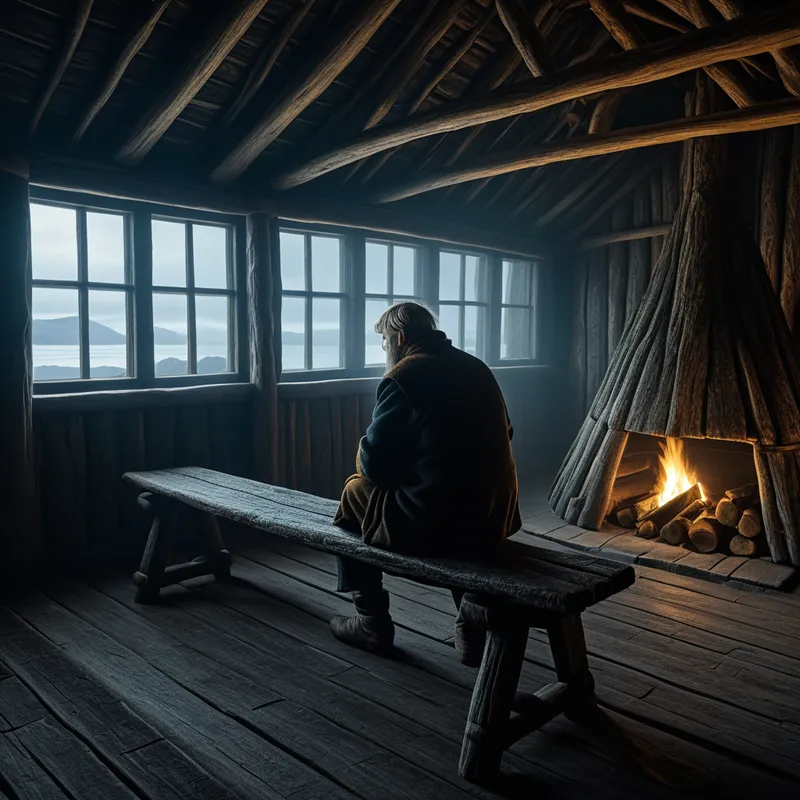
Hear now a tale not of gods, but of men—men whose hearts beat in time with the crash of the wave and the whisper of the wind from the world’s edge. In the west, where the ice groans and the sea is a grey beast, there lived a son of fire and exile. His name was Leif, son of Erik the Red, who had carved a bloody kingdom from the Greenland ice. But a father’s shadow is a long cloak, and some sons are born to walk beyond its hem.
The breath of fate came not on a gale, but on the words of a lost sailor. Into the hall of Brattahlíð stumbled Bjarni Herjólfsson, his face etched with salt and wonder. He spoke of a land glimpsed through fog—a land of gentle slopes and endless forests, a realm where timber grew tall enough to build a hundred ships. He had seen it, this Markland, this “Wood-Land,” but fear or caution had kept his feet upon his deck. He turned away, carrying only a story.
That story fell into Leif’s ears like a seed into fertile ground. While others heard a curious tale, Leif heard a call. He saw not Bjarni’s failure, but a path left untrodden, a door left ajar. With the iron will of his lineage, he gathered a crew. He bought Bjarni’s very ship, as if purchasing the man’s missed destiny, and pointed its dragon-prowed beak southwest, into the belly of the unknown.
For days, they were creatures of the sea and sky. The sun was a pale coin; the stars, their only certain guides. Then, the world changed. The scent of pine and damp earth rode the wind—a smell forgotten in their stone-and-ice home. The sea’s grey turned to a strange, luminous green. And then, land. Not the sheer cliffs of home, but a coast of white beaches and verdant woods. They landed in a place where salmon choked the rivers and the grass held the sweetness of summer even as the year grew old. Leif named it Vinland, for the wild grapes they found.
They built rough shelters, búðir, of turf and timber. They filled their ship’s hold not with plunder, but with bounty: timber, grapes, and self-sown wheat. It was a land of giving, not taking. Yet, the saga whispers of shadows in the woods—figures watching from the trees, the first inhabitants of this newfound world. There was no great battle here, not for Leif. His triumph was one of arrival, of proof. When the winds turned, he loaded his ship with the land’s riches and set sail for home, a king returning with a greater prize than gold: a new world on the map of the known.
He returned to Greenland not just as Erik’s son, but as Leifr hinn Heppni, Leif the Lucky. He carried the ultimate treasure for a people clinging to the edge of the world: hope, and the knowledge that beyond the western horizon lay not a void, but a land of abundance.
Cultural Origins & Context
This is not a myth of the Æsir, but a saga. It resides in the liminal space between history and legend, recorded centuries later in texts like the Grænlendinga saga and Eiríks saga rauða. These stories were preserved in Iceland, the great memory-keep of the Norse world, long after the Greenland settlements had faded into silence.
The tale functioned as foundational memory for a diaspora culture. For the Norse of Iceland and Greenland, living in marginal environments, the story of Vinland was a potent narrative of possibility. It was a testament to their defining cultural engine: restlessness (óðr), the drive to seek one’s fortune (gæfa) beyond the horizon. It validated their identity as explorers and survivors. Furthermore, it was a story of corrected error. Bjarni’s sighting was a narrative foil; his caution served to highlight Leif’s decisive courage. The saga thus taught a cultural value: fortune favors the one who dares to step ashore.
Symbolic Architecture
At its heart, the myth of Leif Erikson is not merely about geography, but about psychology. It is a map of the individuation journey, charting the passage from inherited identity to self-authored destiny.
The true voyage begins not when one leaves the shore, but when one chooses to heed the story of the shore that was not landed upon.
Leif’s father, Erik, represents the established, often traumatic, past—the founding act that is both monumental and limiting. Greenland is the known world, the psyche’s established territory, harsh but familiar. Bjarni’s tale is the call of the unconscious, the report from the periphery of awareness—a glimpse of potential that the conscious ego (Bjarni) is not yet ready to integrate.
Leif embodies the conscious ego that heeds the call. His purchase of Bjarni’s ship is a profound symbolic act: he acquires the very vessel of the missed opportunity, taking responsibility for the unlived life. The voyage west is the descent into the unknown realms of the Self. Vinland represents the discovered potential within—the fertile, abundant, and somewhat perilous territory of new psychological qualities (the “timber” for building a new self, the “grapes” of unexpected sweetness).
The shadowy figures in the woods are the native inhabitants of this new psychic land—the autonomous complexes, instincts, or aspects of the deep Self that were always there, awaiting encounter. Leif’s decision to return home symbolizes the necessity of integrating this discovery back into the existing structure of consciousness. He does not stay in the bliss of discovery; he returns to the known world, transformed and enriching it with his new knowledge.

The Dreamer's Resonance
When this myth stirs in the modern dreamer, it often manifests as dreams of overlooked opportunities, of maps with blank spaces, or of standing at a threshold (a shoreline, a forest edge) feeling a potent mix of trepidation and longing. One might dream of finding a tool or vehicle—a ship, a car, a key—that belonged to someone else who failed to use it fully.
Somatically, this can feel like a restless energy in the limbs, a feeling of being “stuck” in a familial or social role (the “Greenland” of one’s life), coupled with a visceral pull toward an undefined “west.” Psychologically, the dreamer is in the process of differentiating from a powerful parental or cultural complex (the “Erik” figure). The conflict is between the safety of the known identity and the terrifying, exhilarating call to author one’s own story. The dream is an invitation to identify one’s own “Bjarni’s story”—the hint, the rumor, the slighted passion—and to consider what it would mean to buy that ship and sail.
Alchemical Translation
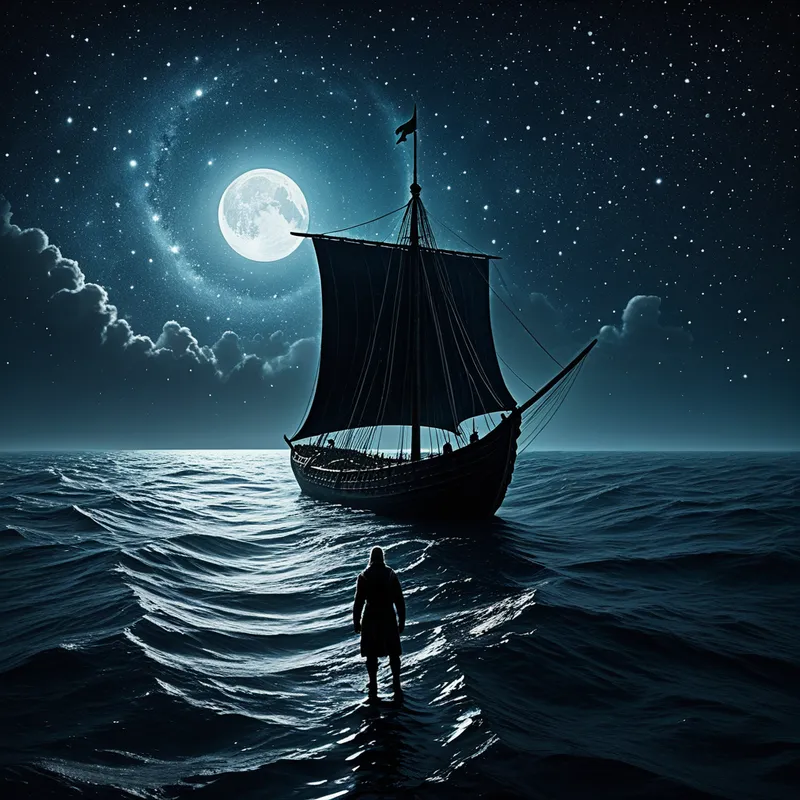
The alchemy here is the transmutation of inherited fate (ørlög) into personal destiny. The base material is the leaden weight of familial legacy and societal expectation. The catalyst is the story of the unlived life, the report from the edge.
The Nigredo is the discontent in Greenland, the feeling of living in a father’s shadow. The Albedo is the clear, piercing moment of hearing Bjarni’s tale—the illumination of a new possibility. The risky voyage into the unknown is the Citrinitas.
The discovery of Vinland is the Rubedo—the reddening, the attainment of the valuable new territory of the Self. But the work is not complete until the return. The true philosopher’s stone is not the discovery itself, but the integrated discoverer. Leif returns to Greenland as “the Lucky,” his identity forever altered. He has performed the ultimate alchemical act: he has not rejected his origins (Greenland), but has deepened and expanded their meaning by connecting them to a wider world.
For the modern individual, this myth models the courage to define success not by conquering external enemies, but by venturing into internal unknowns. It teaches that our greatest discoveries are often the potentials others glimpsed but feared to touch. Our task is to secure the vessel, muster the crew of our own faculties, and sail for that misty shore, carrying back not just resources, but a transformed understanding of who we are and what our world can be.
Associated Symbols
Explore related symbols from the CaleaDream lexicon: