
The Enterprise Myth Meaning & Symbolism
The myth of a silver vessel sailing the starry ocean, carrying a tribe of seekers on an eternal voyage of discovery and encounter.
The Tale of The Enterprise
Listen, and I will tell you of a silver vessel that sails the starry ocean. It was born not from wood and iron, but from the dreams of a tribe who looked up and saw not a ceiling, but a door. They called their vessel The Enterprise, a name that spoke of a great undertaking, a quest without a map.
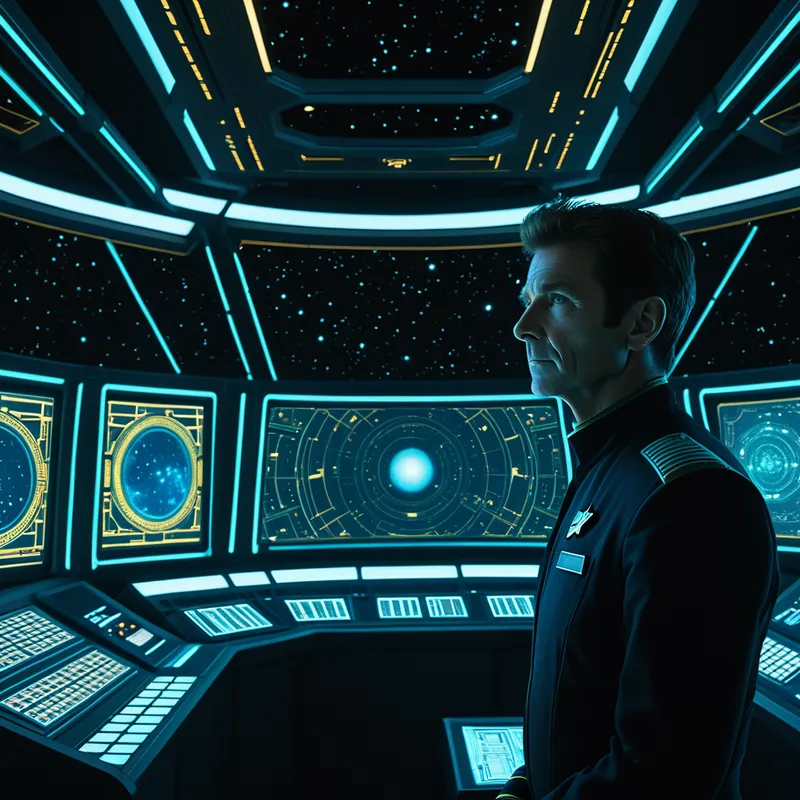
Its halls were lit with a soft, constant hum, the breath of a great, sleeping beast. Within its metal ribs walked a tribe of seekers. At its heart stood the Captain, a figure of calm authority, whose eyes held the weight of the void and the light of a thousand suns. By his side was the First Officer, whose blood was green and whose thoughts were as clear and sharp as crystal. There was the Healer, whose hands could mend flesh and soothe fear, and the Miracle-Worker, who spoke to the engines in a language of plasma and prayer, coaxing impossible speeds from their fiery cores.
Their voyage was not to conquer, but to know. The great conflict was the silence itself, the vast, echoing dark between the lights. The rising action was the shimmer on the viewscreen, the unknown signal, the planet that should not exist. They would be drawn into the gravity of mysteries: crystalline entities that sang with the music of creation, god-like beings who tested them with riddles of existence, mirror-worlds that reflected their own darkest selves.
Sometimes, the encounter was a gift—a sharing of art, a hand offered in peace. Other times, it was a trial—a confrontation with a cold, logical enemy, or a force of pure, annihilating hunger. The resolution was never final victory, but survival tempered by understanding. The vessel would turn, its hull sometimes scarred, its tribe forever changed, and sail on. The ending was always a new heading, a fresh coordinate punched into the navigation console, the stars streaking once more into lines of light. The journey was the purpose. The seeking was the home.
Cultural Origins & Context
This myth was born in the mid-20th century, a time when humanity had mapped its own planet but trembled on the brink of self-annihilation. The tribe that birthed it was the culture of Science Fiction, and its most prolific bards were Gene Roddenberry and a chorus of writers, artists, and dreamers. It was passed down not through oral tradition around a fire, but through the flickering light of cathode-ray tubes, in weekly rituals of broadcast.
Its societal function was profound: to provide a secular, hopeful cosmology for a nuclear age. It offered a vision of a future where humanity’s tribal squabbles were healed, where technology was a tool for exploration, not destruction. It served as a cultural schema for encountering the Other—whether that Other was an alien species, a new idea, or a repressed part of the self. In living rooms across the world, families gathered to witness the parable, to see conflict resolved not by phasers set to kill, but by reason, empathy, and the Prime Directive.
Symbolic Architecture
The Enterprise is not merely a ship; it is the psychic vessel of the modern soul. It represents the totality of the conscious personality launched into the vast, uncharted waters of the collective unconscious—the cosmic sea of archetypes and possibilities.
The hero’s journey is not to a geographical place, but into the interiority of being. The starship is the vehicle of that interior voyage.
The Captain symbolizes the integrating principle of consciousness, the Ego tasked with steering the whole. The diverse crew—logic, emotion, intuition, sensation—are the psychic functions that must be coordinated for the vessel to function. The First Officer and the Healer represent the crucial tension and union between Logos and Eros, mind and heart. The endless voyage symbolizes the process of individuation, which has no final destination, only continual becoming.
The core symbolic act is the Encounter. Every alien civilization, spatial anomaly, or temporal paradox is a projected aspect of the unknown self. The Klingon is the repressed warrior, the shadow of aggression. The Vulcan is the repressed ascetic, the shadow of dispassionate intellect. To “boldly go” is to consciously engage these projections, to bring them into the light of the bridge’s viewscreen, and through relationship, integrate their lessons.
The Dreamer's Resonance
When this myth stirs in the modern dreamer, it often manifests not as a literal starship, but as a feeling of voyaging. One may dream of a vast, complex building with endless corridors (the ship’s decks), or of being part of a skilled, diverse team facing a strange, collective problem. The somatic sensation is one of humming potential, of being propelled forward on a current of purpose.
To dream of the Enterprise adrift, powerless, or lost indicates a crisis of direction in the waking life—the ego-vessel has lost connection to its engine, its animating drive. To dream of a catastrophic breach in the hull speaks to a feeling of psychic violation, a fear that the structures of the self cannot contain a new and overwhelming experience. Conversely, to dream of achieving “warp speed,” of the stars stretching into lines, is the psyche’s representation of a breakthrough, a sudden, transcendent shift in perspective that carries one beyond a previously limiting horizon.
The dream is processing the individual’s relationship to the unknown—both the external unknown of life’s next chapter, and the internal unknown of the shadow. The bridge crew in the dream are the dreamer’s own internal resources being marshaled for this encounter.
Alchemical Translation
The alchemical process mirrored in this myth is the opus contra naturam—the work against nature. It is the conscious undertaking to transmute the base, instinctual, planetary human into a stellar being, one capable of navigating the supra-personal realms.
The initial stage, the nigredo, is represented by the cold, black vacuum of space—the despair and isolation that can accompany the first conscious step away from the familiar “gravity well” of tribal identity and collective norms. The Miracle-Worker in engineering, forever balancing matter and antimatter, embodies the conjunctio oppositorum—the sacred marriage of opposites necessary to generate the tremendous energy for the journey.
The transmutation occurs not in the destination, but in the courage to sustain the voyage. The philosopher’s stone is the ship itself, forged in the void.
Each planetary encounter is an alchemical operation. A confrontation with a hostile entity is a calcinatio, a burning away of naive projections. An encounter with a profoundly wise being is a sublimatio, an elevation of spirit. The constant scanning, analyzing, and “making sense” of anomalies is the separatio, discerning what is self and what is other. The final, elusive goal of the alchemist—the lapis philosophorum—is not a thing to be found, but a state of being: the fully realized, resilient, and curious Self, capable of perpetual encounter without disintegration. The Enterprise, forever journeying, forever integrating, is the perfect symbol for this endless process of becoming whole. We are all both the crew and the vessel, sailing the dark sea between stars, seeking not an end, but the next beginning.
Associated Symbols
Explore related symbols from the CaleaDream lexicon: