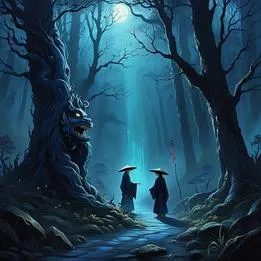
Yokai Spirits Dream Meaning
Supernatural beings from Japanese folklore, ranging from mischievous tricksters to vengeful spirits, embodying the unseen forces of nature and human emotion.
Common Appearances & Contexts
| Context | Emotion | Interpretation |
|---|---|---|
| Being chased by a yokai | Terror | May symbolize a repressed issue or fear you are avoiding. |
| Conversing peacefully with a yokai | Curiosity | Could indicate a willingness to engage with your subconscious. |
| A yokai causing minor mischief | Amusement | Might reflect playful, unexpressed aspects of your personality. |
| Transforming into a yokai | Confusion | Suggests a feeling of alienation or a changing self-identity. |
| Befriending or helping a yokai | Compassion | May represent integrating a difficult part of yourself. |
| A yokai guarding a place or object | Reverence | Could symbolize a protected memory, value, or personal boundary. |
| Multiple yokai interacting | Overwhelm | Might reflect complex, conflicting internal forces or social dynamics. |
| Banishing or defeating a yokai | Triumph | Suggests overcoming a personal obstacle or fear. |
| A yokai offering a gift or warning | Suspicion | Could represent intuitive knowledge or a subconscious message. |
| A yokai associated with a specific object (e.g., lantern, umbrella) | Nostalgia | May connect a mundane item to a deeper memory or emotion. |
| A yokai causing natural phenomena | Awe | Might symbolize feeling subject to powerful, uncontrollable forces. |
| A modern yokai (e.g., in a city) | Unease | Could represent anxieties about technology, society, or urban life. |
Interpretive Themes
The Shadow Self
highYokai often personify hidden fears or desires.
Nature's Agency
highMany yokai originate from objects or animals.
Moral Ambiguity
mediumYokai can be harmful, helpful, or indifferent.
Cultural Memory
highYokai preserve historical fears and values.
Transformation & Liminality
highYokai often change form or inhabit thresholds.
Cultural Lenses
Jungian Perspective
View Context →Archetypes of the collective unconscious, often representing the Shadow or Trickster. They symbolize unintegrated aspects of the psyche that demand recognition for wholeness.
Freudian Perspective
View Context →Manifestations of repressed desires, fears, or traumatic memories from the id, often taking monstrous forms due to censorship by the superego.
Gestalt Perspective
View Context →Projections of disowned parts of the self. Every yokai quality (anger, mischief, sorrow) is an aspect of the dreamer needing integration.
Cognitive Perspective
View Context →Mental constructs arising from pattern recognition and threat detection systems. They personify ambiguous stimuli or unexplained events to reduce cognitive dissonance.
Evolutionary Perspective
View Context →Byproducts of hyperactive agency detection, a survival mechanism to avoid predators. They represent an evolved tendency to attribute intention to environmental events.
East Asian Perspective
View Context →In Japanese tradition, yokai are spirits of place, object, or emotion from Shinto and Buddhist syncretism. Historically explained misfortune; modernly are pop culture icons and environmental metaphors.
European Perspective
View Context →Comparable to faeries, goblins, or household spirits. Historically seen as capricious nature beings or remnants of pagan beliefs, often Christianized as demons or neutralized as folklore.
Global/Universal Perspective
View Context →A near-universal category of supernatural beings explaining the unknown, enforcing social norms, and embodying cultural fears. They serve as narrative tools for morality and cosmology.
Modern Western Perspective
View Context →Often viewed through lenses of psychology, entertainment, or cultural appropriation. They symbolize alienation, mental health struggles, or are consumed as exotic fantasy elements.
South Asian Perspective
View Context →Similar to bhutas, pretas, or yakshas in Hindu/Buddhist lore. They are often spirits of the dead or nature, involved in rituals for protection, appeasement, or spiritual obstacle.
African Perspective
View Context →Analogous to various nature spirits or ancestors in animist traditions. They mediate between the human and spirit worlds, requiring respect and ritual to maintain balance and avoid harm.
North American Perspective
View Context →In some Indigenous traditions, similar to trickster figures (e.g., Coyote) or specific nature spirits. They teach lessons, explain natural phenomena, and embody cultural values and warnings.
Interpret Your Full Dream
Beyond this symbol, every dream carries a unique story. Share your dream for a personalized AI-powered interpretation.