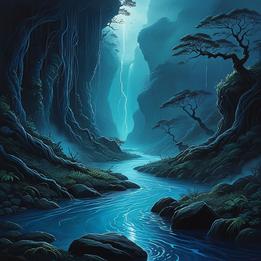
Kappa River
A mythical Japanese water spirit's domain, representing liminal spaces between the human and spirit worlds, often associated with trickery, purity, and danger.
Kappa River Dream Meaning
A mythical Japanese water spirit's domain, representing liminal spaces between the human and spirit worlds, often associated with trickery, purity, and danger.
Interpretive Themes
Mythological Resonance
River Styx
GreekThe boundary river between the world of the living and the underworld, which souls must cross to reach Hades, representing the ultimate liminal space of transformation.
River Boyne
CelticThe sacred river associated with the goddess Boann, whose waters grant wisdom and inspiration to those who dare to enter its mystical currents.
Cultural Lenses
Jungian Perspective
View Context →The river represents the collective unconscious. The kappa is a trickster archetype, a shadow aspect that challenges the ego and guards deeper psychic truths, requiring integration.
Freudian Perspective
View Context →The river symbolizes libidinal energy or the fluidity of repressed desires. The kappa may represent a phallic or infantile figure, with drowning symbolizing castration anxiety or regression.
Gestalt Perspective
View Context →Every part of the dream is an aspect of the dreamer. The dreamer is both the river (flow of experience) and the kappa (mischievous or hidden part), exploring internal polarities.
Cognitive Perspective
View Context →The dream reflects the brain processing concepts of risk, boundaries, and social contracts. The kappa narrative schema helps organize memories related to deception or navigating uncertain social waters.
Evolutionary Perspective
View Context →Symbolizes an evolved caution towards bodies of water (drowning risk) and ambiguous creatures (predator detection). The kappa narrative may encode survival strategies for group living and threat assessment.
East Asian Perspective
View Context →Primarily Japanese. The kappa is a folkloric water imp, a liminal being demanding respect. Historically, it explained drownings; ritually, it connected to water deities. Modernly, it's a popular culture icon.
Global/Universal Perspective
View Context →Rivers universally symbolize life flow, time, and boundaries. Water spirits appear globally as guardians of nature, often capricious, reflecting humanity's awe and fear of untamed water sources.
South Asian Perspective
View Context →Rivers like the Ganges are sacred, purifying. Comparable spirits (e.g., Naga) are serpentine water deities. The dream symbol might blend purification themes with respect for powerful, animate nature.
Modern Western Perspective
View Context →Often viewed through anime/game tropes, reducing the kappa to a cute monster. The river may symbolize stress ('going with the flow') or a barrier to personal goals, stripped of spiritual gravity.
European Perspective
View Context →Parallels exist with Celtic water spirits (kelpies) or Germanic nixies, which also lure humans to watery deaths. Represents the peril and enchantment of wild nature and the unknown.
African Perspective
View Context →Many traditions have water spirits (Mami Wata, river genii) as powerful, ambivalent beings of wealth, healing, and danger. The symbol connects to ancestral spirits and the vital, sometimes treacherous, life force of water.
North American Perspective
View Context →In some Indigenous traditions, rivers are life paths and spirits inhabit all nature. The symbol could reflect environmental concerns or negotiating with powerful, non-human intelligences in the natural world.
Historical Authorities
Want a deeper analysis?
Get a personalized interpretation of your entire dream including this symbol.
Interpret My DreamThe Oracle's Prediction
Combine multiple symbolsA significant revelation about your life's direction will emerge from unexpected sources.
Timeframe
Lunation (~29 Days)
Intensity
Deep
An existing relationship will undergo a fundamental transformation or reveal hidden aspects.
Timeframe
Seasonal (~3 Months)
Intensity
Deep
Common Appearances & Contexts
| Context | Emotion | Interpretation |
|---|---|---|
| Context Crossing the river | Emotion Anxiety | Interpretation Facing a risky transition or decision in waking life. |
| Context Seeing a kappa in the river | Emotion Fear | Interpretation Confronting a deceptive or manipulative aspect of self or others. |
| Context Falling into the river | Emotion Panic | Interpretation Feeling overwhelmed by unconscious emotions or a situation. |
| Context Calmly observing the river | Emotion Contemplation | Interpretation Reflecting on the flow of life or spiritual matters. |
| Context Being pulled underwater by a kappa | Emotion Terror | Interpretation Feeling consumed by a hidden addiction, fear, or compulsion. |
| Context Offering a cucumber to a kappa | Emotion Hope | Interpretation Attempting to appease or negotiate with a difficult force. |
| Context The river is polluted or dry | Emotion Despair | Interpretation Feeling spiritually depleted or that traditions are corrupted. |
| Context Swimming safely in the river | Emotion Triumph | Interpretation Successfully navigating complex emotional or psychic waters. |
| Context A kappa bows, spilling water | Emotion Relief | Interpretation Disarming a threat by acknowledging a vulnerability. |
| Context Building a bridge over the river | Emotion Determination | Interpretation Consciously creating a stable path across a divide. |
| Context Hearing laughter from the river | Emotion Unease | Interpretation Sensing mockery or trickery in one's environment. |
| Context The river leads to a hidden cave | Emotion Awe | Interpretation Journeying deeper into the mysteries of the self. |
Interpret Your Full Dream
Beyond this symbol, every dream carries a unique story. Share your dream for a personalized AI-powered interpretation.