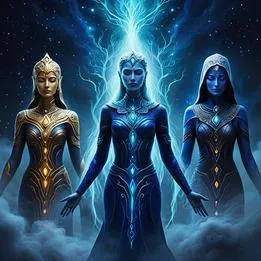
Tetrad Dream Meaning
A sacred grouping of four representing cosmic order, elemental balance, and foundational wholeness across spiritual traditions.
Common Appearances & Contexts
| Context | Emotion | Interpretation |
|---|---|---|
| Four pillars | Security | Foundational support present. |
| Four directions | Orientation | Finding life direction. |
| Four elements | Harmony | Inner balance achieved. |
| Four seasons | Acceptance | Embracing life cycles. |
| Four animals | Protection | Guided by instincts. |
| Four colors | Clarity | Understanding complex situations. |
| Four winds | Change | Transformation approaching. |
| Four gates | Choice | Multiple paths available. |
| Four faces | Integration | Unifying different selves. |
| Four corners | Containment | Safe boundaries established. |
| Four wheels | Progress | Moving forward steadily. |
| Four voices | Wisdom | Multiple perspectives heard. |
Interpretive Themes
Cultural Lenses
Jungian Perspective
View Context →Represents the four psychological functions (thinking, feeling, sensation, intuition) and the process of individuation toward wholeness through integrating opposites in the psyche.
Freudian Perspective
View Context →May symbolize the four stages of psychosexual development (oral, anal, phallic, genital) or represent repressed childhood memories structured in quadrants of consciousness.
Gestalt Perspective
View Context →The tetrad emerges as a complete gestalt pattern, where the whole (fourfold structure) becomes greater than the sum of its parts through perceptual organization and closure.
Cognitive Perspective
View Context →Reflects the brain's natural tendency to organize information into four-part schemas (like four seasons or cardinal directions) for efficient memory encoding and pattern recognition.
Evolutionary Perspective
View Context →Tetrad patterns may have evolutionary advantages in navigation (four directions), social organization (four kinship groups), or survival strategies (four basic needs).
Global/Universal Perspective
View Context →Appears cross-culturally as four elements, seasons, directions, and stages of life, representing universal human attempts to categorize and understand existence.
East Asian Perspective
View Context →In Chinese tradition, the Four Symbols (Azure Dragon, Vermilion Bird, White Tiger, Black Tortoise) guard cardinal directions and represent seasons, elements, and cosmic balance in feng shui.
South Asian Perspective
View Context →In Hinduism, the four varnas (social classes), four ashramas (life stages), and four purusharthas (life goals) structure dharma and spiritual progression toward moksha.
Middle Eastern Perspective
View Context →In Zoroastrianism, the four elements represent Ahura Mazda's creation; in Islamic mysticism, four spiritual stations (sharia, tariqa, haqiqa, marifa) guide Sufi path to divine knowledge.
European Perspective
View Context →Medieval European cosmology featured four humors (blood, phlegm, yellow bile, black bile) governing health and temperament, influencing alchemy and early medicine for centuries.
African Perspective
View Context →In many African traditions, the tetrad appears as four days of the week, four market cycles, or four initiation stages, structuring time, commerce, and rites of passage communally.
North American Perspective
View Context →For many Native American nations, the four sacred directions (each with colors, animals, and teachings) form the Medicine Wheel, guiding healing, ceremonies, and life balance.
Interpret Your Full Dream
Beyond this symbol, every dream carries a unique story. Share your dream for a personalized AI-powered interpretation.