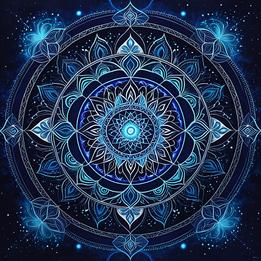
Unity Mandala
A sacred geometric pattern representing cosmic order, spiritual wholeness, and the integration of consciousness with the universe.
Unity Mandala Dream Meaning
A sacred geometric pattern representing cosmic order, spiritual wholeness, and the integration of consciousness with the universe.
Interpretive Themes
Spiritual Integration
highCore to mandala symbolism across traditions.
Psychological Wholeness
highCentral in Jungian dream analysis.
Cosmic Order
mediumReflects ancient cosmological beliefs.
Creative Manifestation
mediumLinked to generative energy and potential.
Transcendence
lowSuggests spiritual awakening or insight.
Mythological Resonance
Mandala
Hindu/BuddhistUsed in rituals and meditation, mandalas represent the universe, with deities at the center, symbolizing spiritual journey and cosmic order.
Medicine Wheel
Native AmericanA circular symbol representing the cycle of life, harmony with nature, and the interconnectedness of all beings.
Cultural Lenses
Jungian Perspective
View Context →Archetype of the Self, representing psychic totality and individuation process. Used in active imagination and therapy to integrate conscious and unconscious elements for wholeness.
Freudian Perspective
View Context →May symbolize womb, unity with mother, or sexual wholeness. The circular form could represent regression to infantile states or fulfillment of primal desires for completeness.
Gestalt Perspective
View Context →Represents the whole being greater than parts. In dreams, it signifies integration of fragmented aspects of self into a cohesive, balanced personality configuration.
Cognitive Perspective
View Context →Mental schema for organizing experience into meaningful patterns. Reflects brain's tendency toward symmetry and order to reduce cognitive dissonance and create coherence.
Evolutionary Perspective
View Context →Adaptive preference for symmetrical patterns signaling health and fitness. May represent social cohesion mechanisms or cognitive tools for navigating complex environments through pattern recognition.
South Asian Perspective
View Context →Sacred Hindu and Buddhist diagram of the cosmos used in meditation and ritual. Represents deities, temples, and spiritual journey toward enlightenment through geometric perfection.
East Asian Perspective
View Context →In Tibetan Buddhism, intricate sand mandalas symbolize impermanence. In Japanese culture, ensō circles represent enlightenment, strength, and the universe in Zen practice.
Middle Eastern Perspective
View Context →Islamic geometric patterns in architecture and art reflect infinite divine unity (tawhid). The repetition without center mirrors God's omnipresence and creation's mathematical perfection.
European Perspective
View Context →Medieval rose windows in cathedrals as mandalas representing divine light and cosmic order. Alchemical circles symbolizing transformation and integration of opposites into unity.
North American Perspective
View Context →Native American medicine wheels as sacred circles representing life cycles, directions, and harmony. Modern use in art therapy and New Age spirituality for healing and balance.
Latin American Perspective
View Context →Aztec calendar stone as cosmic mandala of time and space. Contemporary use in folk art and spiritual practices blending indigenous and Catholic symbolism of divine unity.
Global/Universal Perspective
View Context →Cross-cultural archetype appearing in sacred art worldwide. Represents human longing for order, meaning, and connection to something greater than individual existence.
Historical Authorities
Want a deeper analysis?
Get a personalized interpretation of your entire dream including this symbol.
Interpret My DreamThe Oracle's Prediction
Combine multiple symbolsImproved mental or emotional balance, reducing stress or anxiety.
Timeframe
Immediate (Next 48h)
Intensity
Deep
Common Appearances & Contexts
| Context | Emotion | Interpretation |
|---|---|---|
| Context Meditating on mandala | Emotion Peaceful | Interpretation Seeking inner harmony. |
| Context Creating a mandala | Emotion Fulfilled | Interpretation Expressing creative self. |
| Context Mandala shattering | Emotion Anxious | Interpretation Fear of disintegration. |
| Context Mandala expanding | Emotion Awestruck | Interpretation Experiencing growth. |
| Context Mandala in nature | Emotion Connected | Interpretation Unity with environment. |
| Context Mandala glowing | Emotion Inspired | Interpretation Spiritual illumination present. |
| Context Mandala fading | Emotion Nostalgic | Interpretation Loss of center. |
| Context Mandala transforming | Emotion Curious | Interpretation Personal evolution underway. |
| Context Mandala as map | Emotion Purposeful | Interpretation Seeking direction. |
| Context Mandala in conflict | Emotion Conflicted | Interpretation Inner turmoil symbolized. |
| Context Mandala healing | Emotion Hopeful | Interpretation Recovery and integration. |
| Context Mandala as portal | Emotion Transcendent | Interpretation Gateway to beyond. |
Interpret Your Full Dream
Beyond this symbol, every dream carries a unique story. Share your dream for a personalized AI-powered interpretation.