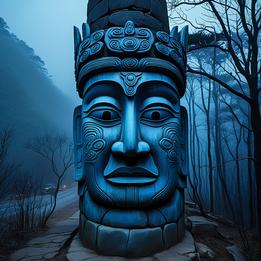
Jangseung Totem
Korean village guardian posts carved with human or deity faces, believed to protect settlements from evil spirits and misfortune.
Jangseung Totem Dream Meaning
Korean village guardian posts carved with human or deity faces, believed to protect settlements from evil spirits and misfortune.
Interpretive Themes
Mythological Resonance
Dokkaebi
KoreanMythical goblins that Jangseung were believed to ward off, protecting villages from mischievous or harmful spirits.
Hermes
GreekAs boundary-crosser and protector of travelers, similar to how Jangseung marks and protects village boundaries.
Cultural Lenses
Jungian Perspective
View Context →Archetype of the Self or Wise Old Man; represents individuation process, collective unconscious wisdom, and integration of spiritual authority within the psyche.
Freudian Perspective
View Context →Phallic symbol representing paternal authority and superego; may indicate unresolved father issues or societal repression of primal instincts.
Gestalt Perspective
View Context →Projection of the dreamer's need for boundaries or protection; represents parts of self that feel responsible for safeguarding others.
Cognitive Perspective
View Context →Mental schema for security and tradition; reflects cognitive processes around threat assessment and cultural memory encoding.
Evolutionary Perspective
View Context →Adaptive mechanism for group cohesion and territory marking; represents evolved need for symbolic protection against perceived threats.
East Asian Perspective
View Context →Korean shamanistic tradition dating to Three Kingdoms period; wooden posts with fierce faces ward off evil spirits, disease, and misfortune at village boundaries.
Global/Universal Perspective
View Context →Cross-cultural guardian figure archetype; like Greek herms or Roman termini, marks boundaries while offering spiritual protection through anthropomorphic representation.
Modern Western Perspective
View Context →Exoticized artifact of 'primitive' spirituality; often appreciated aesthetically while its protective function is rationalized as psychological or cultural metaphor.
European Perspective
View Context →Parallel to boundary markers like Celtic sheela-na-gigs or Nordic stave church portals; protective grotesques at liminal spaces between sacred/profane.
African Perspective
View Context →Similar to nkisi nkondi power figures or Dogon ancestor pillars; mediates between human and spirit worlds while enforcing community norms.
North American Perspective
View Context →Comparable to totem poles among Pacific Northwest tribes; vertical narrative sculptures encoding lineage, rights, and spiritual guardianship of place.
Latin American Perspective
View Context →Echoes of pre-Columbian boundary markers like Inca ushnus or Maya stelae; sacred posts mediating between earthly and celestial realms.
Historical Authorities
Want a deeper analysis?
Get a personalized interpretation of your entire dream including this symbol.
Interpret My DreamThe Oracle's Prediction
Combine multiple symbolsA protective presence will manifest in your living space.
Timeframe
Lunation (~29 Days)
Intensity
Deep
A new guardian figure will enter your social circle.
Timeframe
Seasonal (~3 Months)
Intensity
Deep
Common Appearances & Contexts
| Context | Emotion | Interpretation |
|---|---|---|
| Context Village entrance | Emotion Safety | Interpretation Protection from harm. |
| Context Damaged totem | Emotion Vulnerability | Interpretation Defenses compromised. |
| Context Carving new | Emotion Purpose | Interpretation Creating protection. |
| Context Multiple totems | Emotion Security | Interpretation Strong community. |
| Context Totem speaking | Emotion Awe | Interpretation Divine message. |
| Context Ignoring totem | Emotion Guilt | Interpretation Neglecting tradition. |
| Context Modern city | Emotion Longing | Interpretation Lost heritage. |
| Context Totem moving | Emotion Alarm | Interpretation Boundaries shifting. |
| Context Foreigner viewing | Emotion Pride | Interpretation Cultural appreciation. |
| Context Ancient forest | Emotion Reverence | Interpretation Primordial protection. |
| Context Totem decaying | Emotion Sadness | Interpretation Tradition fading. |
| Context Children playing | Emotion Joy | Interpretation Inherited guardianship. |
Interpret Your Full Dream
Beyond this symbol, every dream carries a unique story. Share your dream for a personalized AI-powered interpretation.