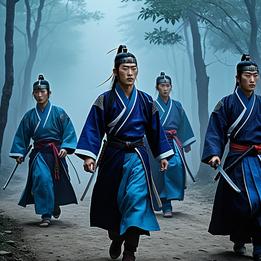
Hwarang Warriors
Elite warrior-youth order of Silla Korea, blending martial arts, Confucian ethics, Buddhist spirituality, and artistic cultivation into an ideal of noble service.
Hwarang Warriors Dream Meaning
Elite warrior-youth order of Silla Korea, blending martial arts, Confucian ethics, Buddhist spirituality, and artistic cultivation into an ideal of noble service.
Interpretive Themes
Individuation & Wholeness
highDream may signal personal synthesis.
Sacred Duty
highAlign actions with core values.
Initiation & Transformation
mediumDream marks a rite of passage.
Idealized Self
mediumAspiration towards perfected identity.
Collective Identity
lowNeed for belonging and shared mission.
Mythological Resonance
General Kim Yu-sin
KoreanThe legendary Hwarang leader who unified Korea through strategic brilliance and unwavering loyalty, embodying the warrior-poet ideal that balanced martial might with spiritual depth.
Achilles
GreekLike the Hwarang, Achilles was a peerless warrior trained in both combat and arts (music), representing the tragic beauty of youthful excellence destined for heroic sacrifice.
Cultural Lenses
Jungian Perspective
View Context →Archetype of the Puer Aeternus (Eternal Youth) integrated with the Warrior, representing the drive for individuation through disciplined spiritual and physical cultivation of the latent Self.
Freudian Perspective
View Context →Sublimation of aggressive and libidinal drives into socially celebrated, ritualized forms of brotherhood, competition, and aesthetic display, satisfying the Superego's demand for idealized conduct.
Gestalt Perspective
View Context →Projection of the dreamer's disowned qualities of discipline, honor, or communal spirit. The Hwarang represents a fragmented part of the self seeking integration into the whole personality.
Cognitive Perspective
View Context →Mental schema for 'excellence through structured training' activated during sleep. May reflect cognitive processing of recent challenges requiring skill integration, discipline, or ethical problem-solving.
Evolutionary Perspective
View Context →Symbolizes high-status coalitional alliance. Dream content reinforces the adaptive benefits of in-group loyalty, coordinated skill display, and adherence to a shared code for social survival and mating success.
East Asian Perspective
View Context →Paragon of the Confucian junzi (noble person) and Buddhist bodhisattva, harmonizing wen (cultural arts) and wu (martial prowess). Historically, a state-building elite; modernly, a pop culture icon of Korean soft power and masculine ideal.
Global/Universal Perspective
View Context →Archetypal motif of the sacred warrior-monk or knightly order, found globally (e.g., Samurai, Knights Templar). Represents the universal human aspiration to fuse spiritual transcendence with earthly power and service.
Modern Western Perspective
View Context →Often interpreted through lens of self-help and peak performance. Symbolizes the 'warrior mindset,' holistic self-optimization, and finding one's 'code' or purpose in a fragmented modern world.
South Asian Perspective
View Context →Resonates with the Kshatriya (warrior) varna ideal in Dharma, where duty (dharma), righteous action, and spiritual discipline (yoga/dhyana) are combined, as exemplified in figures like Arjuna from the Mahabharata.
European Perspective
View Context →Parallels medieval chivalric orders and the concept of chivalry—blending martial skill, religious piety, courtly manners, and service to a lord or lady. An ideal of cultivated masculine virtue.
African Perspective
View Context →Echoes age-grade warrior societies (e.g., Maasai Moran) where youth undergo rigorous initiation, learn communal values, martial skills, and spiritual lore to become protectors and leaders of their people.
Middle Eastern Perspective
View Context →Evokes the Fata (young knightly ideal) in classical Islamic culture, emphasizing muruwwa (manly virtue): courage, generosity, eloquence, and loyalty. A model for personal excellence within a spiritual framework.
Historical Authorities
Want a deeper analysis?
Get a personalized interpretation of your entire dream including this symbol.
Interpret My DreamThe Oracle's Prediction
Combine multiple symbolsRecognition for a project that combines technical skill with creative vision.
Timeframe
Immediate (Next 48h)
Intensity
Deep
Initiation into a new discipline that transforms both body and mind.
Timeframe
Seasonal (~3 Months)
Intensity
Deep
Common Appearances & Contexts
| Context | Emotion | Interpretation |
|---|---|---|
| Context Leading warriors | Emotion Confident | Interpretation Embrace inner authority. |
| Context Training rigorously | Emotion Determined | Interpretation Commitment to self-mastery. |
| Context Facing a foe | Emotion Resolute | Interpretation Confront internal conflict. |
| Context Meditating with group | Emotion Peaceful | Interpretation Seek spiritual harmony. |
| Context Receiving a code | Emotion Reverent | Interpretation Internalize guiding principles. |
| Context Protecting the weak | Emotion Righteous | Interpretation Act on moral courage. |
| Context Failing a test | Emotion Ashamed | Interpretation Fear of inadequacy. |
| Context Wearing ornate armor | Emotion Proud | Interpretation Display of cultivated self. |
| Context Abandoning the path | Emotion Guilty | Interpretation Betrayal of ideals. |
| Context Ancient battlefield | Emotion Nostalgic | Interpretation Longing for lost nobility. |
| Context Modern city setting | Emotion Disoriented | Interpretation Anachronistic values clash. |
| Context Being chosen | Emotion Awed | Interpretation Recognition of potential. |
Interpret Your Full Dream
Beyond this symbol, every dream carries a unique story. Share your dream for a personalized AI-powered interpretation.