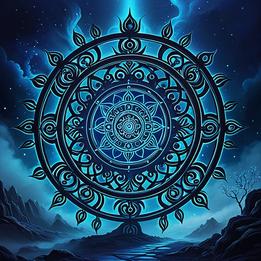
Dharma Wheel
A sacred Buddhist symbol representing the teachings of Buddha, the path to enlightenment, and the cyclical nature of existence.
Dharma Wheel Dream Meaning
A sacred Buddhist symbol representing the teachings of Buddha, the path to enlightenment, and the cyclical nature of existence.
Interpretive Themes
Mythological Resonance
The Buddha
BuddhistAfter attaining enlightenment under the Bodhi tree, the Buddha set the Wheel of Dharma in motion with his first sermon at Deer Park, teaching the Four Noble Truths and the Eightfold Path.
Sudarshana Chakra
HinduVishnu's spinning discus weapon that cuts through illusion and evil, symbolizing the cyclical nature of time and divine order.
Cultural Lenses
South Asian Perspective
View Context →In Buddhism, the Dharmachakra symbolizes the Buddha's first sermon and the Noble Eightfold Path. Historically, it represents the turning of the wheel of Dharma, initiating the spread of Buddhist teachings. Ritually, it's a central icon in temples and art. Modernly, it remains a core symbol of Buddhist identity and practice.
Jungian Perspective
View Context →Represents the archetype of the Self or the mandala, symbolizing psychic wholeness, individuation, and the center of the personality. It points to the integration of conscious and unconscious elements for personal transformation and spiritual realization.
Freudian Perspective
View Context →Might be interpreted as a phallic symbol representing paternal authority, law, and the superego. Its circular motion could symbolize repressed desires or conflicts related to order, control, and the imposition of societal rules upon instinctual drives.
Gestalt Perspective
View Context →Seen as a projection of the self. Each spoke might represent an aspect of the dreamer's personality or life. The dream asks, 'What part of this wheel are you?' to explore integration and the relationship between the parts and the whole.
Cognitive Perspective
View Context →May reflect the mind's attempt to process concepts of causality, moral reasoning, or life patterns. It could symbolize a cognitive schema for understanding order, consequence, and the systematic nature of beliefs or personal growth strategies.
Evolutionary Perspective
View Context →Could tap into deep-seated human adaptations for detecting patterns, understanding cyclical natural phenomena (seasons, life-death), and forming cooperative social structures based on shared rules and symbolic communication that enhance group survival.
East Asian Perspective
View Context →In regions like Tibet, China, and Japan, it's integrated into Vajrayana and Mahayana Buddhism. It often appears with other symbols (deer, lotus), representing the Buddha's teachings. In art, it signifies spiritual authority and the perpetual motion of the Dharma.
Modern Western Perspective
View Context →Often divorced from strict religious context, it's adopted as a generic symbol for karma, mindfulness, balance, and New Age spirituality. It appears in tattoos, jewelry, and decor, representing a personal quest for meaning and holistic living.
Global/Universal Perspective
View Context →As a near-perfect circle with a hub and spokes, it resonates universally as a symbol of the sun, cycles (time, life), unity, centrality, and the radiating influence of a core truth or power across many cultures and eras.
European Perspective
View Context →Historically, through cultural exchange, it influenced heraldic sun wheels and Celtic crosses. In modern esoteric and pagan traditions, it's sometimes reinterpreted as a solar wheel or a symbol of the yearly cycle, blending with indigenous European motifs.
Middle Eastern Perspective
View Context →While not native, its form echoes ancient solar disks (e.g., Shamash) and the concept of divine chariot wheels in Mesopotamian and Zoroastrian traditions. In modern contexts, it might be recognized through globalized Buddhist communities.
African Perspective
View Context →Its circular, radial form finds parallels in many African symbols representing the sun, community, and cyclical time. While not the Dharma Wheel per se, similar geometric principles express concepts of unity, destiny, and the interconnection of life forces.
Historical Authorities
Want a deeper analysis?
Get a personalized interpretation of your entire dream including this symbol.
Interpret My DreamThe Oracle's Prediction
Combine multiple symbolsA profound insight or teaching will arrive, clarifying a long-held confusion.
Timeframe
Lunation (~29 Days)
Intensity
Deep
Common Appearances & Contexts
| Context | Emotion | Interpretation |
|---|---|---|
| Context Spinning rapidly | Emotion Anxiety | Interpretation Life feels out of control; overwhelmed by change. |
| Context Stationary and glowing | Emotion Serenity | Interpretation Inner peace achieved; alignment with life's purpose. |
| Context Cracking or breaking | Emotion Fear | Interpretation Core beliefs are being challenged or shattered. |
| Context Holding it in hands | Emotion Empowerment | Interpretation Taking charge of your spiritual path or destiny. |
| Context Seeing it in the sky | Emotion Awe | Interpretation A call to higher consciousness or divine revelation. |
| Context Trying to turn it but it's stuck | Emotion Frustration | Interpretation Feeling blocked in personal growth or understanding. |
| Context It guides you through a maze | Emotion Hope | Interpretation Finding direction during a confusing life phase. |
| Context It appears in a childhood home | Emotion Nostalgia | Interpretation Reconnecting with foundational values or early teachings. |
| Context It's being polished by an elder | Emotion Respect | Interpretation Receiving wisdom from a mentor or tradition. |
| Context It multiplies into many wheels | Emotion Confusion | Interpretation Too many paths or philosophies causing indecision. |
| Context It's made of light, not material | Emotion Transcendence | Interpretation Experiencing spiritual truths beyond physical reality. |
| Context It stops and reverses direction | Emotion Shock | Interpretation A major life reversal or reevaluation is imminent. |
Interpret Your Full Dream
Beyond this symbol, every dream carries a unique story. Share your dream for a personalized AI-powered interpretation.