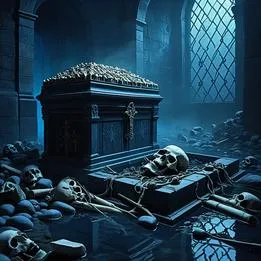
Ossuary Dream Meaning
A repository for human bones, often associated with mortality, ancestral connection, and the sacred preservation of remains after decomposition.
Common Appearances & Contexts
| Context | Emotion | Interpretation |
|---|---|---|
| Entering an ossuary | Awe | Facing profound ancestral presence. |
| Touching bones | Revulsion | Direct contact with mortality. |
| Cleaning an ossuary | Reverence | Ritual care for the dead. |
| Lost in ossuary | Anxiety | Overwhelmed by history, mortality. |
| Ossuary collapsing | Terror | Fear of losing ancestral connection. |
| Finding a specific bone | Discovery | Seeking personal lineage, answers. |
| Ossuary as home | Peace | Acceptance of death's inevitability. |
| Bones rearranging themselves | Wonder | Ancestors communicating, history alive. |
| Building an ossuary | Purpose | Creating legacy, honoring past. |
| Ossuary flooding | Grief | Loss of history, memory erased. |
| Voices in ossuary | Unease | Whispers of the past heard. |
| Light in ossuary | Hope | Illumination, understanding mortality's meaning. |
Interpretive Themes
Mortality and Legacy
highBones as enduring symbols of life passed.
Ancestral Connection
highBones as physical ties to forebears.
Sacred Transition
mediumOssuary as a liminal, consecrated ground.
Memory and Preservation
mediumBones curated to prevent forgetting.
Collective Identity
lowLoss of individuality for group continuity.
Cultural Lenses
Jungian Perspective
View Context →Represents the collective unconscious's bone-house—the foundational, archetypal structures of the psyche. The ossuary is the psyche's repository of ancestral memories and inherited patterns, a place where individual identity dissolves into the transpersonal.
Freudian Perspective
View Context →Symbolizes repressed death wishes (Thanatos) and a return to an inorganic state. May relate to castration anxiety (bones as phallic symbols rendered inert) or a morbid fixation stemming from unresolved childhood experiences with death or separation.
Gestalt Perspective
View Context →The dreamer is the ossuary and all its contents. It represents parts of the self deemed 'dead,' discarded, or from the past that are being stored but not integrated. The dream asks: 'What aspects of yourself have you boxed away?'
Cognitive Perspective
View Context →The mind uses the familiar concept of an ossuary to process concerns about memory, legacy, and the finite nature of life. It's a metaphorical framework for organizing thoughts about mortality, history, and what is preserved versus lost.
Evolutionary Perspective
View Context →Taps into deep-seated adaptations for recognizing mortality and managing dead kin. The symbol triggers mechanisms for ancestor veneration, which promoted group cohesion and transmission of knowledge, and hazard avoidance related to corpses and disease.
European Perspective
View Context →Strongly tied to medieval Christian charnel houses and catacombs, reflecting memento mori ('remember you will die') traditions. It symbolizes the democratic equality in death and a temporary resting place before Resurrection, blending piety with macabre artistry.
East Asian Perspective
View Context →In Buddhist contexts, relates to sky burial or secondary burial rites where bones are collected after decomposition. Honors ancestors but emphasizes impermanence (anicca). In modern contexts, may relate to crowded urban columbaria, reflecting space for the dead.
Middle Eastern Perspective
View Context →Evokes ancient mass burial pits or Jewish ossuaries (kokhim) from the Second Temple period, used for secondary burial to free the soul. Symbolizes ritual purity, family lineage, and the physical vessel for the soul's journey in antiquity.
African Perspective
View Context →In some traditions, bones of ancestors are curated in sacred groves or relics, serving as conduits for communication and blessings. The ossuary is a powerful ritual space linking the living community with the active, guiding presence of the dead.
Latin American Perspective
View Context →Connected to Dia de los Muertos and cults like Santa Muerte, where bones are not feared but celebrated as part of life's cycle. Ossuaries may symbolize joyful remembrance, a tangible connection to ancestors who are invited back to visit.
Modern Western Perspective
View Context →Often aestheticized as 'dark tourism' or gothic art, divorced from original sacred context. Represents a secular fascination with mortality, history, and the macabre, or an anxiety about legacy in an era of digital, impermanent records.
Global/Universal Perspective
View Context →A cross-cultural symbol for humanity's universal practice of caring for the dead. Represents the tension between the physical decay of the body and the enduring desire to memorialize, honor, and maintain a connection with those who have died.
Interpret Your Full Dream
Beyond this symbol, every dream carries a unique story. Share your dream for a personalized AI-powered interpretation.