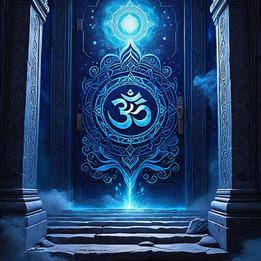
Hindu Om
The primordial cosmic vibration representing the essence of ultimate reality, consciousness, and the universe in Hinduism.
Hindu Om Dream Meaning
The primordial cosmic vibration representing the essence of ultimate reality, consciousness, and the universe in Hinduism.
Interpretive Themes
Mythological Resonance
Prajapati
HinduCreator deity who manifested universe through primordial sound, with Om as his essence.
Logos
UniversalDivine word or reason that creates and orders reality, found in Greek philosophy and Christian theology.
Cultural Lenses
South Asian Perspective
View Context →In Hinduism, Om is the supreme bija (seed) mantra, representing Brahman (ultimate reality) and the trimurti (Brahma, Vishnu, Shiva). It is chanted in rituals, meditation, and scriptures like the Upanishads to invoke cosmic energy and spiritual purity.
Jungian Perspective
View Context →A symbol of the Self, the central archetype of wholeness and the psyche's totality. It represents the individuation process—integrating conscious and unconscious elements to achieve psychic unity and spiritual fulfillment.
Freudian Perspective
View Context →May symbolize primal, oceanic feelings of unity with the mother or the womb, reflecting repressed desires for regression to a state of undifferentiated bliss and security from early infancy.
Gestalt Perspective
View Context →Represents the holistic integration of the dreamer's fragmented parts (thoughts, feelings, sensations) into a cohesive whole. The symbol itself is a foreground figure asking to be reconciled with the background of the dreamer's life.
Cognitive Perspective
View Context →A schema or mental representation for concepts of infinity, peace, or spirituality. The dream may reflect cognitive processes attempting to organize and understand abstract, existential ideas or reduce anxiety through symbolic meaning-making.
Evolutionary Perspective
View Context →Could tap into an evolved predisposition for pattern recognition and agency detection in nature. The symbol might represent a hyperactive agency detection for a unifying cosmic force, promoting social cohesion and reducing existential anxiety.
Modern Western Perspective
View Context →Often stripped of specific Hindu theology, it functions as a generic signifier for mindfulness, New Age spirituality, and holistic wellness. It is commodified in lifestyle products, representing a search for meaning in a secular context.
Global/Universal Perspective
View Context →Recognized worldwide as an icon of Eastern spirituality and meditation. It transcends its origins to symbolize universal human quests for inner peace, cosmic connection, and the sacred sound believed to underlie all creation.
East Asian Perspective
View Context →In Buddhist contexts (e.g., Tibetan, Zen), Om is incorporated into mantras and visualizations, often as part of 'Om Mani Padme Hum.' It symbolizes the essence of enlightenment, compassion, and the vibrational nature of reality.
European Perspective
View Context →Historically viewed through colonial and orientalist lenses as an exotic spiritual emblem. In contemporary esoteric traditions like Theosophy, it is interpreted as a symbol of ancient wisdom and the cosmic root vibration.
Middle Eastern Perspective
View Context →In Sufi Islamic mysticism, similar concepts of the 'Ism-e-Azam' (Greatest Name) or the primordial sound 'Kun' (Be!) resonate. Om may be seen as a parallel expression of the divine creative command and unity of existence.
North American Perspective
View Context →Adopted into eclectic spiritual practices, from hippie counterculture to mainstream yoga. It often represents personal enlightenment, alternative spirituality, and a connection to perceived ancient wisdom outside Abrahamic traditions.
Historical Authorities
Want a deeper analysis?
Get a personalized interpretation of your entire dream including this symbol.
Interpret My DreamThe Oracle's Prediction
Combine multiple symbolsA profound experience of cosmic unity or expanded consciousness.
Timeframe
Immediate (Next 48h)
Intensity
Deep
Common Appearances & Contexts
| Context | Emotion | Interpretation |
|---|---|---|
| Context Chanting Om alone in silence | Emotion profound peace | Interpretation Suggests deep inner alignment and self-acceptance. |
| Context Seeing Om glow with light | Emotion awe | Interpretation May indicate spiritual revelation or insight. |
| Context Struggling to pronounce Om | Emotion frustration | Interpretation Could reflect difficulty accessing inner truth. |
| Context Om symbol cracking or breaking | Emotion anxiety | Interpretation May signal a crisis of faith or belief. |
| Context Hearing Om from an unseen source | Emotion curiosity | Interpretation Suggests guidance from the unconscious or divine. |
| Context Writing or drawing the Om symbol | Emotion focus | Interpretation Indicates active engagement with spiritual identity. |
| Context Om appearing in a chaotic scene | Emotion hope | Interpretation Symbolizes a center of calm amidst turmoil. |
| Context Multiple Om symbols rotating | Emotion wonder | Interpretation May represent the cyclical nature of existence. |
| Context Trying to erase an Om symbol | Emotion guilt | Interpretation Could reflect rejecting a spiritual calling. |
| Context Om symbol on a doorway or threshold | Emotion anticipation | Interpretation Suggests entering a new phase of awareness. |
| Context Om vibrating with intense sound | Emotion overwhelm | Interpretation May indicate powerful, unstoppable inner forces. |
| Context Gifting or receiving an Om symbol | Emotion gratitude | Interpretation Represents sharing or accepting spiritual wisdom. |
Interpret Your Full Dream
Beyond this symbol, every dream carries a unique story. Share your dream for a personalized AI-powered interpretation.