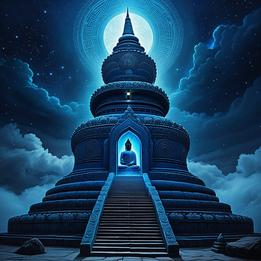
Stupa
A Buddhist monument representing enlightenment, the Buddha's mind, and the path to spiritual awakening through its architectural symbolism.
Stupa Dream Meaning
A Buddhist monument representing enlightenment, the Buddha's mind, and the path to spiritual awakening through its architectural symbolism.
Interpretive Themes
Spiritual Awakening
highStupa's structure mirrors spiritual ascent.
Sacred Geometry
highProportions symbolize universal balance.
Memory and Legacy
mediumOften contains relics or scriptures.
Inner Peace
mediumCircumambulation induces meditative state.
Transcendence
lowSpire points toward liberation.
Mythological Resonance
The Great Stupa of Sanchi
BuddhistOne of India's oldest stone structures, built to enshrine relics of the Buddha, representing the cosmic mountain and the Buddha's enlightened mind.
Axis Mundi
UniversalThe world axis or cosmic pillar connecting heaven, earth, and underworld, found in countless traditions as a center of spiritual power and orientation.
Cultural Lenses
Jungian Perspective
View Context →Represents the Self archetype—the center of psychic totality. Its mandala-like structure symbolizes wholeness, integration of consciousness and unconsciousness, and the individuation process toward psychological completeness.
Freudian Perspective
View Context →Phallic symbol representing paternal authority and superego demands. The dome may symbolize maternal containment, reflecting unresolved Oedipal conflicts or sublimated sexual energy redirected toward spiritual ideals.
Gestalt Perspective
View Context →Symbolizes the whole self—each architectural element represents parts of the dreamer's personality. The stupa's completeness urges integration of fragmented aspects into a harmonious, functioning whole.
Cognitive Perspective
View Context →Mental schema for spiritual concepts—organizing beliefs about enlightenment, morality, and transcendence. Dreaming of a stupa may indicate cognitive processing of existential questions or moral dilemmas.
Evolutionary Perspective
View Context →Monument-building instinct reflecting status, group cohesion, and memory preservation. The stupa may tap into innate drives for legacy, sacred space creation, and ritual behavior that strengthens social bonds.
South Asian Perspective
View Context →Buddhist reliquary monument originating in ancient India. Symbolizes the Buddha's enlightenment (dome=world, spire=nirvana). Ritual circumambulation (pradakshina) accumulates merit. Modernly, remains a pilgrimage focus and peace symbol.
East Asian Perspective
View Context →Pagoda-evolved structure in China, Japan, Korea. Blends Buddhist cosmology with local geomantic principles (feng shui). Historically marked sacred landscapes; today functions as cultural heritage and tourist attraction alongside religious practice.
Global/Universal Perspective
View Context →Archetypal sacred mountain or axis mundi connecting earth and heaven. Cross-culturally represents spiritual ascent, cosmic order, and human aspiration toward the divine. Modernly symbolizes universal peace and intercultural dialogue.
Middle Eastern Perspective
View Context →While not native, stupas resonate with Islamic dome architecture (mosques, shrines) and Zoroastrian tower-of-silence structures. In modern context, may represent interfaith dialogue or appreciation of Buddhist peace philosophy.
Modern Western Perspective
View Context →Exotic spiritual symbol often divorced from religious context—represents mindfulness, Eastern wisdom, or architectural beauty. Frequently appears in meditation apps, wellness spaces, and as decorative art signifying 'spiritual but not religious' orientation.
European Perspective
View Context →Historically encountered through colonial and scholarly lenses. Today, represents Buddhist philosophy's growing influence, with stupas built in Western countries as symbols of peace, often sparking discussions about cultural appropriation versus appreciation.
Oceanian Perspective
View Context →In regions with Buddhist communities (Australia, New Zealand), stupas represent multiculturalism and spiritual diversity. For Indigenous cultures, may parallel sacred stone arrangements or markers, though distinct in origin and meaning.
Historical Authorities
Want a deeper analysis?
Get a personalized interpretation of your entire dream including this symbol.
Interpret My DreamThe Oracle's Prediction
Combine multiple symbolsA profound insight or awakening experience that reorients your understanding of reality.
Timeframe
Seasonal (~3 Months)
Intensity
Deep
Common Appearances & Contexts
| Context | Emotion | Interpretation |
|---|---|---|
| Context Climbing a stupa | Emotion Determination | Interpretation Spiritual progress effort. |
| Context Stupa crumbling | Emotion Anxiety | Interpretation Faith or stability threatened. |
| Context Circumambulating stupa | Emotion Devotion | Interpretation Ritualistic mindfulness practice. |
| Context Stupa glowing | Emotion Awe | Interpretation Divine presence or insight. |
| Context Building a stupa | Emotion Purpose | Interpretation Creating spiritual foundation. |
| Context Stupa in distance | Emotion Longing | Interpretation Unattained enlightenment goal. |
| Context Stupa surrounded by chaos | Emotion Calm | Interpretation Inner peace amidst turmoil. |
| Context Entering a stupa | Emotion Curiosity | Interpretation Exploring inner wisdom. |
| Context Stupa covered in vines | Emotion Nostalgia | Interpretation Neglected spiritual practices. |
| Context Stupa on mountain | Emotion Inspiration | Interpretation Elevated spiritual perspective. |
| Context Stupa reflecting water | Emotion Clarity | Interpretation Self-reflection and insight. |
| Context Stupa with open gate | Emotion Welcome | Interpretation Accessible spiritual path. |
Interpret Your Full Dream
Beyond this symbol, every dream carries a unique story. Share your dream for a personalized AI-powered interpretation.