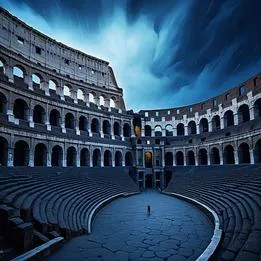
Colosseum
The Oracle's Essence
An ancient Roman amphitheater symbolizing monumental human achievement, public spectacle, and the tension between civilization and violence.
Interpretive Themes
Modern Visibility
Today, the Colosseum is primarily viewed as a historic tourist landmark and architectural marvel, though its violent past remains a point of reflection.
Cultural Lenses
Jungian
Learn More βThe Colosseum represents the collective shadowβthe arena where repressed societal violence and primal instincts are ritualistically contained and witnessed, integrating the dark aspects of the psyche.
Freudian
Learn More βSymbolizes sublimated aggression and the death drive (Thanatos) enacted as public spectacle. The structure itself may represent rigid societal superego, containing and directing id-like violent impulses.
Gestalt
Learn More βThe dreamer is all parts: the gladiator, the crowd, the emperor, and the stones. The symbol asks, 'Which part of this conflict or spectacle do you most identify with or disown?'
Cognitive
Learn More βThe mind uses this familiar, grandiose image to schematize concepts of social evaluation, high-stakes performance, or historical consequence, often processing recent events of public scrutiny or personal tests.
Evolutionary
Learn More βTaps into ancient adaptations for social hierarchy, coalitional conflict, and public ritual. It may activate status anxiety, in-group/out-group dynamics, or the human drive for communal gathering and storytelling.
European
Learn More βA direct legacy of Roman Empire, symbolizing the foundations of Western law, engineering, and political power, but also its costs in violence, slavery, and imperial overreach. Modernly, a monument to both heritage and critique.
Middle Eastern
Learn More βViewed through the lens of later empires (Byzantine, Ottoman) that repurposed Roman sites. Can symbolize the cyclical nature of imperial rise/fall, or the transformation of spaces of violence into centers of trade or worship.
Modern Western
Learn More βAn icon of mass tourism and pop culture (e.g., films), often divorced from itsθ‘θ ₯ history. Represents commodification of history, or a backdrop for reflecting on contemporary spectacle in media and politics.
East Asian
Learn More βMay be interpreted through concepts of 'face' and public honor/shame, or as a foreign symbol of a distant, fallen empire offering lessons on the impermanence of worldly power and grandeur.
African
Learn More βCould parallel indigenous traditions of communal gathering spaces for ritual, dispute resolution, or performance. Might also symbolize external colonial structures imposed on the landscape, representing contested history and endurance.
Latin American
Learn More βEvokes pre-Columbian ceremonial ball courts or Spanish bullringsβspaces of ritualized conflict and public life. Can symbolize layered histories of conquest, cultural fusion, and the spectacle of political power.
Global/Universal
Learn More βA widely recognized symbol of human ambition, architectural genius, and collective violence. Speaks to universal themes of glory and ruin, the audience's complicity in spectacle, and what societies build to endure.
Contextual Nuances
Watching a fight
Engaged in internal conflict.
Being a gladiator
Feeling trapped or tested.
Exploring ruins alone
Reflecting on past endeavors.
Crowd cheering you
Seeking validation publicly.
Structure collapsing
Foundations feel unstable.
Questions for Reflection
- "In what area of your life do you feel you are performing for an audience?"
- "What 'gladiatorial' challenge are you facing or avoiding?"
- "What legacy or structure in your life feels ancient and in need of repair or reinterpretation?"
Related Weavings
The Portal is Always Open
Every dream is a personalized dispatch from the deep. Don't let yours fade into static.
Interpret Full Dream