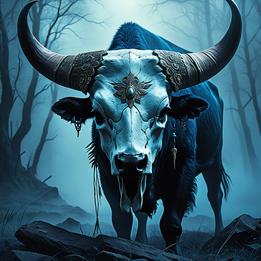
Buffalo Skull
A powerful symbol of death, sacrifice, and spiritual connection, often representing ancestral wisdom and the cycle of life.
Buffalo Skull Dream Meaning
A powerful symbol of death, sacrifice, and spiritual connection, often representing ancestral wisdom and the cycle of life.
Interpretive Themes
Ancestral Connection
highSkull as vessel for ancestral spirits.
Sacrifice and Provision
highAnimal's death nourishes the community.
Mortality and Transition
mediumReminder of life's impermanence.
Strength and Resilience
mediumBone structure symbolizes durability.
Spiritual Gateway
lowSkull as threshold for communication.
Mythological Resonance
White Buffalo Calf Woman
LakotaSacred being who brought the pipe ceremony, symbolizing peace and abundance.
Buffalo Spirit
Plains TribesProvider of life, where every part of the buffalo was used in a sacred cycle.
Cultural Lenses
Jungian Perspective
View Context →Represents the Self archetype, integration of consciousness with the collective unconscious, and confronting mortality as part of individuation. Symbolizes primal wisdom and the shadow of life-giving sacrifice.
Freudian Perspective
View Context →May symbolize death drive (Thanatos), paternal authority, or castration anxiety. The skull as a memento mori confronting repressed fears of mortality and ancestral expectations.
Gestalt Perspective
View Context →Represents unfinished business with ancestors or unacknowledged aspects of the self. The empty eye sockets might symbolize what the dreamer refuses to see or acknowledge in their life.
Cognitive Perspective
View Context →Memory consolidation of cultural symbols or personal experiences with mortality. The brain processes concepts of sacrifice, heritage, and impermanence through this familiar symbolic image.
Evolutionary Perspective
View Context →Activates ancient neural pathways related to death recognition, resource gratitude, and social bonding through shared ritual. Symbolizes survival dependence on large game and communal mourning practices.
North American Perspective
View Context →In many Indigenous Plains cultures, sacred symbol of life, sacrifice, and gratitude. Used in rituals, represents the animal's spirit giving itself for human survival, with the skull housing spiritual power.
African Perspective
View Context →In some pastoralist cultures, represents ancestral veneration, clan identity, and ritual sacrifice. The skull may be preserved as a conduit to ancestor spirits and a symbol of pastoral wealth and protection.
European Perspective
View Context →Historically associated with hunting trophies, vanitas art (memento mori), and heraldry. In modern context, often appears in Gothic or rustic decor, symbolizing mortality, wilderness, or aesthetic rebellion.
East Asian Perspective
View Context →Less common symbol, but in some contexts represents longevity paradox (through death remembrance), or in Buddhist contexts, impermanence (anicca). Sometimes appears in martial arts as toughness symbol.
Modern Western Perspective
View Context →Often aestheticized in fashion and decor, sometimes controversially appropriated from Indigenous cultures. Can represent connection to nature, rustic authenticity, or countercultural resistance to modernity.
Latin American Perspective
View Context →In Dia de los Muertos and similar traditions, skulls represent joyful remembrance of ancestors. Buffalo specifically might connect to rural life, sacrifice, or syncretic spiritual practices blending Indigenous and Catholic elements.
Global/Universal Perspective
View Context →Cross-culturally recognized as memento mori (reminder of death), symbol of sacrifice for community, and connection to ancestral wisdom. Appears in art worldwide as powerful spiritual and mortality symbol.
Historical Authorities
Want a deeper analysis?
Get a personalized interpretation of your entire dream including this symbol.
Interpret My DreamThe Oracle's Prediction
Combine multiple symbolsYou will receive guidance from ancestral wisdom.
Timeframe
Lunation (~29 Days)
Intensity
Deep
A period of resilience and recovery is supported.
Timeframe
Seasonal (~3 Months)
Intensity
Deep
Common Appearances & Contexts
| Context | Emotion | Interpretation |
|---|---|---|
| Context Finding a buffalo skull in a desert | Emotion loneliness | Interpretation Feeling isolated but guided by ancestral wisdom. |
| Context Wearing a buffalo skull as a mask | Emotion empowerment | Interpretation Assuming protective ancestral strength and identity. |
| Context A buffalo skull speaking to you | Emotion awe | Interpretation Receiving direct ancestral messages or warnings. |
| Context Buffalo skull on an altar | Emotion reverence | Interpretation Engaging in spiritual ritual or honoring sacrifice. |
| Context Buffalo skull crumbling to dust | Emotion anxiety | Interpretation Fear of losing ancestral connections or traditions. |
| Context Painting or decorating a buffalo skull | Emotion creativity | Interpretation Actively shaping your spiritual heritage. |
| Context Buffalo skull floating in water | Emotion calm | Interpretation Emotional cleansing through ancestral wisdom. |
| Context Being chased by a buffalo skull | Emotion terror | Interpretation Ancestral guilt or unresolved obligations pursuing you. |
| Context Gifting a buffalo skull to someone | Emotion responsibility | Interpretation Passing on spiritual knowledge or burdens. |
| Context Buffalo skull in a modern office | Emotion discomfort | Interpretation Conflict between traditional values and contemporary life. |
| Context Multiple buffalo skulls in a circle | Emotion belonging | Interpretation Strong community or familial spiritual bonds. |
| Context Buffalo skull transforming into something else | Emotion wonder | Interpretation Spiritual evolution or changing relationship with heritage. |
Interpret Your Full Dream
Beyond this symbol, every dream carries a unique story. Share your dream for a personalized AI-powered interpretation.