Bindu
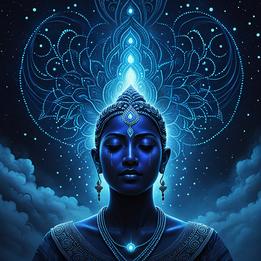
A sacred point or dot representing the origin of creation, consciousness, and the universe in Hindu and Buddhist traditions.
Bindu Dream Meaning
A sacred point or dot representing the origin of creation, consciousness, and the universe in Hindu and Buddhist traditions.
Interpretive Themes
Mythological Resonance
Shiva Bindu
HinduThe point of absolute consciousness from which Shiva's cosmic dance emerges, containing all potentiality before manifestation, worshipped as the source of creation.
Sri Yantra
TantricThe sacred geometric diagram whose central bindu represents the union of Shiva and Shakti, the point of ultimate reality from which the entire cosmos unfolds in precise mathematical progression.
Cultural Lenses
South Asian Perspective
View Context →In Hinduism and Buddhism, Bindu is the metaphysical point from which the universe emanates, representing Shiva-Shakti union, the third eye in Tantra, and the seed of all mantras and yantras in ritual practice.
Jungian Perspective
View Context →Represents the Self archetype—the central organizing principle of the psyche. The point where consciousness and unconscious meet, symbolizing individuation and the integrated personality in analytical psychology.
Freudian Perspective
View Context →Could symbolize the phallus or a fixation on a primal object. May represent regression to the womb or a condensation of psychic energy focused on a single point of desire or anxiety.
Gestalt Perspective
View Context →The focal point of awareness in the here-and-now. Represents how the mind organizes perception around a central figure against a ground, emphasizing present-moment attention and phenomenological experience.
Cognitive Perspective
View Context →A cognitive schema representing singularity or origin. May reflect mental processes of abstraction, focusing attention, or conceptualizing beginnings in problem-solving and memory organization.
Evolutionary Perspective
View Context →May tap into innate human fascination with points as sources (sun, fire) or targets. Could represent adaptive attention mechanisms for identifying central objects in visual fields or conceptualizing origins.
Modern Western Perspective
View Context →Often appears in New Age spirituality as a symbol of singularity consciousness, used in meditation apps and mindfulness practices to represent focus and the present moment in contemporary wellness culture.
East Asian Perspective
View Context →In Taoism, resembles the Wuji (無極) state—the undifferentiated void before Yin-Yang separation. In Zen, represents the one-pointed mind in meditation and the essence before form manifests.
Middle Eastern Perspective
View Context →In Islamic mysticism (Sufism), parallels the Nuqta (نقطة)—the divine point from which creation unfolds, representing Allah's first command 'Be!' and the essence of existence in mystical poetry and art.
Global/Universal Perspective
View Context →A cross-cultural symbol of origin found in creation myths worldwide—the cosmic egg, the world navel, the primordial dot in art. Represents humanity's universal quest to understand beginnings.
European Perspective
View Context →In Western esotericism (Kabbalah, Alchemy), represents the Monad—the indivisible unity from which all emanates. In Renaissance art, the vanishing point in perspective symbolizes divine infinity and human perception limits.
African Perspective
View Context →In some African cosmologies, resembles the primordial seed or egg from which the world hatched. In ritual contexts, may represent the center point in circular dances or the focus of communal energy.
Historical Authorities
Want a deeper analysis?
Get a personalized interpretation of your entire dream including this symbol.
Interpret My DreamThe Oracle's Prediction
Combine multiple symbolsA realization of fundamental unity or cosmic connection.
Timeframe
Seasonal (~3 Months)
Intensity
Deep
Common Appearances & Contexts
| Context | Emotion | Interpretation |
|---|---|---|
| Context Meditation or prayer | Emotion Peaceful | Interpretation Spiritual connection deepening. |
| Context Seeing a dot | Emotion Curious | Interpretation Seeking life's origin. |
| Context Point expanding | Emotion Awe | Interpretation Creative potential unfolding. |
| Context Center of mandala | Emotion Centered | Interpretation Finding inner balance. |
| Context Vanishing point | Emotion Mystified | Interpretation Mystery of existence. |
| Context Dot on forehead | Emotion Reverent | Interpretation Third eye awakening. |
| Context Shrinking to point | Emotion Focused | Interpretation Concentration intensifying. |
| Context Point in darkness | Emotion Hopeful | Interpretation Light in obscurity. |
| Context Multiple points merging | Emotion Unified | Interpretation Integration of aspects. |
| Context Point pulsating | Emotion Energized | Interpretation Life force active. |
| Context Guided to point | Emotion Guided | Interpretation Divine direction present. |
| Context Point dissolving | Emotion Transcendent | Interpretation Ego dissolution occurring. |
Interpret Your Full Dream
Beyond this symbol, every dream carries a unique story. Share your dream for a personalized AI-powered interpretation.