
Zhuangzi and the Butterfly Dream
A foundational Taoist parable where philosopher Zhuangzi awakens from a dream, uncertain whether he dreamed of being a butterfly or a butterfly now dreams of being him.
The Tale of Zhuangzi and the Butterfly Dream
The story does not begin with thunder or revelation, but with a quiet awakening in the soft light of a late afternoon. The philosopher Zhuangzi, having dozed beneath a tree, stirs. He sits up, brushes a fallen leaf from his sleeve, and for a long moment, he is utterly still. A profound perplexity has settled upon him, as delicate and disorienting as a dusting of pollen.
He remembers, with perfect clarity, being a butterfly. Not dreaming of a butterfly, but being one. He felt the lightness of its wings, a pair of sun-dappled sails catching the warm breeze. He knew the butterfly’s joy, its aimless, ecstatic fluttering from blossom to blossom. It was a consciousness unburdened by name, duty, or the weight of a human form. There was no “Zhuangzi” in that state; there was only flight, fragrance, and the unselfconscious fulfillment of a butterfly’s nature. The boundary between self and world was gossamer-thin, permeable. He was the flight, and the air that carried it.
Now, here he sits, a man named Zhuang Zhou, feeling the solid earth beneath him, the weight of his bones. Yet the memory is not a memory of something other; it is a residue of a lived experience. The certainty of his human identity wavers. A chill of existential wonder passes through him, not of fear, but of profound, unsettling openness.
Which is the real state? Is Zhuang Zhou a man who has just now awakened from a dream of being a butterfly? Or is he, right now, the dream of a butterfly somewhere, a butterfly nestled on a peony, dreaming with all its insect heart that it is a man named Zhuangzi? The categories of “dreamer” and “dreamed,” “real” and “illusion,” dissolve into a playful, infinite regression. He has stumbled upon the hinge between worlds, and found it to be not a door, but a shimmering, oscillating mirror. The question he poses is not meant to be answered, but to be inhabited—a space in which the very ground of identity and reality becomes fluid.
Cultural Origins & Context
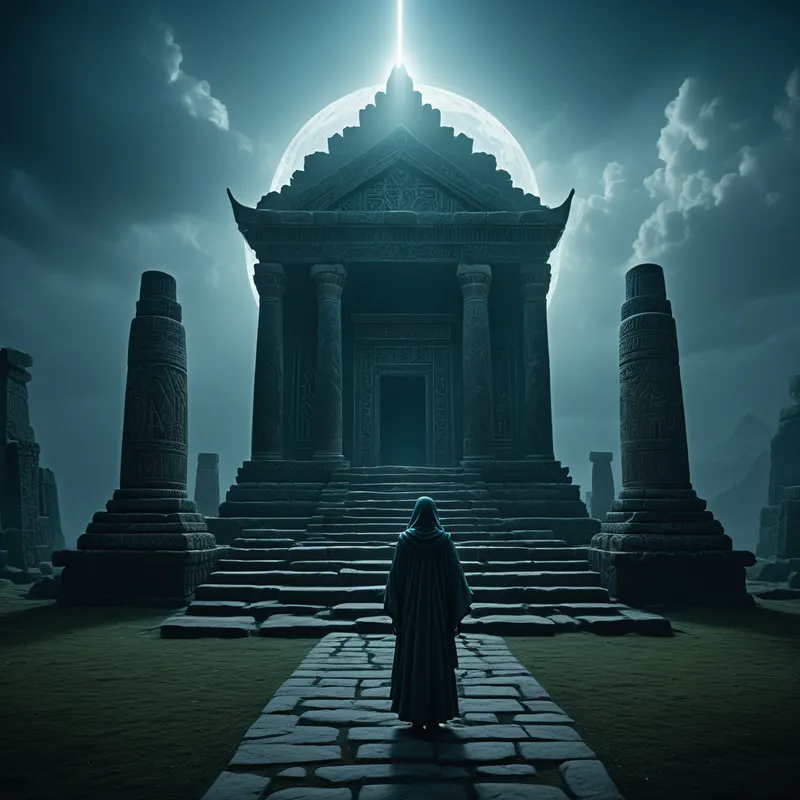
This parable is found in the second chapter, “The Sorting Which Evens Things Out” (Qí Wù Lùn), of the foundational Taoist text, the Zhuangzi (c. 4th century BCE). The text is a masterpiece of philosophical literature, attributed to the sage Zhuang Zhou and his disciples. It emerges from the Warring States period, a time of immense social chaos, rigid hierarchies, and fierce philosophical debate about how to live and govern.
Against the backdrop of Confucian rituals and Mohist utilitarianism, the Zhuangzi offers a radical, liberating vision. It champions spontaneity (zìrán), effortless action (wúwéi), and a perspective that transcends the rigid, human-made distinctions that cause suffering and conflict. The Butterfly Dream is not an isolated anecdote; it is the crystallized essence of this worldview. It directly challenges the Confucian ideal of a fixed, socially-defined self. If one cannot definitively know whether one is a man or a butterfly, how can one be bound by the titles of “minister,” “father,” or “sage”? The dream undermines the very platform from which we declare what is “right” or “real,” inviting a return to a more primordial, flowing state of awareness—the Dao.
Symbolic Architecture
The myth’s power lies in its sublime simplicity, built from three core elements: the Dreamer, the Butterfly, and the Dream itself.
The Dreamer (Zhuangzi) represents the constructed, cognitive self—the identity formed by memory, language, and social role. He is the principle of questioning awareness. The Butterfly is the symbol of the transformed, unselfconscious soul. In Taoist and broader Chinese symbolism, the butterfly (húdié) often represents immortality, the soul, and joyous freedom. Its metamorphosis from caterpillar to winged beauty mirrors the spiritual transformation from earthly attachment to weightless liberation. It acts without deliberation, perfectly aligned with the Dao.
The Dream is the liminal space, the medium of transformation. It is not merely a nocturnal fantasy but the very fabric of provisional reality. The dream state is granted equal ontological weight to the waking state; both are presented as types of experience, one no more inherently “real” than the other.
The dream is the great equalizer of experiences, rendering the solidity of the human world and the weightlessness of the butterfly’s flight equally vivid, equally true to the consciousness experiencing them.
This creates a profound ontological ambiguity. The parable performs an alchemical operation on perception: it does not ask us to choose between realities, but to hold the tension of their coexistence. This is the “hidden tension” mentioned in the description—not a conflict, but a vibrating, creative paradox that shatters conventional understanding.
The Dreamer's Resonance
Psychologically, the Butterfly Dream maps onto the fundamental human experience of ego-dissolution and the questioning of perceptual certainty. We have all had moments where a powerful dream lingers, coloring our waking hours with its emotional texture, making the so-called real world seem momentarily thin or strange. Zhuangzi elevates this common experience to a philosophical and spiritual principle.
The dream resonates with the Jungian concept of the psyche’s natural movement toward wholeness, which often involves the relativization of the ego. The ego, like Zhuangzi the man, believes itself to be the central, real actor. The dream introduces the butterfly—a symbol of the Self (the total, integrated psyche) or perhaps the anima (the inner life force)—which lives by a different, more instinctual and joyful logic. The awakening is not a return to “normal,” but an irreversible expansion of perspective. The ego is not destroyed; it is simply no longer the sole arbiter of reality. This can induce a healthy aporia—a state of fertile puzzlement that is the beginning of wisdom.
In modern terms, it prefigures questions about the nature of consciousness and simulated reality. Are we biological beings dreaming of digital avatars, or are we code in a vast simulation dreaming of flesh and bone? Zhuangzi’s parable provides the ancient, poetic framework for this very contemporary anxiety and wonder.

Alchemical Translation
The alchemical process here is one of solve et coagula—dissolve and reconstitute. The fixed identity of “Zhuangzi” is dissolved in the solvent of the dream. It is liquefied, merged with the essence of “butterfly.” Upon awakening, it is not simply reconstituted as before. The new compound contains the memory of the butterfly’s freedom; the self has been irrevocably alloyed with otherness.
Enlightenment, in this Taoist sense, is not the acquisition of sacred knowledge, but the sustained ability to dwell in this question—to wear one’s identity lightly, like a garment that can be changed, knowing the wearer beneath is neither the garment nor the butterfly’s wing, but the capacity for transformation itself.
This is the practice of “free and easy wandering” (xiāoyáo yóu) that Zhuangzi espouses. To be enlightened is to be capable of this fluid shifting of perspectives, to not cling to any one state as ultimately “true.” It is to become a conscious participant in the dream-like, ever-transforming process of the Dao. The anxiety of “Who am I really?” is transmuted into the liberation of “I am the space in which both man and butterfly can appear.”
Associated Symbols
Explore related symbols from the CaleaDream lexicon:
- Butterfly — The soul in flight, symbolizing joyous transformation, weightless freedom, and the unselfconscious life aligned with the Dao.
- Dream — The liminal, non-ordinary state of consciousness that challenges the hegemony of waking reality and serves as a medium for profound transformation.
- Mirror — Reflects reality without attachment or distortion, representing the mind of the sage that holds all images (man, butterfly) without claiming any as the true self.
- Transformation — The fundamental process of change and metamorphosis, from caterpillar to butterfly, from fixed identity to fluid awareness.
- Reality — The provisional and shifting ground of experience, presented not as a single objective truth but as a spectrum of vivid, conscious states.
- Identity — The constructed and ultimately fluid sense of self, which can be worn lightly and exchanged in the great play of existence.
- Door — The threshold between states of being (waking/dreaming, human/animal), a portal that opens both ways and questions the direction of passage.
- Water — The Taoist ideal of effortless action and adaptability, flowing into any form without losing its essential nature, much like consciousness in the dream.
- Mountain — The seemingly solid, immutable perspective of the ordinary ego, which the dream reveals to be just one vantage point in a vast landscape.
- Sky — The boundless, open awareness that contains both the man’s thoughts and the butterfly’s flight, the context in which all identities arise and pass.