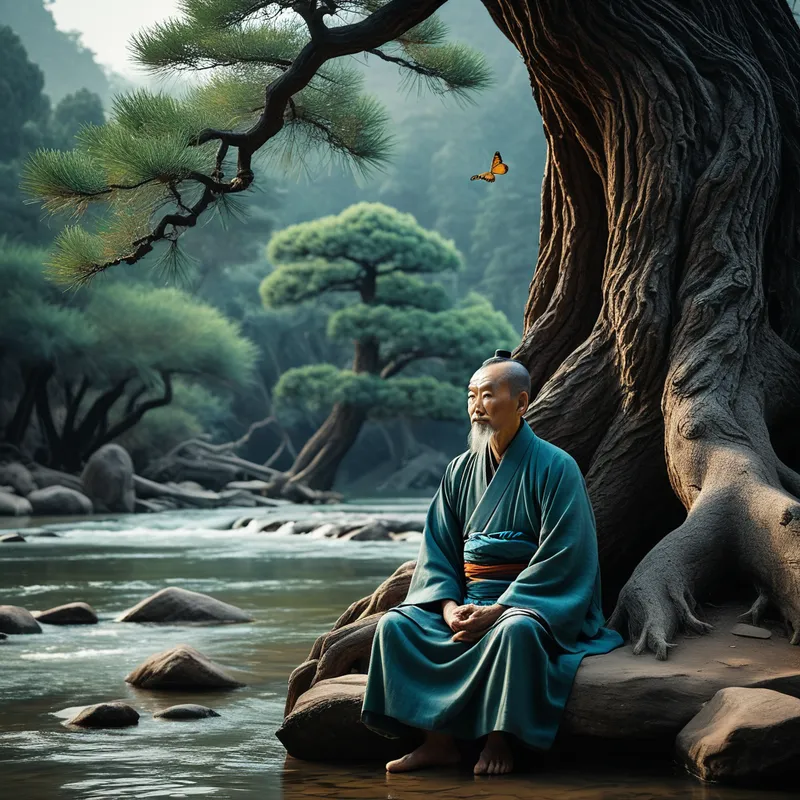
Zhuangzi Myth Meaning & Symbolism
A philosopher dreams he is a butterfly, awakening to question the very nature of reality, self, and the freedom found in non-attachment.
The Tale of Zhuangzi
In the fading light of the Warring States, when the world was sharpened by ambition and clattered with the sound of swords being forged, there lived a man who tended a tiny garden of quietude. His name was Zhuangzi. He did not seek the courts of kings, where advisors spoke in rigid certainties. He preferred the company of the crooked tree, deemed useless by the carpenter, and the muddy banks where turtles dragged their slow, deliberate shells.
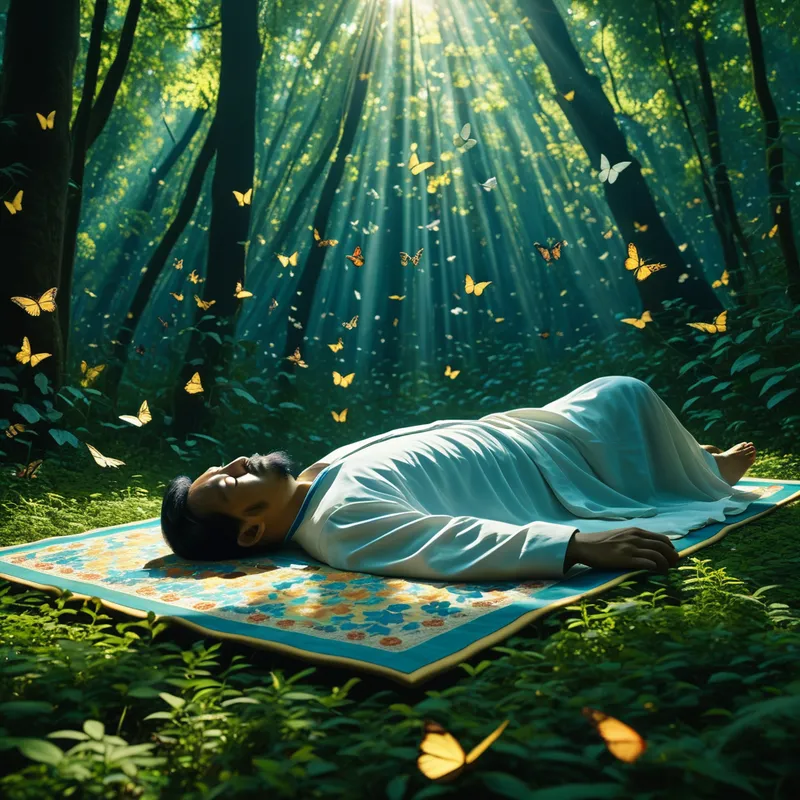
One afternoon, heavy with the scent of blooming wisteria and the drone of cicadas, Zhuangzi laid his weary bones beneath the generous shade of an old tree. The river’s murmur was a lullaby. His breath grew deep, his thoughts untethered, and the boundary between his skin and the warm earth began to soften, then dissolve.
He was no longer a man.
He was a butterfly—a creature of weightless, joyous impulse. He knew the specific delight of sunbeams filtering through maple leaves, the taste of nectar from a purple flower, the effortless dance on a breeze that asked no questions. There was no memory of being a man named Zhuangzi, with his burdens and his philosophies. There was only this: the fluttering certainty of being a butterfly, complete and unselfconscious, moving through a world of pure sensation and flight.
Then, a shift—a gentle pulling back. The sunlight dimmed, the petals hardened into wood, the breeze settled. He awoke. He was Zhuangzi again, lying on his mat, the impressions of the dream vivid as paint on silk.
But a profound unease settled in his chest, a crack in the foundation of knowing. He sat up, the weight of his body strange and solid. He looked at his own hands, then at a real butterfly dancing outside his window.
“Now,” he whispered to the empty air, his voice full of wonder and dread, “I do not know whether I was then a man dreaming I was a butterfly, or whether I am now a butterfly, dreaming I am a man.”
The question hung in the humid air, not seeking an answer, but dissolving the very ground upon which answers are built. From that day, he walked through the world with a different step, seeing the carpenter’s “useless” tree as a palace of shade, and the king’s chariot as a cage of polished worry.
Cultural Origins & Context
The figure of Zhuangzi emerges from the fertile chaos of the Warring States period (c. 475–221 BCE), a time of brutal political fragmentation and intense philosophical debate known as the Hundred Schools of Thought. Unlike the rigid rituals of Confucianism or the utilitarian doctrines of Legalism, the text attributed to Zhuangzi represents the playful, mystical, and deeply skeptical wing of Daoism.
The book, a collection of anecdotes, parables, and dialogues, was likely compiled by his disciples and later scholars. It was not a scripture for state worship, but a manual for personal liberation, passed down among hermits, artists, and free thinkers. Its societal function was profoundly counter-cultural: to question the very foundations of conventional knowledge, social ambition, and even the fixed sense of self, offering instead a vision of freedom found in spontaneous alignment with the Dao. It served as an antidote to the anxiety of the age, teaching how to “wander beyond the dust and grime” of worldly affairs.
Symbolic Architecture
At its core, the butterfly dream is not a puzzle to be solved, but a symbol of the psyche’s fundamental fluidity. The butterfly represents the soul unbound—transformative, beautiful, and transient. The man, Zhuangzi, represents the conscious ego, the constructed identity rooted in history, name, and social role.
The dream reveals that consciousness is not a fixed point, but a relationship between states of being.
The myth dismantles the tyranny of a single, monolithic “I.” It posits that what we call the self is a temporary constellation of perceptions, no more ultimately real than the vivid reality of a dream. The true self, in Zhuangzi’s philosophy, is the Zìrán (自然), the “self-so,” the spontaneous process of existence that flows through both man and butterfly. The anxiety of not knowing which is the dream is, paradoxically, the gateway to a greater knowing: the realization of our participation in a vast, metamorphic process.
The conflict is not external, but internal—the ego’s shock at discovering its own provisional nature. The resolution is the enduring, awe-filled question itself, which becomes a practice of non-attachment, allowing one to hold identity lightly and move with the transformations of life.
The Dreamer's Resonance
When this myth stirs in the modern unconscious, it often manifests not as a literal dream of butterflies, but as dreams of profound disorientation or fluid identity. One might dream of looking in a mirror to see a stranger’s face, or of being in one’s childhood home that is simultaneously a futuristic spaceship. The somatic sensation is often one of vertigo, weightlessness, or a dissolving boundary.
Psychologically, this signals a crucial process: the de-integration of a worn-out ego structure. The conscious personality, perhaps overly identified with a job title, a social role, or a fixed story about oneself, is beginning to soften. The psyche is offering a taste of its own boundless, shape-shifting nature. It is a frightening but necessary initiation, a call to release the tight grip on “who I am” and entertain the terrifying, liberating possibility that the self is far vaster and more mysterious than the daily persona allows.
Alchemical Translation
The alchemical work modeled by Zhuangzi’s dream is the transmutation of certainty into wonder, and of fixed identity into fluid participation. The modern individual, often trapped in the rigid opus of curating a perfect self-image online or adhering to a linear life script, is invited into a more profound operation.
The first stage (nigredo) is the confusion, the “not knowing.” This is the necessary darkening, the dissolution of the old, rigid ego. The second stage (albedo) is the illumination of the question itself—the pure, reflective state of awareness that can hold both possibilities (man and butterfly) without collapsing into one. The final gold (rubedo) is not an answer, but a way of being: the achievement of Xiāoyáo yóu (逍遙遊).
The individuated self is not a more solid statue, but a more skilled dancer in the metamorphic currents of the Dao.
This is the alchemical translation: to stop trying to be only the “man” (the responsible, defined ego) or only the “butterfly” (the escaped, irresponsible fantasy). The goal is to become the dreaming itself—the conscious vessel that can contain and appreciate the endless transformations of life and psyche, navigating the world with a heart both grounded and free, forever wandering between the real and the imagined, knowing both are true.
Associated Symbols
Explore related symbols from the CaleaDream lexicon: