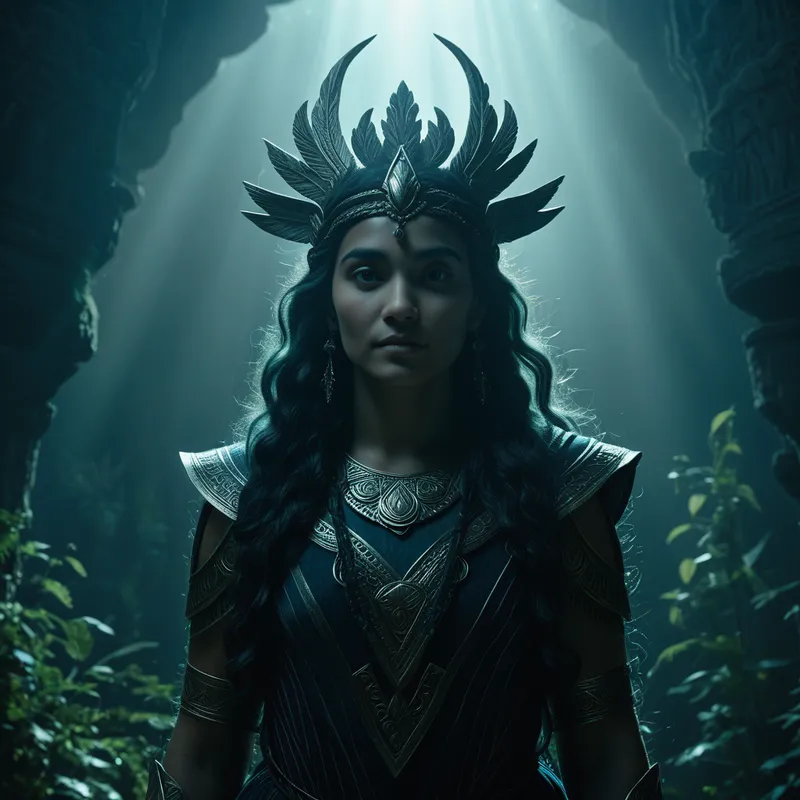
Zhong Kui Demon Slayer
A failed scholar who became a ghost, Zhong Kui now hunts demons as Taoism's ultimate protector against malevolent spirits.
The Tale of Zhong Kui Demon Slayer
The tale begins not in the celestial courts, but in the dusty examination halls of the mortal world. [Zhong Kui](/myths/zhong-kui “Myth from Chinese culture.”/) was a scholar of profound learning and fierce ugliness, his face a landscape of wrathful brows and a bristling beard, a visage that belied a heart devoted to classical virtue. He traveled to the imperial capital to sit for the jinshi examinations, the pinnacle of a scholar’s ambition. His literary prowess was unmatched, and he triumphed, earning the coveted title of zhuangyuan, the top candidate.
But in the glittering court of Emperor Xuanzong of Tang, his victory turned to ash. When the emperor beheld the champion’s fearsome countenance, he recoiled in horror and disgust. The title was revoked, not for lack of merit, but for lack of beauty. The cosmic order of meritocracy was shattered by a moment of human revulsion. Cast out from the dream he had sacrificed everything to attain, a wave of black despair consumed Zhong Kui. In a final, furious act of protest against [the world](/myths/the-world “Myth from Tarot culture.”/)’s injustice, he took his own life, dashing his head against the palace steps.
His spirit, however, refused the quiet dissolution of the grave. Burning with a scholar’s unresolved grievance and a righteous man’s fury, he descended into [the underworld](/myths/the-underworld “Myth from Greek culture.”/). Yet, even there, his integrity shone. The Yama Kings, judges of the dead, recognized not a malevolent ghost, but a soul of unyielding principle and potent energy. They anointed him, granting him formal authority and a retinue of demonic minions. He was reborn not as a victim, but as a king—the King of Ghosts, tasked with a singular, cosmic purpose: to police the realms of spirits and men, hunting the malevolent and protecting the innocent.
His legend crystallized in a famous dream of the very emperor who had spurned him. Plagued by a fever and haunted by a mischievous demon, Emperor Xuanzong fell into a troubled sleep. From the shadows of the royal bedchamber, the small demon stole the emperor’s flute and his beloved consort’s embroidered perfume pouch. The emperor was helpless. Then, a colossal figure erupted into the dream. It was Zhong Kui, now magnified to a titanic scale, wearing a tattered scholar’s cap and robes, his face a mask of divine wrath. With swift, terrible finality, he seized the little demon, gouged out its eye, and devoured it. Upon waking, the emperor’s fever had broken. He summoned the court painter [Wu Daozi](/myths/wu-daozi “Myth from Chinese culture.”/) and described the savior in vivid detail. The resulting portrait, hung in the palace, fixed Zhong Kui’s image for eternity: the ultimate outsider, now the ultimate protector, a divine paradox made flesh in ink and legend.
Cultural Origins & Context
Zhong Kui’s myth is a distinctly Taoist resolution to a deeply Confucian anxiety. He emerges from the heart of Tang Dynasty China, a period of immense cultural flourishing where the state-sponsored path of the scholar-official was the paramount avenue to social order and personal honor. The imperial examination system was a meritocratic ideal, but it was also a brutal psychological gauntlet, creating a vast class of educated men whose identities and fates hinged on the capricious judgment of examiners and emperors. Zhong Kui is the ultimate “failed scholar,” but his failure is not of mind, but of form. His myth gives voice to the collective resentment and fear of all those betrayed by the system meant to reward virtue.
Taoism, with its vast [pantheon](/myths/pantheon “Myth from Roman culture.”/) of functional deities and its pragmatic magic for managing the spirit world, provided the perfect vessel for this cultural wound. It offered a parallel cosmology where true power and [justice](/myths/justice “Myth from Tarot culture.”/) were not contingent on human aesthetics or political favor. Zhong Kui was absorbed into Taoist ritual practice as a marshal, a divine enforcer. His image became a central tool of folk exorcism. During the [Dragon Boat Festival](/myths/dragon-boat-festival “Myth from Chinese culture.”/), a time associated with potent yang energy and the dispelling of poisonous influences, his portrait was pasted on household gates to bar entry to pestilence and evil spirits. He transcended tragedy to become a vital, working part of the spiritual ecosystem—a bureaucrat of the numinous, correcting the imbalances that the human bureaucracy could not.
Symbolic Architecture
Zhong Kui’s entire being is a [constellation](/symbols/constellation “Symbol: Represents guidance, destiny, and the navigation through life, symbolizing the connections between experiences and paths.”/) of profound psychological and spiritual symbols. He is the ultimate [integration](/symbols/integration “Symbol: The process of unifying disparate parts of the self or experience into a cohesive whole, often representing psychological wholeness or resolution of internal conflict.”/) of opposites, a walking alchemical formula.
He is the Wound that becomes the Talisman. His rejection and suicide are not erased but are the very source of his authority; the scar becomes the seal of office. His rage is not purified away but is harnessed as the fuel for a righteous crusade.
He embodies Poetic Justice on a cosmic scale. The emperor who denied him recognition in life must, in a moment of vulnerability, summon his image for salvation. The judge becomes the judged, and the outcast becomes the indispensable guardian of the very order that cast him out.
His physical form is a sacred text. The tattered scholar’s [robes](/symbols/robes “Symbol: Robes symbolize social roles, authority, and spiritual or professional identity, often representing the persona one presents to the world.”/) signify his eternal [connection](/symbols/connection “Symbol: Connection symbolizes relationships, communication, and bonds among individuals.”/) to the [path](/symbols/path “Symbol: The ‘path’ symbolizes a journey, choices, and the direction one’s life is taking, often representing individual growth and exploration.”/) he was denied, a [uniform](/symbols/uniform “Symbol: A uniform often signifies authority, conformity, or a role within a group, reflecting one’s identity and societal expectations.”/) he will not discard. The furious [brow](/symbols/brow “Symbol: The brow represents thought, expression, and perception. It is the seat of intellect and emotional display.”/) and piercing eyes are not mere ugliness, but the “awful face” of divine law, a visage meant to terrify disorder back into order. He is often depicted subduing mischievous or malevolent minor demons, not by annihilating them, but by commanding them. They become part of his retinue, illustrating a core Taoist principle: that [chaos](/symbols/chaos “Symbol: In Arts & Music, chaos represents raw creative potential, uncontrolled expression, and the breakdown of order to forge new artistic forms.”/) and dark [energy](/symbols/energy “Symbol: Energy symbolizes vitality, motivation, and the drive that fuels actions and ambitions.”/) cannot be simply destroyed, only recognized, mastered, and integrated into a greater [harmony](/symbols/harmony “Symbol: A state of balance, agreement, and pleasing combination of elements, often associated with musical consonance and visual or social unity.”/).
The Dreamer’s Resonance
To encounter Zhong Kui in the inner landscape is to confront the archetype of the Shadow made heroic. He represents those parts of [the self](/myths/the-self “Myth from Jungian culture.”/) deemed too ugly, too angry, too passionate, or too wounded to be accepted by the conscious ego—the “imperial court” of the personality. His myth tells the dreamer that these rejected aspects do not simply vanish. Like Zhong Kui’s ghost, they gather power in the darkness, often manifesting as self-sabotage, depression, or inexplicable rage.
His redemption path offers a profound blueprint for psychological integration. It does not involve prettifying [the shadow](/myths/the-shadow “Myth from Jungian culture.”/) or sanitizing its pain. Instead, it involves a radical acknowledgment: This, too, has power. This, too, serves a purpose. The suicidal despair is alchemized into a fierce will to protect. The sense of cosmic injustice becomes an unwavering compass for justice. The individual’s personal grievance is transformed into a transpersonal mandate to guard against the “demons” of meaninglessness, despair, and cruelty, both within and without. He is the patron saint of those who have been profoundly wronged by life’s structures, showing that the path forward is not through forgetting the wound, but through weaponizing its lessons in service of a greater whole.
Alchemical Translation
The process of Zhong Kui’s transformation is a perfect map of the Taoist alchemical journey, the neidan or internal alchemy aimed at forging [the immortal](/myths/the-immortal “Myth from Taoist culture.”/) spirit. His life represents the initial stages of refinement and catastrophic failure.
The Lead of his base existence—his scholarly ambition and mortal form—is subjected to the Fire of ultimate humiliation and destruction in the calcination of his suicide. This is the necessary nigredo, the blackening, the death of the old identity.
His sojourn in the [underworld](/myths/underworld “Myth from Greek culture.”/) is the [albedo](/myths/albedo “Myth from Alchemical culture.”/), the whitening. Here, in the reflective silence of the grave, the pure essence of his character—his integrity and sense of justice—is separated from the dross of his worldly failure. It is recognized and validated by a higher authority (the Yama Kings). Finally, his return as the King of Ghosts is the [rubedo](/myths/rubedo “Myth from Alchemical culture.”/), the reddening. The purified essence is infused with divine authority and purpose, returning to the world not as a man, but as a dynamic, functioning principle of order. He becomes a living Taoist [Talisman](/myths/talisman “Myth from Global culture.”/), a concentrated glyph of power whose very image conducts spiritual authority. His story teaches that true spiritual power is often forged in the kiln of profound personal catastrophe, and that the redeemed self is not a return to innocence, but a hard-won embodiment of complex, sovereign power.
Associated Symbols
Explore related symbols from the CaleaDream lexicon:
- Demon — The embodiment of [chaos](/myths/chaos “Myth from Greek culture.”/), malevolence, or untamed psychic energy that Zhong Kui is destined to confront, command, and integrate, representing the shadow contents of both the world and the self.
- Justice — The driving principle of Zhong Kui’s posthumous existence, a cosmic rectification that operates beyond and in spite of flawed human systems of judgment.
- Redemption — The transformative arc from victimhood to sovereignty, where personal failure and suffering are not the end but the raw material for a higher purpose.
- Mask — Zhong Kui’s fearsome face is his true face, yet it also functions as a ritual mask, a sacred visage meant to perform a specific spiritual function of awe and protection.
- Wound — The foundational trauma of rejection and suicide that is not healed in a conventional sense, but which becomes the source of his unique power and identity.
- Poetic Justice — The narrative principle embodied in his return to save the emperor, where fate delivers a fitting and ironic resolution that restores moral balance.
- Taoist Talisman — Zhong Kui himself becomes a living, powerful sigil, and his image is used as a physical talisman to ward off evil, representing the concretization of spiritual intent.
- Shadow — The totality of [the personal unconscious](/myths/the-personal-unconscious “Myth from Jungian Psychology culture.”/), including all traits, desires, and memories deemed unacceptable by the conscious ego, which Zhong Kui represents in its heroic, integrated form.
- Rage — The potent, fiery emotion born of injustice, which in his myth is not extinguished but alchemized into the focused, righteous fury of the protector.
- Door — The household gate upon which his image is pasted, symbolizing [the threshold](/myths/the-threshold “Myth from Folklore culture.”/) between safety and danger, order and chaos, which he is appointed to guard.
- Hero — An archetypal figure who ventures beyond the conventional boundaries of the known world to confront great darkness, often at great personal cost, for the benefit of the community.