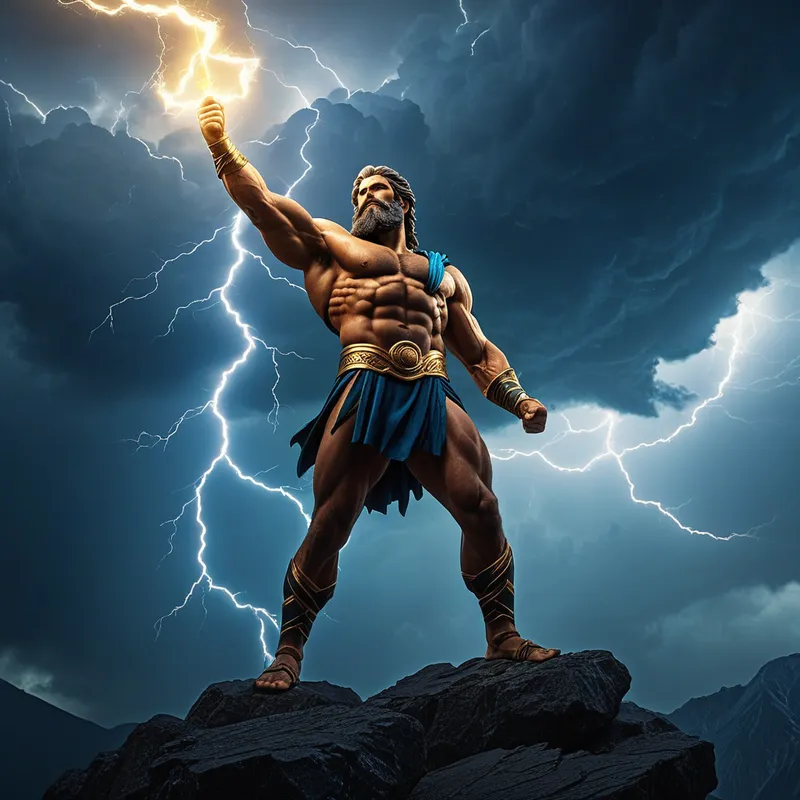
Zeus's Lightning Bolt Myth Meaning & Symbolism
The supreme weapon of the king of the gods, forged by the Cyclopes, representing ultimate authority, terrifying power, and the raw force of consciousness.
The Tale of Zeus's Lightning Bolt
Before there was order, there was chaos. Before there was a king, there was a titan. In the beginning, the cosmos groaned under the cruel, immutable reign of Kronos, who devoured his own children to preserve his power. But one child was saved: Zeus. He grew in secret, fed by the earth and the stars, until his strength was a tempest held in check. When the time came, he confronted his father, and with a mighty heave, forced Kronos to disgorge his swallowed brothers and sisters—Hestia, Demeter, Hades, Poseidon, and Hera. The war that followed shook the foundations of the world. The Titans clashed with the new gods, and for ten years, the universe was a battlefield of elemental fury.
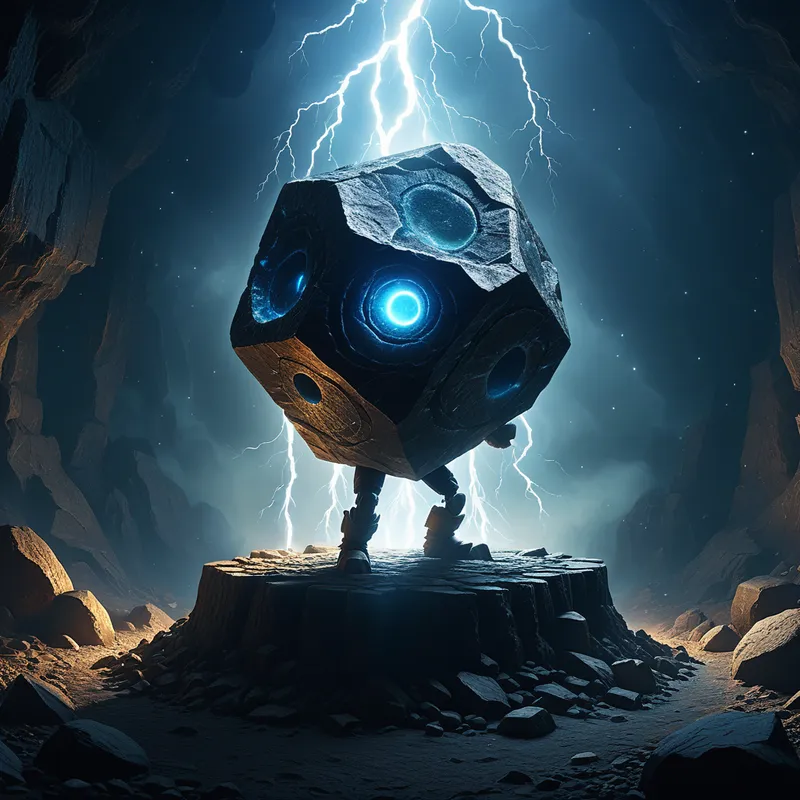
Zeus knew raw strength was not enough. He needed a weapon to match his will, a tool to carve destiny from the formless strife. On the advice of Gaia, he journeyed to the deepest, darkest pit of the earth, to the Tartarean forge. There, in a cavern lit only by the glow of molten star-metal, labored the Cyclopes—Brontes, Steropes, and Arges. Imprisoned by Kronos, they were masters of the primal craft. With hammers that rang like celestial bells, they worked their art not for beauty, but for absolute function. They took the essence of the coming storm, the promise of the first flash that splits the sky, and forged it into a single, perfect form.
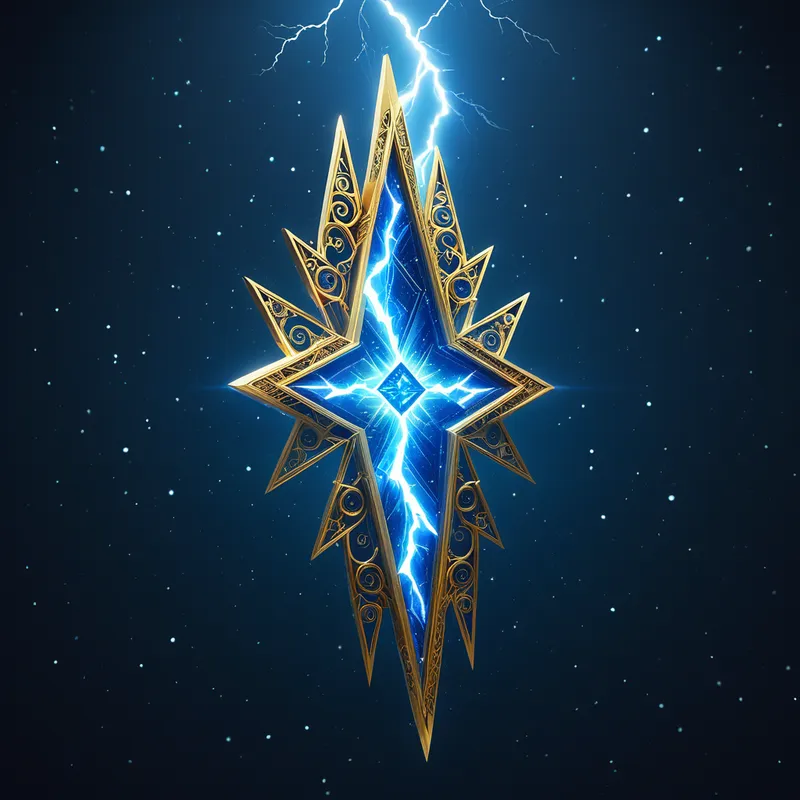
What they placed in Zeus’s hand was not merely a weapon. It was a jagged shard of pure potential, a fracture in reality made solid. It hummed with a sound below hearing, and its light was the blue-white of a newborn star. With this bolt in his grip, Zeus returned to the fray. The final battle was not a contest; it was a declaration. He raised the bolt, and the very air screamed in anticipation. When he cast it, the world witnessed its first true act of sovereignty. The lightning did not just strike; it judged. It cleaved mountains, boiled seas, and with a cataclysmic roar, hurled the Titans down into Tartarus. The chaos ended. From the silence that followed, punctuated only by the distant rumble of settling power, a new order was born. The bolt remained, forever in Zeus’s hand or at his side, the immutable symbol that the sky itself had a king, and his word was final, instantaneous, and absolute.
Cultural Origins & Context
This foundational myth was not a singular story but the bedrock of the Greek cosmological and political imagination. It was propagated through the epic poetry of Homer and the Theogony of Hesiod, performed at festivals and in royal courts. Its function was multifaceted. For the emerging city-state (polis), it provided a divine model for kingship and authority. Just as Zeus established kosmos (order) over chaos through his decisive power, so too must the human ruler wield authority to maintain social order. The lightning bolt was the ultimate argument, justifying the sometimes terrifying and arbitrary exercise of power as a necessary, divine principle.
Furthermore, the myth explained the natural world. Every thunderclap was the sound of Zeus’s chariot; every lightning strike was a literal manifestation of his will—a warning, a punishment, or a display of terrible majesty. It rooted the terrifying and awe-inspiring phenomenon of storms within a comprehensible narrative of divine personality. The myth also served a societal function by illustrating the proper order of things: craft (the Cyclopes) in service to wise sovereignty (Zeus), brute force (the Titans) overthrown by sanctioned, strategic power. It was a story that told its listeners who they were in the cosmic scheme: beings living under a sky ruled by a capricious but ultimately ordering intelligence.
Symbolic Architecture
The lightning bolt of Zeus is one of mythology’s most potent condensations of symbolic meaning. It is not a simple tool but an extension of the god’s very essence.
The lightning bolt is the instantaneous manifestation of will, the moment pure intention bridges the gap between the psychic realm and the material world, leaving a scar of reality in its wake.
First, it is the symbol of sovereign authority. It is the scepter of the sky-king, the final argument that establishes and enforces law. It represents the terrifying responsibility of the one who holds the power to make ultimate decisions. Psychologically, this maps to the ego’s necessary function as the executive of consciousness, tasked with making choices and imposing order on the inner chaos of impulses and drives.
Second, it embodies creative-destructive power. The bolt that defeats the Titans is the same force that can fertilize the earth (through storms) or incinerate a mortal. It is the archetypal coincidentia oppositorum—the union of opposites. It contains both the flash of illuminating insight and the blast of annihilating rage. In the human psyche, this represents the raw, undifferentiated libido or psychic energy itself, which can be channeled into artistic creation, intellectual breakthroughs, or violent outbursts.
Finally, it signifies sudden, transformative revelation. Lightning illuminates a dark landscape for a split second, revealing what was hidden. As the weapon forged in darkness and wielded in light, it symbolizes the traumatic yet necessary moments of truth that shatter old structures of the self, making way for new consciousness.
The Dreamer's Resonance
When the symbol of Zeus’s lightning bolt fractures the landscape of a modern dream, it signals a profound psychological event. This is not a dream of gentle growth but of sudden, unavoidable confrontation.
To dream of being struck by lightning often accompanies a life crisis where a deeply held self-concept, relationship, or career path is shattered by an external event or a devastating internal realization. The somatic experience in the dream—the blinding flash, the deafening thunder, the feeling of being seared—mirrors the shock and disorientation of the waking trauma. The psyche is registering a force of truth so powerful it cannot be integrated gradually; it must be endured as a cataclysm.
Conversely, to dream of wielding the lightning bolt speaks to a moment of emerging personal authority. The dreamer may be confronting a situation where they must make a final, unilateral decision, exercise power they have been hesitant to claim, or deliver a difficult truth. There is often a mix of exhilaration and terror in such dreams, reflecting the ambivalence of stepping into one’s own sovereignty. The bolt becomes a symbol of the dreamer’s own untapped will, terrifying in its potency, demanding to be used responsibly. These dreams ask: What inner Titan (an outdated complex, a oppressive parental voice, a chronic fear) needs to be overthrown? And does the dreamer have the courage to forge and wield the weapon of their own conviction?
Alchemical Translation
The myth of Zeus’s lightning bolt provides a stark model for the alchemical process of psychic transmutation, or individuation. The journey is not one of gentle refinement but of violent confrontation and the integration of supreme power.
The initial state is the prima materia of inner chaos: the rule of the "Titanic" complexes—unconscious, archaic patterns (like Kronos’s fear-driven tyranny) that consume our potential. Liberation begins with the "freeing of the siblings"—the retrieval of other psychic functions (emotion, intuition, sensation) that have been suppressed. But this alone leads only to civil war within the psyche.
The alchemical forge is not a gentle hearth but the pressurized crucible of necessity, where the raw ores of pain, conflict, and potential are hammered into a weapon of consciousness.
The crucial, transformative act is the descent to the Cyclopean forge. This is the engagement with the deepest, most instinctual and creative layers of the unconscious (the Cyclopes). Here, in the dark, the raw materials of one’s nature—one’s anger, passion, and primal energy—are consciously worked upon. The forging of the bolt is the disciplina of focusing this chaotic energy into a precise instrument of will. The individual must become both the Cyclops (the craftsman) and Zeus (the sovereign) to create and wield this power.
Finally, wielding the bolt represents the ultimate stage: the conscious assumption of authority over one’s own psyche. It is the moment the ego, aligned with the greater Self, actively chooses its destiny, cuts through paralyzing conflicts, and establishes a new inner order. The danger, as the myth shows, is inflation—believing the power is solely one’s own, rather than a forged gift from the depths. The integrated individual holds the lightning bolt not to terrorize their inner or outer world, but to illuminate it, knowing that this power to create and destroy is the sacred, terrifying responsibility of a conscious life.
Associated Symbols
Explore related symbols from the CaleaDream lexicon: