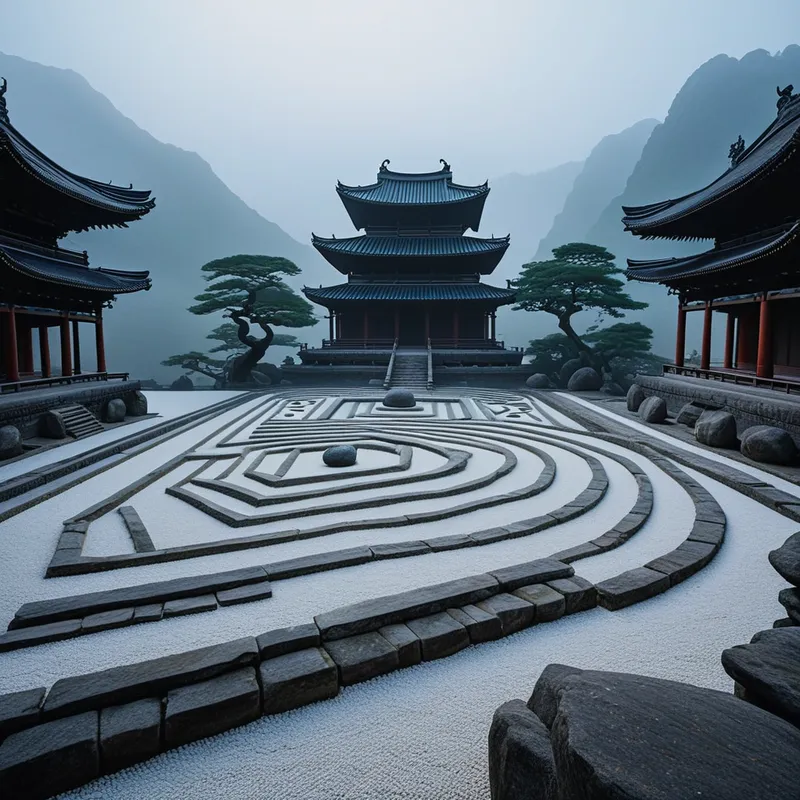
Zen Rock Garden Myth Meaning & Symbolism
A mythic tale of a monk who, through profound stillness, sculpted a landscape of the mind, turning raked gravel and stone into a gateway to enlightenment.
The Tale of Zen Rock Garden
Listen, and let the silence between the words speak.
In a time when the world was a cacophony of clashing swords and clamoring hearts, there lived a monk named Sōei. He dwelled in the temple of Ryōan-ji, a place where the very air tasted of pine and patience. Sōei was a vessel of quietude, but within him raged a silent tempest—the tempest of a mind that could not find its own shore. He saw the suffering of the world, the clinging, the wanting, the endless cycle of thought that was like gravel kicked into a clear pond.
One evening, as the last cicada fell silent, the abbot placed before Sōei a barren rectangle of earth, coarse white gravel, and fifteen rough, unyielding stones. "The garden is your mind," the abbr title="Zen Buddhist master">roshi said, his voice like wind over stone. "Find the pattern that was never made."
For days, Sōei sat in zazen, his breath becoming the wind, his heartbeat the distant temple bell. The stones were not stones to him; they were mountains, tigers, sleeping dragons, the stubborn islands of ego and attachment. The gravel was not gravel; it was the churning sea of thought, the endless waves of consciousness. He moved not a single pebble.
Then, on the seventh night, under a moon so full it seemed to bleed silver, the boundary between Sōei and the garden dissolved. He did not think; he became. His hands, guided by a will older than his own, took up the wooden rake. With a motion that was neither his nor the garden's, he drew a single line in the gravel. It was not straight, but it was true. It flowed like a river, curved like a question.
One by one, he placed the stones, not as a builder, but as a discoverer. Each one found its nest in the gravel, its relationship to the others a mystery that could be seen but never solved from any single vantage point. Around them, with infinite care, he raked the gravel into concentric waves, patterns that spoke of water flowing around immovable truth. He worked until his hands bled and the dawn broke, not as a victory, but as a revelation.
When he stepped back, he saw it. The fifteen stones, yet from any angle, only fourteen were ever visible. The garden was complete, yet perpetually unfinished. It was a map of the cosmos and a mirror of the soul. The conflict of his mind had found its resolution not in an answer, but in a perfect, breathing question made of stone and space. The garden was born, and in its birth, Sōei was unmade and remade. He had not created a garden; he had awakened one.
Cultural Origins & Context
The mythos of the kare-sansui, specifically the garden at Ryōan-ji in Kyoto, is not a myth of gods and monsters, but of human consciousness encountering the absolute. It emerged in the Muromachi period (14th-16th centuries), a time of civil war and profound social upheaval. In this chaos, Zen Buddhism offered a path inward, a fortress of the spirit that no sword could breach.
The garden’s creator is historically unattributed, purposefully so. This anonymity is central to its mythic power. It is a story passed down not through epic poems, but through silent transmission from master to disciple, from the garden itself to the seated observer. Its societal function was, and remains, pedagogical. It is a kōan in physical form, a teaching tool that bypasses intellect to speak directly to the intuitive mind. It served the samurai class as a training ground for focus and equanimity, and the monk as a focal point for kenshō.
Symbolic Architecture
The Zen Rock Garden is a mandala of the psyche, a symbolic architecture of enlightenment. Every element is a deliberate cipher.
The fifteen stones are the aggregates of existence, the islands of phenomenal reality. That one is always hidden from view symbolizes the inherent limitation of the egoic perspective; a part of the whole Self is always in shadow, always unknown. The raked white gravel represents the substrate of mind—pure, undifferentiated consciousness, or the void (śūnyatā) from which all form arises. The ripples are the transient waves of thought, emotion, and perception that play upon its surface, beautiful but ultimately insubstantial.
The enclosing clay wall, stained with age and oil, represents the bounded nature of our human experience, the vessel of the body and the conditioned mind. Its weathered beauty speaks of the dignity of this container.
The garden teaches that enlightenment is not the destruction of the rocks of the self, but the profound understanding of their placement within the vast, still sea of being.
Psychologically, the hero of this myth is not Sōei the monk, but the act of perception itself. The garden models the psyche in a state of integrated wholeness, where the conscious mind (the visible patterns) acknowledges and makes space for the unconscious (the hidden stone, the depth beneath the gravel).

The Dreamer's Resonance
When this myth appears in modern dreams, it rarely manifests as a literal garden. Instead, one may dream of geometric patterns in sand or snow that they feel compelled to create or decipher. They may dream of arranging a set of objects—stones, books, bones—in a configuration that feels cosmically significant yet frustratingly elusive. The somatic sensation is often one of profound, focused calm coupled with a deep, wordless urgency.
This dream pattern signals a psychological process of ordering a chaotic inner landscape. The dreamer is likely grappling with fragmented thoughts, unresolved emotions, or a sense of existential clutter. The psyche is attempting, through the symbolic act of raking and placing, to find the inherent pattern within the chaos, to differentiate the eternal (the stones) from the ephemeral (the gravel). It is a dream of the Self organizing itself from the inside out, a somatic experience of the mind seeking its own native stillness.

Alchemical Translation
The alchemical process modeled here is the transmutation of psychic noise into sacred geometry, of suffering into serene composition. For the modern individual, the "gravel" is the incessant internal narrative—the anxieties, regrets, plans, and fantasies. The "stones" are the core, often unconscious, complexes: the father complex, the mother complex, the persona, the shadow.
The first stage, nigredo (the blackening), is Sōei's initial turmoil, the recognition of inner chaos. The albedo (whitening) is the act of sitting in zazen, the purification of attention, the raking clear of discursive thought. The crucial stage is coniunctio (the conjunction). This is not a merging of two, but of many—the conscious placement of each "stone"-complex into a conscious relationship with the whole. One does not eliminate the stubborn rock of anger or the hidden stone of grief; one gives it its rightful, contained place in the total landscape of the self.
The ultimate gold produced is not perfection, but the capacity to hold imperfection in a state of dynamic, beautiful balance. It is the achievement of an inner wabi-sabi—the individuated Self.
The triumph is the realization that you are both the gardener and the garden. The struggle for peace is the path of peace. You rake the gravel of your thoughts not to finish, but to engage in the eternal, enlightening act of raking. The garden is never complete, and in that endless becoming lies its perfection and its profound, mythic truth.
Associated Symbols
Explore related symbols from the CaleaDream lexicon: