Zashiki-warashi Myth Meaning & Symbolism
A benevolent childlike spirit from Japanese folklore, whose presence blesses a household with fortune, but whose departure heralds its decline.
The Tale of Zashiki-warashi
Listen, and let the old wood of the house settle around you. In the deep north, where the snow silences the world and the wind speaks through the eaves of the great farmhouses, there dwells a secret. Not in the bustling hearth, nor the honored family altar, but in the quiet, shadowed corner of the best room—the zashiki.
It begins with a feeling. A chill that is not cold, a draft from no crack in the wood. You might hear it first: the soft, clear sound of a child’s laughter, echoing from an empty corridor. Or you might see the evidence—a small, damp footprint on the immaculate tatami where no child has walked, the subtle displacement of a cushion as if someone just stood up.
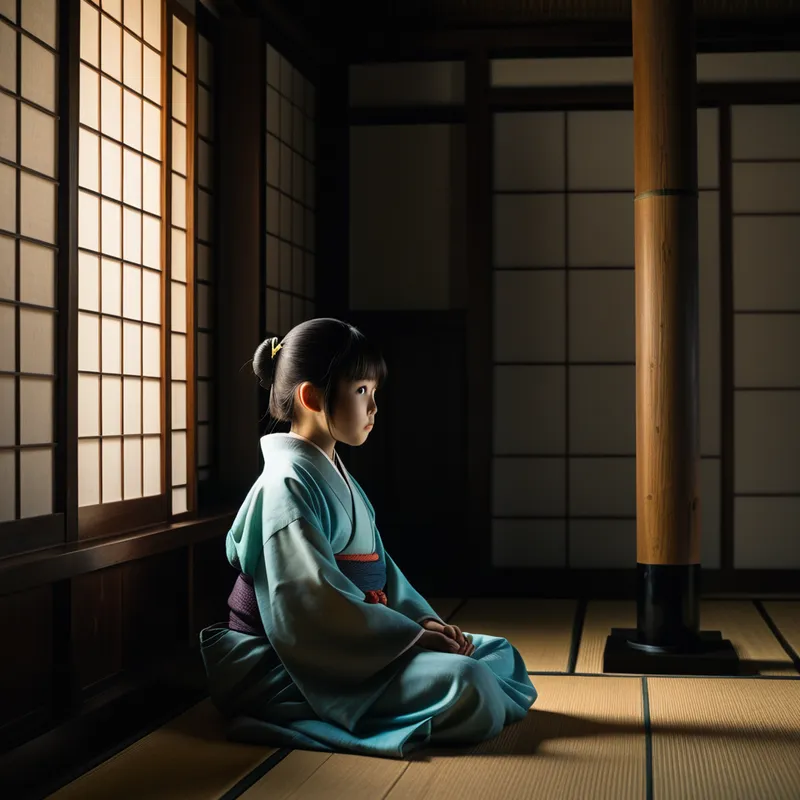
This is the coming of the Zashiki-warashi. She—or sometimes he—appears as a child of five or six, with hair cut in a straight bob, dressed in the fine kimono of a bygone era. Their face is often pale, their eyes hold a knowledge far beyond their years, and their presence is felt more than fully seen. They are not of the human family, yet they choose the family. They claim the house.
When they arrive, fortune blossoms like a sudden, hardy flower in winter. The rice stores never seem to deplete. Business dealings turn unexpectedly prosperous. Health settles upon the inhabitants like a warm quilt. The house itself seems to sigh in contentment, its beams strong, its walls secure. The family knows, with a quiet, superstitious certainty, that they are being watched over. They might leave out small offerings—a sweet mochi, a pretty pebble—which vanish by morning. They learn not to stare directly, not to question the giggles from the attic, for the spirit is shy, a creature of periphery.
But the tale holds a second, deeper truth, written not in laughter but in silence. The Zashiki-warashi’s bond is to the house, not the people. Should the family become arrogant, neglectful of the home’s spirit, or cruel to one another, the child will grow sullen. The laughter stops. The feeling in the zashiki becomes one of profound loneliness. And then, one day, they are simply gone. Perhaps you see them from the corner of your eye, walking down the lane away from the house, or hear the final, fading shuffle of small feet in the attic.
With their departure, the fortune drains away like water from a broken bowl. Decline is inevitable. The house falls into disrepair, the family’s luck turns, and the structure itself seems to dim, as if its very soul has departed. The blessing was never a permanent gift, but a sacred, conditional trust.
Cultural Origins & Context
The Zashiki-warashi belongs to the rich tapestry of Japanese yōkai and household spirits, with roots specifically in the Tōhoku region of northern Japan. These stories were not the fare of court nobles but the oral lore of farming and fishing villages, passed down through generations by the fire. They functioned as a sophisticated form of folk wisdom and social regulation.
Anthropologically, the myth served multiple purposes. It explained sudden shifts in a family’s fortune in a pre-modern world where cause and effect could be mysterious. More importantly, it encoded values of hospitality, humility, and domestic harmony. The spirit rewarded a well-kept, respectful household and punished pride and discord. It taught that prosperity was a fragile covenant with the unseen world of the home itself. The spirit acted as a psychic anchor, tying the family’s fate to the moral and physical state of their dwelling—a powerful motivator for maintaining both.
Symbolic Architecture
Psychologically, the Zashiki-warashi is a profound symbol of the genius loci—the spirit of a place—manifested in the form of the divine child. It represents the latent potential, the inherited fortune, and the ancestral memory that resides within a structure, a family line, or the psyche itself.
The child in the parlor is the soul of the house; when the soul departs, only a hollow shell remains.
The spirit is the archetypal Innocent, not in a naive sense, but in its representation of pure potential and unearned grace. Its arrival signifies an alignment with this potential, a state of being "in grace." Its childlike form suggests this fortune is not the result of hard labor alone, but a kind of blessing, a gift from the unconscious or the ancestral past that must be received with humility.
Conversely, its departure symbolizes a severance from this root of vitality. It is the moment the psyche—or the family—loses connection to its own source of meaning and abundance, becoming identified solely with its egoic struggles and material concerns. The house’s subsequent decline is a powerful image of psychic decay when cut off from the nourishing waters of the deeper Self.

The Dreamer's Resonance
To dream of a Zashiki-warashi is to encounter the psyche’s own assessment of its "inner home." Is your psychic house in order? Is its spirit content?
You may dream of a beautiful, traditional house that feels both familiar and alien. You hear a child playing in another room, but the door is always just closed. This dream speaks to a connection with a nascent, creative part of the self that is not yet fully integrated—a talent, intuition, or inner child that holds the key to your vitality, but remains shy and peripheral. The somatic feeling is often one of wistful curiosity, a gentle pull towards exploration of forgotten rooms within yourself.
The darker version of this dream is the search for a lost child in an increasingly dilapidated mansion. Rooms are dusty, walls are cracked, and a profound silence weighs on the air. This is the dream of depletion, signaling that the dreamer has, through neglect, arrogance, or trauma, lost touch with their inner source of fortune and innocence. The body may feel heavy upon waking, carrying the grief of this departure. The dream is a call to housekeeping—not of your physical space, but of your inner world, to make it a hospitable place for your spirit to reside once more.
Alchemical Translation
The myth of the Zashiki-warashi models the alchemical process of inhabitation and its shadow, abandonment. The individuation journey is not just about discovering the Self, but about creating a dwelling place for it within the conscious personality—a temenos, or sacred precinct.
The first stage is Invitation, the creation of inner space through introspection and respect for the unconscious. This is the well-kept zashiki. The second is Manifestation, where the inner wealth (the Self as divine child) makes its presence known through synchronicities, renewed creativity, and a sense of being guided. This is the fortune brought by the spirit.
The work is not to capture the child, but to maintain the home so the child never wishes to leave.
The critical, ongoing stage is Stewardship. This is the alchemical rubedo, the reddening, which requires constant attention, humility, and integration. One must not claim the spirit’s blessings as one’s own egoic achievement (the arrogance that drives it away). One must continue to "leave out offerings"—engage in practices that honor the unconscious, such as active imagination, dream work, or creative expression.
The final, transformative understanding the myth offers is that the spirit and the house are ultimately one. The goal of psychic transmutation is not to host a fleeting guest, but to become the house that is inherently blessed, where the inner child is not a visitor but the very foundation. When consciousness becomes a worthy dwelling, the distinction between host and spirit dissolves, and the individual lives not from a place of seeking fortune, but from being its natural, embodied source.
Associated Symbols
Explore related symbols from the CaleaDream lexicon: