Yuki-onna Myth Meaning & Symbolism
A spectral woman of the blizzard, embodying winter's lethal beauty and the frozen heart of a promise broken, offering mercy and demanding silence.
The Tale of Yuki-onna
Listen, and feel the cold settle in your bones. It was a night when the world was not a world, but a single, howling whiteness. The mountain pass was a forgotten path, swallowed by a shin'yuki so dense it stole breath and direction. Two woodcutters, a youth named Minokichi and his elder master Mosaku, were caught in its heart, their bodies numbing, their hope freezing solid.
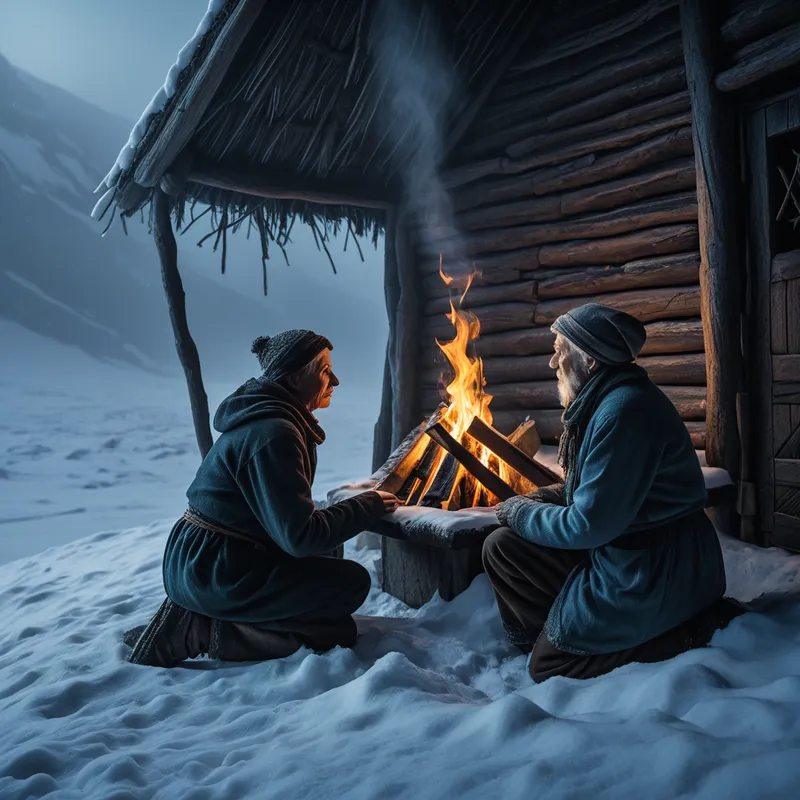
By a mercy they did not deserve, they stumbled upon a lone woodsman’s hut. Inside, the air was still and only slightly less deadly than the storm. They built a meager fire, its feeble light dancing on walls of ice. As they shivered into a desperate sleep, a new cold entered—not from the wind, but from a presence.
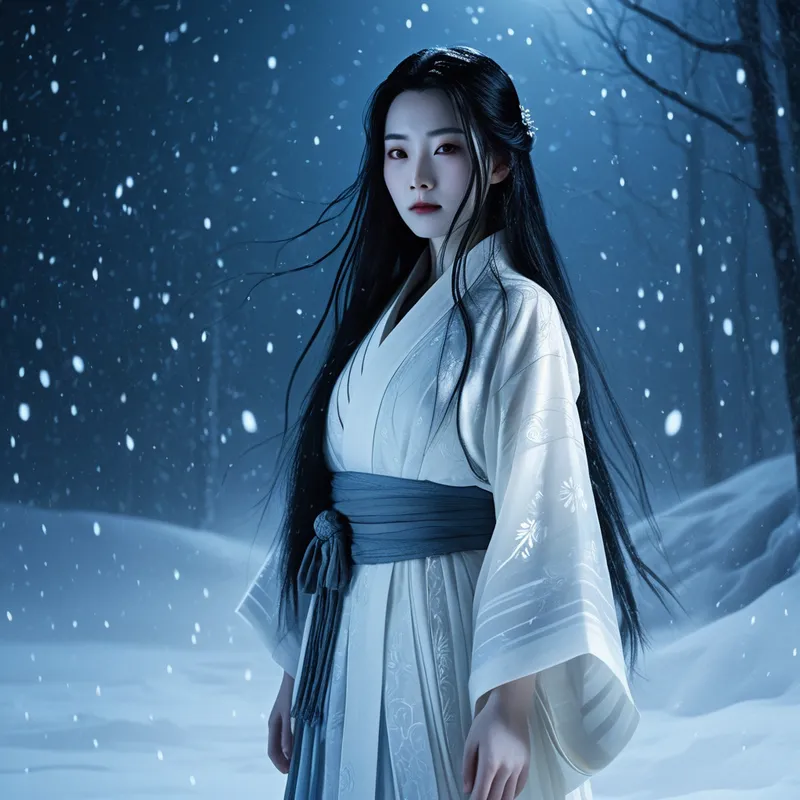
The door did not open. She simply was there. A woman of impossible, spectral beauty, skin as pale as the heart of a glacier, hair as black as a moonless midnight, flowing over a white kimono so thin it seemed woven from frost itself. She drifted towards old Mosaku and bent over him. From her lips flowed a long, shimmering, icy breath. He did not wake; he simply ceased, his body hardening into a silent statue of winter.
She turned to Minokichi. Her eyes held the emptiness of a thousand frozen years. Yet, as she gazed upon his youthful terror, something shifted—a flicker in the endless winter. “I would have taken you as I took the old man,” her voice was the whisper of snow settling. “But your youth moves me. Speak of me to anyone—your mother, your wife, anyone—and I will know. I will return, and I will still the warmth in your heart forever.” Then, like mist before a sudden wind, she dissolved into the storm’s fury, leaving only the cold and the corpse.
Years passed. Minokichi, haunted yet alive, met a girl named Yuki. She was beautiful, diligent, and strangely cool to the touch. They married, and she bore him many children, her beauty never fading as the seasons turned. But on a winter’s night, as Minokichi watched his wife sew by the hearth, the memory of that fatal storm surged within him. Overcome, he broke his sacred silence and told her the tale of the ghost in the snow.
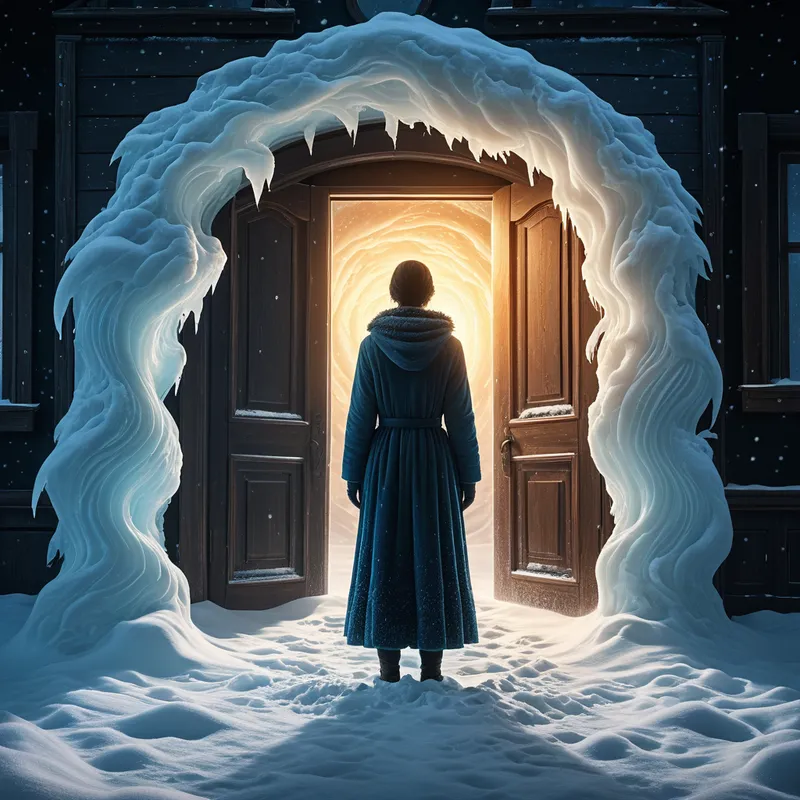
Yuki stopped sewing. The needle fell from her fingers. The warmth drained from her face, leaving the familiar, terrible pallor. “That woman was I,” she said, her voice now the wind in the eaves. “I warned you, Minokichi. I would have killed you tonight for your betrayal, but for the faces of our sleeping children.” Her form began to waver, thinning like ice on a spring pond. “Tend to them. If they come to harm through your neglect, I will hear of it.” And with a sigh colder than regret, the woman who was Yuki, who was Yuki-onna, streamed out through the keyhole, back into the eternal blizzard from whence she came, leaving a husband forever winter-struck in a now-silent house.
Cultural Origins & Context
The tale of Yuki-onna is a classic yōkai narrative, collected and preserved by folklorists like Kunio Yanagita. These stories were not mere entertainment; they were oral teachings born from the intimate, perilous relationship between rural communities and the natural world. Told around hearths during the long, isolating winter months, the myth served a profound societal function. It personified the very real, existential threat of winter—the blizzard that could erase a traveler, the cold that could steal into a home and claim a life.
Yuki-onna is a spirit of the liminal spaces: the mountain pass, the forest’s edge, the boundary between the village and the wild. Her stories were warnings, teaching respect for the mountain’s power and the importance of prudence. Furthermore, as a beautiful yet deadly female entity, she exists within a wider global pattern of nature spirits who are both alluring and perilous, reflecting an ambivalent view of nature itself as both life-giving and mercilessly destructive. Her transmission through oral tradition allowed the tale to shape-shift slightly with each telling, yet her core essence—the beauty that kills, the mercy that binds, the secret that must be kept—remained a chilling constant.
Symbolic Architecture
At its heart, Yuki-onna is not merely a ghost story; she is a profound symbol of the psyche’s encounter with the Other. She represents the ultimate, frozen aspect of the Anima—the inner feminine principle in a man’s psyche, here in its most impersonal, elemental form. She is not a lover in a human sense, but the lover as an archetypal force: captivating, binding, and utterly inhuman in her laws.
The promise extracted in the face of death is the soul’s first contract with a power greater than ego.
Her dual nature is the myth’s central tension. She is the blizzard that kills and the wife who bears children. She is the absolute zero of nature’s indifference and a spark of compassion that spares Minokichi. This duality symbolizes the psyche’s own frozen potentials—traumas, innate patterns, or core complexes that are both a part of us and feel alien, beautiful in their patterned intricacy yet deadly to our conscious identity if approached without respect. The secret she demands is the integrity of the encounter with this numinous, unconscious content. To babble it aloud—to treat it as mere gossip or a conquered memory—is to profane it and trigger its destructive return.

The Dreamer's Resonance
When the pattern of Yuki-onna crystallizes in a modern dream, it signals a profound somatic and psychological process. The dreamer is not simply recalling a myth; they are experiencing its living architecture within their own inner landscape.
To dream of a beautiful, chilling woman in a winter setting often points to an active confrontation with a cold, perhaps neglected, aspect of the inner feminine or the emotional self. This could manifest as a creative force that feels blocked and icy, a relationship pattern that feels lifeless, or a part of the self that has been “frozen” in time due to trauma or neglect. The somatic sensation is key: a literal feeling of cold in the dream, a numbness, or a breathtaking beauty that simultaneously terrifies.
The dream may replay the myth’s central dilemma: being granted a reprieve (mercy) with a condition (silence). Psychologically, this mirrors a moment of insight or a temporary integration of a difficult complex, which comes with the unspoken demand to hold it consciously, to tend to it, and not to immediately dissect it or share it prematurely for social validation. The betrayal in the dream—the breaking of the promise—often signifies the ego’s inability to contain the transformative, yet terrifying, new awareness, causing it to retreat back into the unconscious, leaving the dreamer with a sense of profound, chilly loss.
Alchemical Translation
The journey with Yuki-onna is a stark map for psychic transmutation, a wintery path of individuation. It begins with the catastrophic encounter—the blizzard. This is the necessary crisis, the freezing of old, comfortable identities (represented by Mosaku’s death) that forces the psyche (Minokichi) into a humble hut of introspection.
The mercy shown is the first alchemical moment. The unconscious force does not annihilate the conscious ego but recognizes its potential and sets a condition. This is the prima materia of transformation: a terrifying, beautiful insight that one must carry in silence, allowing it to incubate. Minokichi’s marriage to Yuki is the symbolic union, the hieros gamos or sacred marriage, with this once-alien element. For a time, it is fruitful; it brings structure (family, home) and beauty into life. The cold wife is the integrated complex, still distinct, but now a working part of the whole personality.
The final test of integration is not in the union, but in the confession. Can the ego acknowledge the terrifying, inhuman origin of its own depth?
The breaking of the promise is the critical, nearly fatal, stage of the work. It is the ego’s arrogance, believing it has domesticated the archetype and can now claim it as a personal story. This “confession” severs the connection, revealing the archetype’s ultimate autonomy. Yuki-onna leaves, but she does not kill. This is the alchemical translation: the archetype, once met and honored, even if later betrayed, transforms. Its absolute, lethal power is tempered. It becomes a watching, demanding conscience (“tend to our children”)—an internalized moral or creative imperative born from the encounter, rather than an external annihilating force. The individual is left forever changed, living in a world where warmth is precious and memory holds a permanent, chilling draft, having truly met the lover who is also the storm.
Associated Symbols
Explore related symbols from the CaleaDream lexicon: