Yemoja
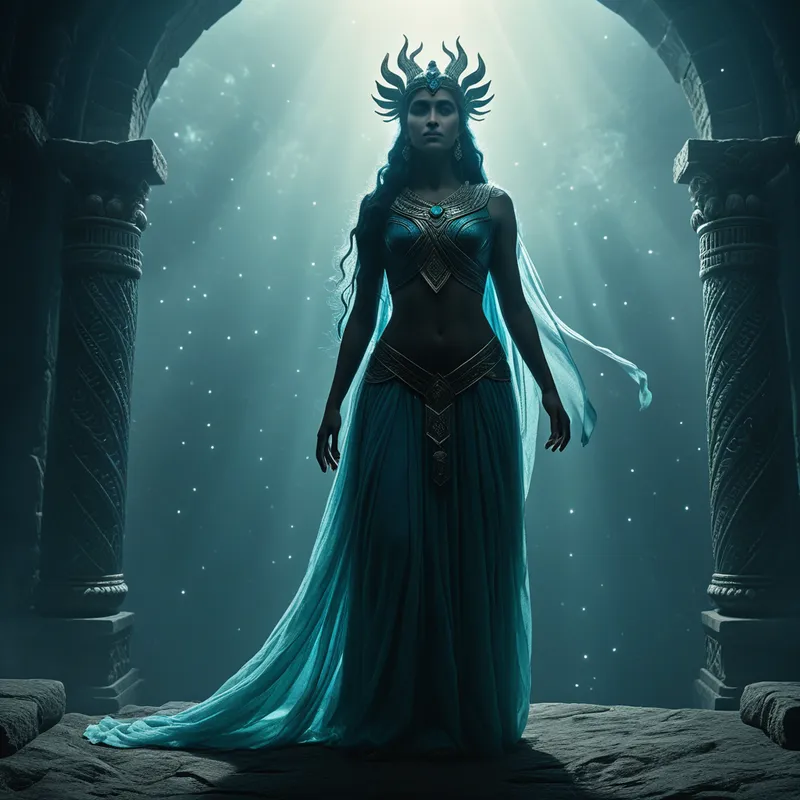
Yemoja is the Yoruba mother goddess of oceans, rivers, and fertility, embodying nurturing, creation, and the life-giving forces of water in West African mythology.
The Tale of Yemoja
In the beginning, there was the great expanse of [Olokun](/myths/olokun “Myth from Yoruba culture.”/), the deep, unfathomable sea, a realm of potent potential and undifferentiated being. From these profound depths, consciousness stirred. The [Orishas](/myths/orishas “Myth from African Diaspora culture.”/), the divine forces of nature and society, began to take form. Among the first and most essential was Yemoja.
She was not born in a singular moment, but emerged as the very principle of nurturing containment. The vast, salty womb of Olokun became focused, personified, and given a mother’s heart. Yemoja became [the great mother](/myths/the-great-mother “Myth from Jungian culture.”/), the one who holds and shapes life. Her first children were the other Orishas themselves—powerful beings like [Shango](/myths/shango “Myth from African Diaspora culture.”/), the kingly warrior, and Oshun, the sweet river. She nurtured them within her aqueous realm, teaching them the first lessons of existence before they journeyed to their own domains upon [the earth](/myths/the-earth “Myth from Hindu culture.”/).
Her story is not one of distant creation, but of intimate, often painful, giving. One myth tells of a time of great strife among her divine children on earth. Overwhelmed by their conflicts and the weight of her own boundless compassion, Yemoja wept. Her tears, falling from the heavens and rising from the depths of her heart, became a great deluge that covered the land. From this cataclysm of maternal sorrow, rivers were carved and the oceans were filled. Her body, in a sense, became [the world](/myths/the-world “Myth from Tarot culture.”/)’s waters—the amniotic fluid of the planet itself. In another telling, she is the protector who receives the souls of the dead, washing them clean in her saline embrace at the sacred confluence of river and sea, preparing them for the journey to the ancestral realm.
She is the goddess who is both the source and the destination, the gentle lap of waves on the shore and the terrifying power of the storm surge. To her children, she is Iyá—Mother—the ultimate comfort. Her breasts are full and nurturing, her gaze is steady and deep. She provides not just physical sustenance from her waters, but emotional and spiritual solace. Yet, cross her or harm what she has nurtured, and her tranquil surface can erupt into a tempestuous rage, a reminder that the mother’s love is fierce and her boundaries, like the shoreline, are sacred.
Cultural Origins & Context
Yemoja (also spelled Yemaya, Yemanja, Iemanja) originates from the Yoruba people of what is now southwestern Nigeria and parts of Benin and Togo. Her worship is central to the Isese tradition and was carried across the Atlantic during the transatlantic slave trade. In [the crucible](/myths/the-crucible “Myth from Alchemical culture.”/) of the diaspora, she became a [cornerstone](/myths/cornerstone “Myth from Biblical culture.”/) of syncretic religions like Santería (where she is known as Yemayá), Candomblé (Yemanjá), and Umbanda, often syncretized with [the Virgin Mary](/myths/the-virgin-mary “Myth from Christian culture.”/) as Our Lady of Regla.
Her domain is explicitly the ocean and all salt waters, distinguishing her from Oshun, who rules the fresh, sweet waters of rivers and streams. This distinction is critical. The ocean represents the unknown, the source of life, the place of trade, danger, and the final journey. As such, Yemoja presides over the major transitions of life: birth, motherhood, and [death](/myths/death “Myth from Tarot culture.”/). She is the goddess of fishermen and sailors, of market women and mothers. In traditional Yoruba society, she was seen as the mother of all Orishas and, by extension, the mother of all humanity, embodying the principles of community, care, and the unbreakable bonds of family.
Her annual festivals, particularly in Brazil and Cuba, see millions dress in white and blue, her sacred colors, and offer flowers, perfumes, and mirrors to [the sea](/myths/the-sea “Myth from Greek culture.”/). These rituals are not mere pageantry but profound acts of communion, acknowledging her as the sustaining, life-giving force that connects the African homeland with the diaspora, the living with the ancestors, and the individual soul with the collective womb of existence.
Symbolic Architecture
Yemoja’s [symbolism](/symbols/symbolism “Symbol: The use of symbols to represent ideas or qualities, often conveying deeper meanings beyond literal interpretation. In dreams, it’s the language of the unconscious.”/) is an intricate map of the [psyche](/myths/psyche “Myth from Greek culture.”/)’s deepest layers, where the personal [mother complex](/symbols/mother-complex “Symbol: A deep psychological pattern where unresolved maternal relationships influence identity, spirituality, and emotional life, often manifesting as dependency, idealization, or rebellion.”/) meets the archetypal [Mother](/symbols/mother “Symbol: The symbol of ‘Mother’ represents nurturing, protection, and the foundational aspect of one’s emotional being, often associated with comfort and unconditional love.”/) of All.
She is the container. Before the ego can form, it must be held. Yemoja represents that primal, psychic environment—the unconscious itself—that holds and nourishes the nascent fragments of identity until they are strong enough to venture forth. Her waters are the medium of the soul.
Her dual nature—the nurturing breast and the destructive wave—speaks to the wholeness of the maternal archetype, which encompasses not only unconditional love but also necessary limitation, the “no” that defines the self. A mother who only says yes creates a flood; one who only says no creates a desert. Yemoja is both.
Her association with the [moon](/symbols/moon “Symbol: The Moon symbolizes intuition, emotional depth, and the cyclical nature of life, often reflecting the inner self and subconscious desires.”/) links her to cycles, tides, and the rhythmic, non-[linear](/symbols/linear “Symbol: Represents order, predictability, and a direct, step-by-step progression. It symbolizes a clear path from cause to effect.”/) time of the [body](/symbols/body “Symbol: The body in dreams often symbolizes the dreamer’s self-identity, personal health, and the relationship they have with their physical existence.”/) and [intuition](/symbols/intuition “Symbol: The immediate, non-rational understanding of truth or insight, often described as a ‘gut feeling’ or inner knowing that bypasses conscious reasoning.”/). She governs the ebb and flow of emotions, the swelling of [pregnancy](/symbols/pregnancy “Symbol: Represents creation, potential, and transformation—a journey of nurturing something new within oneself.”/), and the monthly cycles of women. In this, she is the antithesis of purely solar, rational [consciousness](/symbols/consciousness “Symbol: Consciousness represents the state of awareness and perception, encompassing thoughts, feelings, and experiences.”/). She is the knowing that comes from feeling, the intelligence of the [depths](/symbols/depths “Symbol: Represents the subconscious, hidden emotions, or foundational aspects of the self, often linked to primal fears or profound truths.”/).
The mirror, often offered to her, is a profound symbol. It does not merely reflect the surface, but invites one to look into the depths, to see the self reflected in her vastness. To gaze into Yemoja’s mirror is to confront the oceanic nature of one’s own soul—beautiful, terrifying, and endlessly generative.
The Dreamer’s Resonance
When Yemoja surfaces in the inner landscape of dream or active imagination, she calls the dreamer to the shores of their own emotional and creative depths. She appears not to solve problems, but to invite immersion.
To dream of calm, nurturing waters, of being held or fed by a maternal figure associated with the sea, may signal a profound need for self-care, for a return to the source of one’s own being. It is a call to allow oneself to be nourished, to rest in the primal trust that one is held by life itself. Conversely, dreams of tidal waves, drowning, or a fierce oceanic goddess may point to emotions that have been dammed up, now threatening to overwhelm the conscious ego. Yemoja, in her stormy aspect, demands that we acknowledge the power of what we have repressed—grief, rage, or a creativity too long denied.
She particularly resonates with those navigating the passages of motherhood—whether giving birth, caring for others, or nurturing a project or aspect of [the self](/myths/the-self “Myth from Jungian culture.”/). She embodies the sacrifices and the boundless, often overwhelming, love inherent in that role. She also speaks to anyone, regardless of gender, who is called to develop their capacity for compassion, containment, and deep, intuitive knowing. To work with Yemoja is to learn to hold space, for oneself and for others, with the steadfastness of the ocean floor and the adaptability of [water](/myths/water “Myth from Chinese culture.”/).

Alchemical Translation
The psychological alchemy of engaging with Yemoja is the process of [solve et coagula](/myths/solve-et-coagula “Myth from Alchemical culture.”/)—dissolving and coagulating—perfected. It is the work of returning to the undifferentiated state of the [prima materia](/myths/prima-materia “Myth from Alchemical culture.”/) (the salty waters of the unconscious) to be reformed anew.
The first stage is dissolution into the maternal waters. This is the surrender of rigid ego structures, the letting go into tears, into grief, into the unknown feelings that wash over us. It is a necessary regression, a return to the source to remember who we are beneath our adaptations.
From this fertile dissolution comes coagulation, the forming of the Pearl. Just as an oyster creates a pearl from an irritant coated in nacre, the psyche, immersed in Yemoja’s wisdom, learns to transform pain, memory, and experience into something of beauty and value. The pearl is the integrated self, born of pressure and time within the protective shell of her embrace.
Her alchemy is one of salt and water—the preservation of essence (salt) within the fluidity of experience (water). To integrate Yemoja is to become a vessel that can both contain deep feeling and allow it to flow, to be both the calm lagoon and the connecting river, finding one’s unique form while never forgetting one’s source in the universal mother-sea of the unconscious.
Associated Symbols
Explore related symbols from the CaleaDream lexicon:
- Ocean — The vast, primal womb of Yemoja, representing the unconscious, the source of all life, and the realm of deep emotion and ancestral memory.
- Mother — The archetypal principle of nurturing, unconditional love, fierce protection, and the source from which all individuality emerges.
- River — The life-giving, flowing aspect of Yemoja’s children and her own tears, symbolizing journey, emotion, and the connection between source and destination.
- Moon — Governing the tides of Yemoja’s oceans and the cycles of the body, representing intuition, rhythm, cyclical time, and the reflective, feminine principle.
- Mirror — Offered to Yemoja to see into the depths, symbolizing self-reflection, the surface of consciousness over the unconscious, and the truth found in looking within.
- Womb — The ultimate container of life, directly analogous to Yemoja’s oceanic realm, symbolizing potential, gestation, safety, and the origin of being.
- [Pearl](/myths/pearl “Myth from Chinese culture.”/) — Formed in the depths under pressure, representing beauty born of suffering, the integrated self, and the precious wisdom gained from immersion in the unconscious.
- Tears — The sacred water of emotion and release, from which Yemoja created rivers, symbolizing grief, compassion, purification, and the liquid essence of feeling.
- Circle — Representing wholeness, cycles, containment, and the encompassing, non-linear nature of Yemoja’s maternal love and the rhythms of life she governs.
- Vessel for Water — A [calabash](/myths/calabash “Myth from African Diaspora culture.”/) or ship, symbolizing the human body, the community, and the individual psyche as containers for the sacred, life-sustaining essence of Yemoja.
- Door — [The threshold](/myths/the-threshold “Myth from Folklore culture.”/) where river meets sea, where life meets death, symbolizing transition, passage, and Yemoja’s role as guardian of the gates between worlds.
- Rebirth — The core promise of Yemoja’s waters, representing cleansing, renewal, and the eternal return to the source for transformation and new beginnings.