Yellow Emperor Myth Meaning & Symbolism
The myth of the Yellow Emperor, Huangdi, tells of a divine ruler who defeated chaos, established cosmic order, and birthed the soul of Chinese civilization.
The Tale of Yellow Emperor
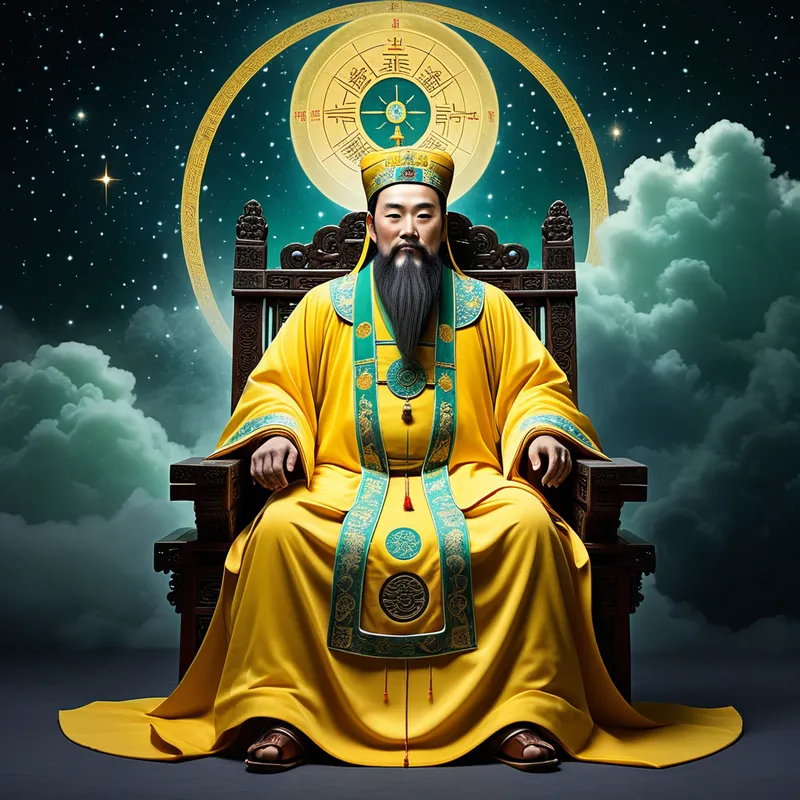
In the dawn-time of the world, when the earth was still soft and the sky close enough to touch, the people lived in the shadow of chaos. Tribes knew only their own fires, and the great river plains echoed with the clamor of a hundred petty kings. From this discord, a light was kindled in the north, near the sacred Ji River. He was born under the sign of the bear, they say, with the four faces of a sovereign, able to see to the corners of the world. His name was Huangdi, and his essence was the color of the central, life-giving earth.
His rise was not gentle. A brother-king, Yandi, sought dominion, and their armies met in the great field of Banquan. The earth shook three times before Huangdi’s virtue prevailed, uniting the tribes under one banner. But a greater shadow remained—Chiyou, a titan of the south. Chiyou was no mere man; he had a bronze head and iron brow, fed on stones and sand, and commanded demons of fog and wind. He embodied raw, untamed force, the chaos that eats civilization whole.
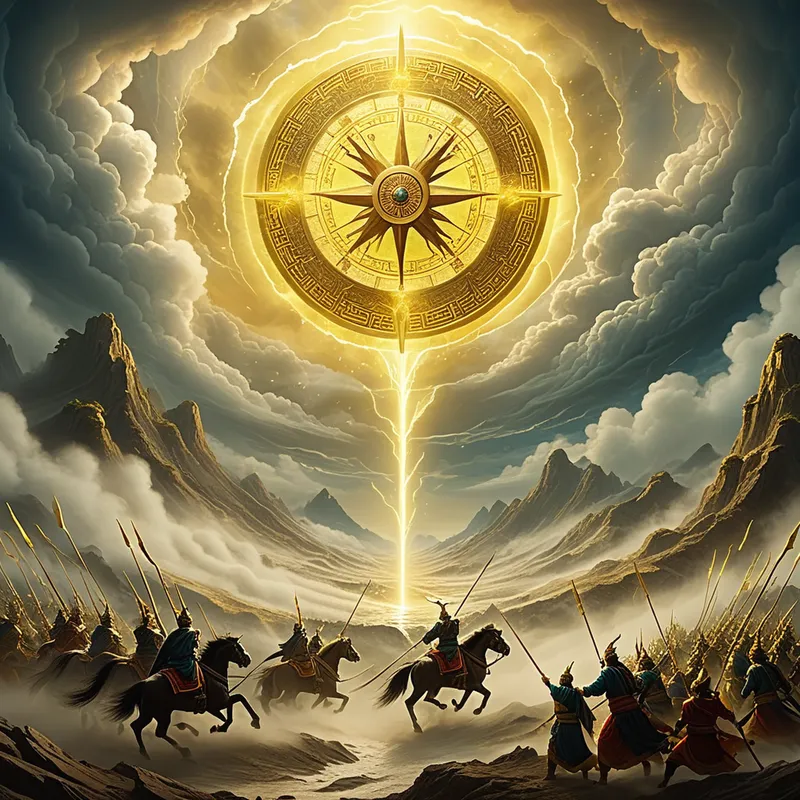
The final confrontation gathered at Zhuolu. Chiyou breathed out a thick, impenetrable fog that swallowed the sun for three days. Huangdi’s warriors stumbled blind, lost in the white void. In this moment of despair, the Emperor, in his divine contemplation, fashioned a miracle: the South-Pointing Chariot. A figure of a celestial immortal always pointed the way south, cutting through the illusion. Yet the fog persisted.
Then, from the high Kunlun Mountains, aid descended. The Daughter of Drought, a goddess whose very presence banished moisture, came to her father’s side. As she strode across the battlefield, the magical fog burned away, and Chiyou’s power broke. The titan was defeated, and order was forged in the crucible of that battle.
His reign was the true beginning. He did not merely rule; he wove the fabric of reality for his people. He taught them to build houses, fashion boats and carts, and establish markets. His wife, Leizu, discovered the secret of silk. His minister Cangjie created writing, causing grain to fall from the sky and ghosts to weep at night. He delineated the seasons with the Yellow Emperor's Inner Calendar, and his dialogues on medicine and the body became the Huangdi Neijing. After a long and sagely rule, a golden dragon descended from the heavens. Huangdi mounted it, and with seventy of his loyal ministers, ascended into the constellations, becoming the eternal polestar around which all order revolves.
Cultural Origins & Context
The figure of the Yellow Emperor sits at the nebulous crossroads of history, myth, and statecraft. Emerging from the rich oral traditions of the Zhongyuan region, his story was crystallized during the Warring States and early Han periods. Texts like the <abbr title=""Historical Records" by Sima Qian">Shiji provided a genealogical and narrative backbone, placing him at the origin point of Chinese history and claiming him as the ancestor of all later ruling houses.
This was not merely storytelling; it was nation-building. In a context of competing philosophical schools—Confucianism, Daoism, Legalism—Huangdi became a versatile archetype. For Daoists, he was the seeker of the Dao and longevity. For Confucians, he was the sage-king who instituted ritual and social order. For the state, he was the primordial unifier, a precedent and divine mandate for centralized rule. His myth functioned as a cultural root system, providing a shared ancestor, a model of virtuous kingship, and a symbolic narrative for the transformation from barbarism to civilization.
Symbolic Architecture
At its heart, the myth of Huangdi is a profound drama of order emerging from chaos. He is not a god of creation ex nihilo, but a god of organization. The pre-Huangdi world represents the undifferentiated, conflict-ridden psyche—the raw material of life without structure or meaning.
The true battle is not against an external monster, but against the internal fog that prevents us from finding our center.
Huangdi symbolizes the conscious ego’s first, monumental task: to establish a stable, functioning identity (the kingdom) by integrating powerful, chaotic forces. Chiyou is not pure evil; he is the potent, terrifying, and necessary shadow—the untamed instinct, rage, and primal power that must be confronted and assimilated, not ignored. The South-Pointing Chariot is the symbol of consciousness itself—the orienting principle (often linked to the De of the ruler) that can navigate the fog of confusion, doubt, and unconscious drives. The Daughter of Drought represents a specific, potent quality (clarity, discernment) that must be invoked to dissolve the particular form the chaos takes—in this case, obfuscation and illusion.
His subsequent inventions—writing, calendar, medicine—are not technological gifts but symbolic acts of psychic differentiation. They represent the structures of culture: language to articulate inner experience, time to sequence our existence, and a system to understand the body as a microcosm of the natural order.
The Dreamer's Resonance
When the pattern of the Yellow Emperor stirs in the modern psyche, it often manifests in dreams of foundational crisis or integration. One might dream of a chaotic, fog-filled landscape where familiar landmarks are lost—a direct mirror of Chiyou’s fog, representing a life period of profound disorientation, where old identities and paths no longer serve.
The dreamer may find or be given a simple, potent tool: a key, a specific book, a compass, or a golden thread. This is the South-Pointing Chariot of the soul, the nascent symbol of a new orienting principle trying to emerge. Somatic sensations can accompany this—a feeling of solid ground underfoot after drifting, or a sudden, clear insight that “dries up” confusing emotions. The battle is rarely violent; it is more often a dream of finding the correct alignment, of assembling a council (the loyal ministers) of one’s own inner capacities, or of finally building a stable “house” for the self after a long period of psychic homelessness.
Alchemical Translation
The individuation process modeled by Huangdi is one of civilizing the inner wilderness. It begins with the acknowledgment of internal conflict (the warring tribes) and the claim of central authority—the “I” taking responsibility for the realm of the self.
Individuation is the slow, deliberate work of building an inner kingdom worthy of a dragon’s ascent.
The confrontation with the Chiyou-shadow is crucial. This is not about eradication, but about engaging the immense, often frightening energy of our unlived life—our repressed anger, wild creativity, or primal vitality—and bringing it under the aegis of consciousness. Defeating Chiyou means depriving these forces of their autonomous, destructive power and harnessing their strength for the kingdom. The fog clears when we stop running from a part of ourselves and instead turn to face it with our full attention.
The subsequent “reign” is the long, unglamorous work of building enduring inner structures: consistent values (laws), a personal philosophy (writing), a connection to natural rhythms (calendar), and mindful care of the body (medicine). This established inner order creates a vessel stable enough to hold the numinous. The final ascent on the dragon is not a literal death, but the achievement of a symbolic immortality—the point where the conscious personality (Huangdi) becomes aligned with the transpersonal, guiding patterns of the Self (the polestar), achieving a state of wholeness that transcends the individual ego. The ruler archetype is fulfilled not in control over others, but in the sovereign integration of the entire self.
Associated Symbols
Explore related symbols from the CaleaDream lexicon: