Leizu Myth Meaning & Symbolism
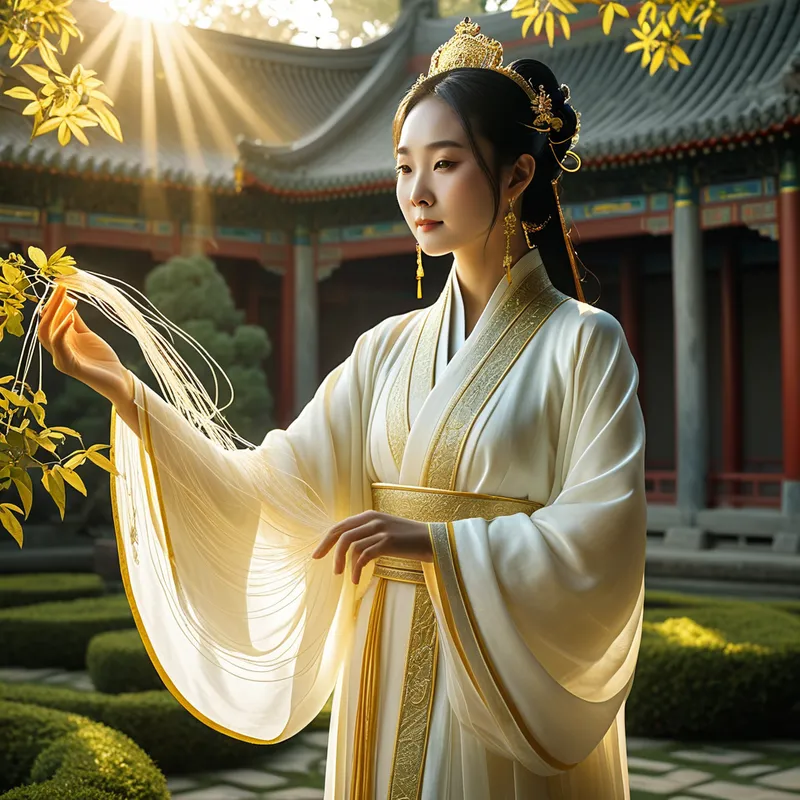
The myth of Leizu, who discovered silk by observing a silkworm, embodies the sacred union of nature, wisdom, and the transformative power of the feminine.
The Tale of Leizu
In the dawn time of the world, when the Huangdi ruled with wisdom from the heart of the Middle Kingdom, a quiet miracle was waiting to be born. It did not arrive with thunder or the clash of armies, but with a whisper, a falling leaf, and the patient gaze of an empress.
Her name was Leizu, consort to the Yellow Emperor. While the court concerned itself with rites and harvests, she found her sanctuary in the imperial gardens, a place where sunlight fell through leaves like liquid jade. One afternoon, beneath the broad canopy of a mulberry tree, she sat in contemplation. The air was sweet with the scent of earth and leaf. A gentle wind stirred, and from the branches above, a small, white object tumbled, landing softly in her cup of warm tea.
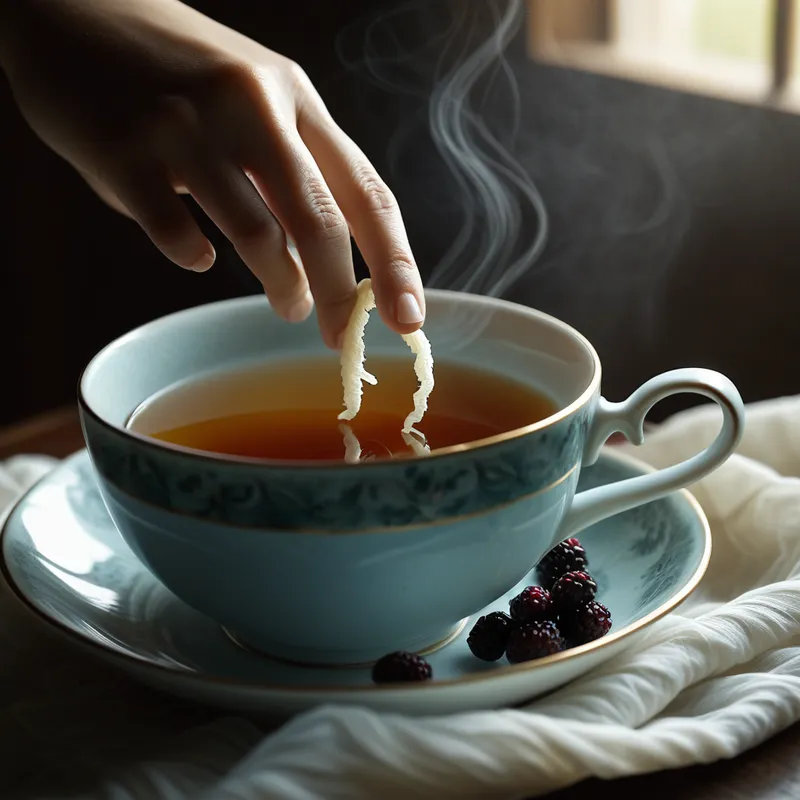
It was a cocoon, a tiny, oval vault of secrecy. As she watched, curious, the heat of the tea began to work a subtle magic. A fine, glistening thread loosened from the cocoon’s surface. With an intuition as deep as the rivers, Leizu reached in. Her fingers, delicate yet sure, found the end of that single, impossibly strong filament. She began to pull.
And the world unraveled.
Mile upon mile of continuous, luminous thread spilled forth, winding around her hand, a river of captured moonlight. It was stronger than hemp, finer than the most delicate grass, and held a sheen that rivaled the pearls of the deepest sea. In that moment, the secret of the silkworm was no longer a secret of the wild; it was a gift, passed from the instinctual world to the realm of human consciousness through the vessel of a watching, reverent mind. She did not conquer the worm; she attended to it. She learned its rhythms, planted groves of mulberry trees for its sustenance, and mastered the art of nurturing the moths. From a chance observation in a garden, Leizu orchestrated the birth of an art, a culture, a thread that would one day bind continents.
Cultural Origins & Context
The legend of Leizu is not a myth of the distant, divine antediluvian age, but one rooted in the foundational narratives of Chinese civilization. She is intimately tied to the Huangdi, a culture hero credited with establishing the bedrock of Chinese society—medicine, writing, the calendar. Leizu’s story provides the essential, complementary feminine principle: the domestication of nature for sustenance and beauty, the transformation of a raw, natural product into a cornerstone of culture and economy.
This myth was passed down not as a sacred, immutable scripture, but as a foundational history, recorded in texts like the Shiji and later compendiums. Its tellers were historians and scholars, its function both pedagogical and identity-forming. It explained the origin of sericulture, China’s most guarded and valuable technology for millennia, elevating it from a mere craft to a divine gift. The myth served to sanctify the labor of countless women who, for generations, would tend the silkworms in quiet, dedicated rooms, their work seen as a continuation of the empress’s sacred discovery. It positioned wisdom not as sheer intellectual force, but as attentive partnership with the natural world.
Symbolic Architecture
At its core, the myth of Leizu is an allegory of conscious creation emerging from unconscious process. The silkworm’s cocoon is the perfect symbol of the latent, self-contained potential within the psyche—a structure built from the inside out, a protected space where a radical metamorphosis occurs in darkness.
The greatest discoveries are not torn from the world, but are received by it, offered up when a prepared mind meets a moment of grace.
Leizu represents the ego in its most creative and feminine aspect: receptive, observant, patient. She does not invent silk; she discovers the process by which it can be unraveled and rewoven. The key action is not making, but unmaking the cocoon in a controlled, reverent way to access the treasure within. This is the symbolic difference between destructive force and transformative technique. The mulberry tree, the silkworm, and the empress form a sacred triad: the nourishing source, the instinctual producer, and the conscious cultivator. Together, they model a sustainable, cyclical relationship with nature, where humanity participates in, rather than dominates, the creative cycles of life.
Psychologically, Leizu embodies the archetype of the Creator, but specifically one whose creativity is an act of midwifery. She attends to the autonomous, instinctual life (the silkworm), provides the right conditions (the garden, the mulberry leaves), and intervenes at the precise, opportune moment (the warm tea loosening the sericin) to bring its hidden product into the realm of human culture and meaning.
The Dreamer's Resonance
When this myth stirs in the modern unconscious, it may manifest in dreams of hidden threads, delicate cocoons, or moments of quiet, pivotal observation. To dream of patiently following a single, glowing thread through a labyrinth speaks to a process of tracing one’s own innate potential back to its source. It is the psyche’s signal that a period of incubation is complete, and a latent talent, idea, or aspect of the self is ready to be carefully “unraveled” into the light of consciousness.
Somatically, this can feel like a gentle pulling in the solar plexus or chest—not the violent rupture of breakthrough, but the steady, sure tension of something being drawn forth. One might dream of drinking a warm, herbal tea that clarifies vision, or of tending to a vulnerable, precious creature. These dreams often occur during life transitions where the dreamer is moving from a passive state of being (the larval stage, consuming experience) into a phase where they must actively spin their experiences into a new identity (the cocoon stage), before finally being ready to share their unique “thread” with the world. The conflict in such dreams is rarely monstrous; it is the anxiety of handling something infinitely precious and fine without breaking it.

Alchemical Translation
The individuation process modeled by Leizu’s myth is one of alchemical translation: turning the base, instinctual material of the psyche into the gold of conscious, creative life. The “prima materia” here is not lead, but the raw, automatic productions of the instinctual self—our compulsions, our natural talents, our deepest urges that initially seem opaque or useless.
Individuation is not about spinning a new self from nothing, but about learning the sacred technique of unraveling the self you have already, instinctively, spun in the dark.
The first stage is Observation (the Garden): creating the inner stillness and space (the temenos) to notice what the unconscious is naturally producing. This is Leizu sitting beneath the mulberry tree, a state of receptive attention. The second is Nurturance (the Mulberry Leaves): consciously feeding and protecting these instinctual sprouts, even before we understand their ultimate purpose. The third is the Catalytic Moment (the Warm Tea): often an external event or a surge of emotional heat that loosens the glue binding our latent potential, making it accessible. The final, disciplined act is Unraveling and Re-weaving (the Silk Thread): the careful, patient work of drawing out this inner thread and, through the conscious labor of the ego, weaving it into the fabric of our lived identity and contribution to the world.
This myth assures us that our most valuable resources are not acquired externally, but are revealed from within, through a partnership between conscious attention and the autonomous, creative spirit of life itself. We are all both the silkworm and the empress, spinning in the dark and learning, in the light, how to unwind our own glorious, singular thread.
Associated Symbols
Explore related symbols from the CaleaDream lexicon: