Yawar Myth Meaning & Symbolism
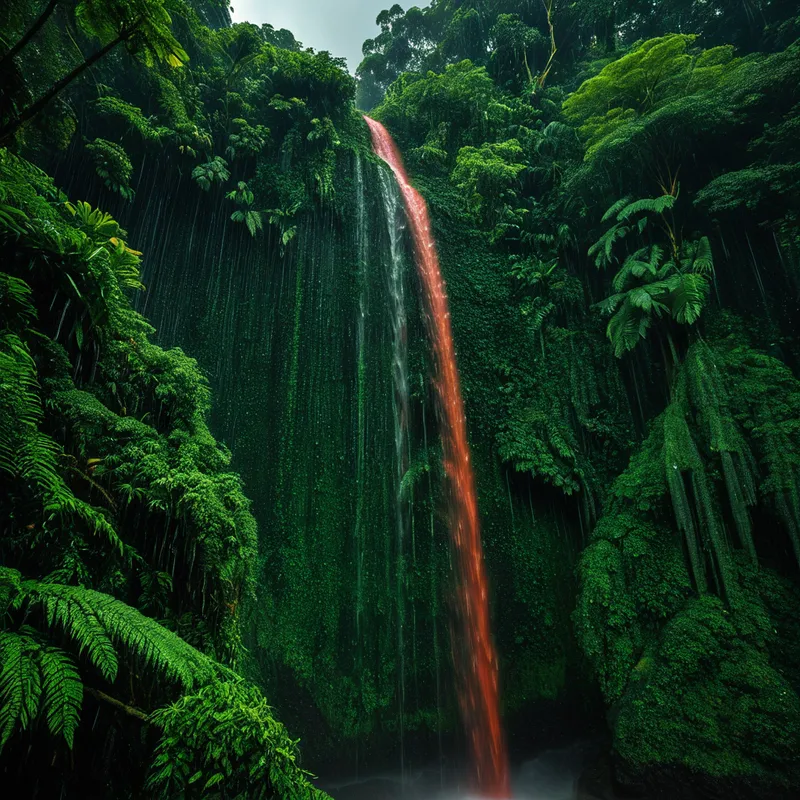
A myth of a primordial being whose sacrifice brings the vital, life-giving rain, weaving the cycle of death and renewal into the fabric of the world.
The Tale of Yawar
Listen. Before the rivers knew their courses and the rain had a name, the world was a great, green thirst. The sun was a relentless eye, baking the clay, curling the leaves. The people moved like shadows, their throats dust, their songs silent. The forest itself held its breath, a cathedral waiting for a hymn it had forgotten.
In that time of cracking earth, there lived Yawar. He was not a god of thunderous power, but a being of the deep, silent places. His body was the color of wet clay and shadow; his hair flowed like the black waters of a tannin-stained creek. He carried within him the memory of all waters—the first dew, the mother’s milk, the tear of grief. He walked among the parched people, and their dry whispers clung to him like spidersilk: “Water… life…”
He saw the children listless, the hunters returning empty-handed, the shaman’s rattles still. The great Ceiba tree, the pillar of the world, seemed to shrink into itself. The balance was broken. The giving had stopped, for there was nothing left to give.
Yawar climbed to a high place where the stone met the sky. He did not call to the spirits of storm or wind. Instead, he began to weep. But these were not tears of water. From his eyes fell a slow, heavy rain of crimson—thick, vital, and warm. It was his own life, his essence, drawn from the very source. He wept for the people, for the forest, for the silence. He wept until his form grew faint, translucent against the sun, and his weeping became a gentle, steady fall.
The crimson rain did not stain; it sank into the cracked earth with a hiss of steam and a scent of iron and wet soil. Where it fell, the hard ground softened. Roots drank deeply. From the enriched earth, green shoots erupted with a sound like unfolding parchment. The rivers, fed by this sacred offering, began to murmur again in their beds. The first true rain, clear and cool, followed, washing the crimson into the roots of all things, marrying sacrifice with renewal.
Yawar was gone, his form dissipated into the mist that now rose from the revitalized forest. But his gift remained, woven into the cycle: to live, something must be given. The rain, when it comes, carries the memory of that first, necessary sacrifice.
Cultural Origins & Context
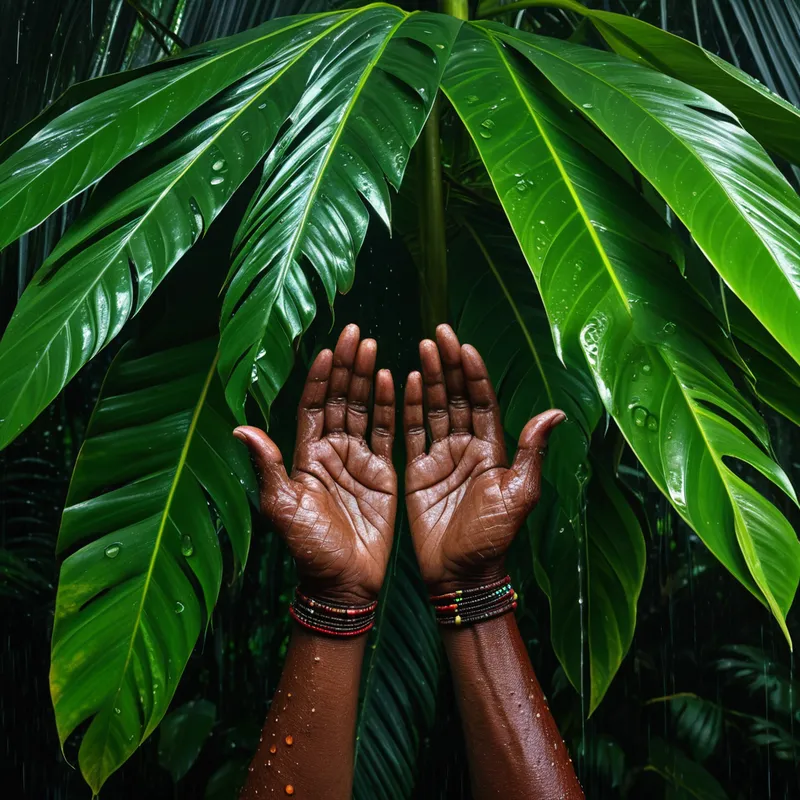
The narrative of Yawar finds its roots among various Indigenous peoples of the Upper Amazon basin. It is not a single, fixed story but a resonant motif within a larger cosmological understanding where the boundaries between body, landscape, and community are fluid. The myth was traditionally transmitted orally, not as mere entertainment, but as vital, applied knowledge during times of drought or ecological stress.
Elders and shamans (payés or vegetalistas) would recount the tale during ceremonies, often those intended to petition for rain. Its telling was an act of remembrance and participation, a way to psychologically and spiritually prepare the community for the concept of reciprocal exchange with the living world. The myth served to explain the fundamental cost of life and the sacredness of water, framing it not as a simple resource but as a spiritual substance paid for by ancestral sacrifice. It established an ethical framework: the forest gives, but it has already given of itself.
Symbolic Architecture
At its core, Yawar is not about a heroic feat of strength, but a profound act of compassionate dissolution. The symbolism is an intricate map of a sacred economy.
The deepest nourishment does not come from taking, but from a willing dissolution that feeds the roots of the world.
The Crimson Rain is the central symbol. It represents life force (sami or similar) in its most concentrated, pre-cultural form—blood as the seat of the soul and the carrier of vitality. Its transformation into life-giving rain is the ultimate alchemy: internal essence becomes external sustenance. It symbolizes the principle that true creation and fertility are often preceded by a form of death or loss.
Yawar himself is the archetypal caregiver, but one whose care takes the ultimate form. He is the primal parent who feeds the children from his own substance. His act moves beyond empathy into a state of radical identification: I am the forest thirsting, therefore I will become the rain. He represents the part of the psyche—and of a culture—that understands sustainability as a cycle of sacred debt and payment, not infinite extraction.
The Parched World is the state of psychic or spiritual aridity. It is the depression of the soul, the creative block, the societal period where old ways yield no life and new ones have not yet been born. It is the necessary void that calls forth the sacrifice.
The Dreamer's Resonance
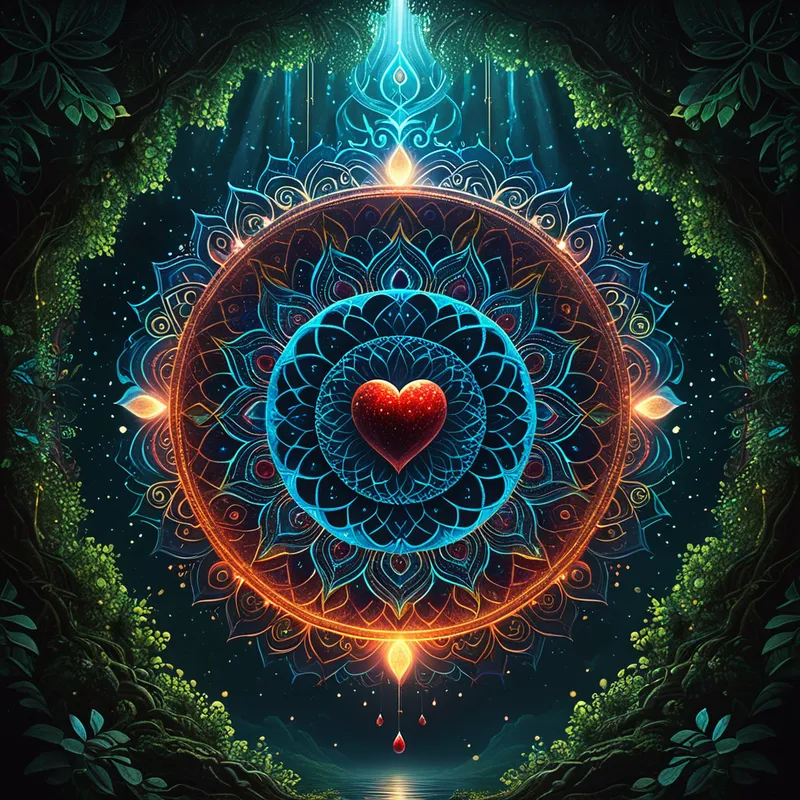
When this myth stirs in the modern unconscious, it rarely appears as a literal story. It manifests as a somatic and emotional landscape. To dream of a blood-rain, or to find oneself in a dream giving something vital away until one fades, is to encounter the Yawar process.
Psychologically, this is often a signal of a necessary depletion. The dreamer may be in a life phase—a caregiving role, a creative project, a period of intense emotional labor—that requires the expenditure of a deep reserve. The dream is not necessarily a warning, but an initiation into the mythic dimension of their experience. The somatic feeling is often one of profound release mixed with deep fatigue, a sense of being "poured out."
It asks the dreamer: What is the "life-blood" you are being asked to offer? Is it your time, your emotional energy, an old identity? And crucially, what is the "parched earth" in your life or community that this offering is meant to nourish? The dream challenges the modern cult of personal preservation, suggesting that some forms of exhaustion are sacred, the prelude to a new kind of fertility.

Alchemical Translation
The individuation process, the journey toward psychic wholeness, requires many deaths. The Yawar myth models the most sacred of these: the death-by-offering.
Individuation is not just about claiming one's gold; it is about consciously choosing what parts of one's soul-essence to spend, and on what altar.
The first alchemical stage is Recognizing the Drought (Calcinatio). This is the burning, arid feeling of a life that has become sterile, repetitive, emotionally dry. The ego's resources are exhausted. One must confront the fact that continuing as one is, is a living death.
The core transmutation is The Voluntary Sacrifice (Solutio). This is the conscious, painful decision to liquefy a bound form—a cherished self-image, a stored-up resentment, a hoarded talent—and let it flow out. It is the act of the caregiver who must finally care for the world by spending their own stored essence. This is not martyrdom, but a sacred exchange: inner complexity for outer fertility.
The result is Communion and New Growth (Coagulatio). The sacrificed essence does not vanish; it is taken up into the larger system—the psyche, relationships, community. The "rain" that follows brings new connections, insights, and creative impulses that feel both foreign and deeply familiar, for they are grown from the seeds of what was given. The individual is no longer a discrete, parched self, but a node in a nourishing cycle. They have learned the ultimate lesson of the caregiver archetype: that in the right sacrifice, one does not lose oneself, but becomes a vital part of the living world's bloodstream.
Associated Symbols
Explore related symbols from the CaleaDream lexicon: