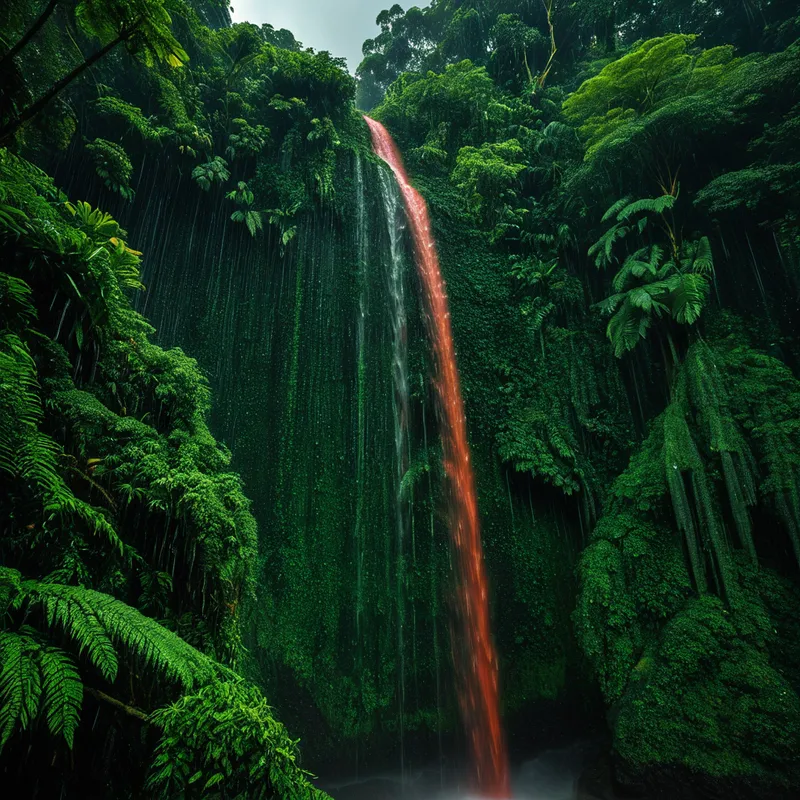
The Dream of Ecology: The Psyche’s Internal Ecosystem
The Somatic Echo
Before the image of a dying tree or a polluted river forms in the mind’s eye, the dream of ecology announces itself in the body. It is a deep, systemic unease. A feeling of being out of sync—not just tired, but depleted at the root. It can manifest as a hollow ache in the solar plexus, a sign of resources being drained from a core you cannot name. Or it might be a tightness in the chest, a constriction of breath, as if the very air you draw upon internally has grown thin and toxic. This is the somatic whisper of an internal ecosystem under stress, a signal that the relationships between your parts—your thoughts, your emotions, your exiled histories—have become extractive, polluted, or neglected. The body knows imbalance long before the conscious self can articulate the crisis.
The Dreamer’s Log (Case Vignette)
In the dream, I am in my apartment, but it is also a vast, silent greenhouse. I notice a single potted plant on the windowsill, a species I don’t recognize. Its leaves are turning a translucent, brittle brown, and I realize with a slow-dawning horror that I haven’t watered it in years. I rush to the sink, but the tap only groans and releases a trickle of rust-colored dust.
This dream is not about horticulture; it is an alchemical portrait of a vital, instinctual part of the self left in a state of profound neglect, its life-force slowly desiccating within the controlled environment of the persona.

The False Lead
The dream of ecology is not a simple warning about environmental activism or a literal concern for planetary health, though it may wear that costume. To mistake it for only that is to externalize a profoundly internal process. It is also not merely a metaphor for “feeling drained” or “needing self-care.” Those are surface symptoms. The true theme speaks to a structural, systemic failure in the psyche’s own governance—a breakdown in the sacred reciprocity between the conscious ego and the autonomous, instinctual life of the unconscious. It is the dream of a kingdom where the ruler has forgotten they are also a steward, where parts of the realm have been declared wastelands and cut off from the capital’s resources.
Psychological Architecture
The architecture here is one of relational collapse. In the language of internal family systems, it is the exile of the “wild” parts—the untamed emotions, the unruly creativity, the raw instinct—to psychic landfills, where they fester and leak toxicity back into the system. The manager parts, in their desperate bid for control and order, pave over the wetlands of intuition and dam the rivers of feeling, creating a psyche that is orderly but sterile, efficient but dying of thirst. The shadow work of the ecology dream is the agonizing, humble labor of decommissioning this internal monoculture. It requires venturing into those neglected territories, not as a colonizer with solutions, but as a penitent listener. You must sit in the silence of the “polluted river” within—the backlog of grief, the swamp of shame—and allow it to speak its history of misuse. Individuation in this realm is the slow, non-linear process of restoring biodiversity to the soul, recognizing that the “weed” of rage and the “blight” of sorrow have their own necessary functions in the holistic health of the whole.
Mythic Resonance
This process echoes the myth of the Wasteland, most famously rendered in the Arthurian Grail legends. The kingdom does not fall to an external enemy, but to a sickness that emanates from its wounded, impotent king—the Fisher King. The land and the ruler are one: his unhealed wound (a failure of sovereignty, a break in right relationship) manifests as a barren, lifeless realm where nothing grows, and the waters are poisoned. The healing question—Whom does the Grail serve?—is not one of utility, but of sacred service and restored order. It challenges the ego’s assumption of ownership, pointing toward a stewardship based on reverence for a life that flows through but does not belong to it. Similarly, the Greek figure of Gaia is not merely “Earth,” but the primal, systemic intelligence of a living, responsive whole. To offend one part is to offend the entire organism, a truth the psyche knows intimately.
Symbolic Nodes
- Dying or Polluted Water: Stagnant emotions, poisoned intuition, a loss of life’s flow.
- Barren or Toxic Land: Creative infertility, a foundation that cannot support growth, the scorched earth of burnout.
- Wilting Plants/Sick Animals: Neglected instincts, untended talents, parts of the self starving for attention.
- Invasive Species or Concrete Overgrowth: Mental patterns or defensive systems that choke out native, authentic feeling.
- Unseasonal Weather (Internal Storms, Unending Drought): Emotional disregulation, a climate of inner chaos or aridity.
- Mycelial Networks or Root Systems Revealed: The sudden, awe-inspiring vision of the hidden, connective intelligence of the unconscious.
Archetypal Resonance
The core energy of the ecology dream resonates most powerfully with The Ruler Archetype, specifically in its shadow manifestation. The Shadow Ruler is the internal control-freak, the tyrant of the psyche who believes in dominion through separation, order through suppression, and security through extraction. It is this archetype that builds the psychic dams, declares the emotional wetlands “unproductive,” and mines the soul’s resources without thought for renewal. The somatic echo of tightness and depletion is the direct result of this shadow governance. Yet, the alchemical potential lies in the Ruler’s true purpose: to establish healthy, sovereign order. The dream is a call for this archetype to undergo a metamorphosis—from a tyrant of control to a steward of balance, from a sovereign of dominion to a guardian of sacred reciprocity within the kingdom of the self.
The Alchemical Process
The alchemical transmutation for the ecology dream is Reintegration. The prima materia is the psychic wasteland itself—the feeling of systemic collapse. The intense heat and pressure required are born of a specific, courageous grief: the grief of acknowledging your own complicity in the internal pollution. It is the heat of shame faced without flinching, and the pressure of holding the paradox that you are both the wounded king and the land that suffers. This is the nigredo, the blackening. The process then moves to albedo, the whitening, which is not a cleansing with bleach, but a patient listening. You listen to the testimony of the exiled “weed,” the polluted “river.” You allow their truth to wash over your old maps of self. The final stage, rubedo, the reddening, is the emergence of a new, embodied wisdom: sovereignty as ecosystem. It is the realization that your authority is not diminished by serving the needs of the whole; it is perfected by it. The terror of collapse is transmuted into the profound sovereignty of being a conscious, responsible node within your own vast, living network.

The Integration Protocol
Question 1: Where in my life—in my habits, relationships, or internal dialogue—am I practicing extraction? Where do I take without thought of return, demanding a yield that the system cannot sustainably give?
Question 2: What part of myself have I declared a “wasteland”? What emotion, memory, or desire have I walled off and left to fester, and what might it be trying to compost into nourishment for the whole?
Question 3: If my psyche were a landscape, what is its most neglected element right now—its water (feeling), its soil (foundation), its climate (atmosphere), or its wildlife (instincts)? What one gesture of attention does it crave?
Action 1 (Grounding Scan): Sit quietly and perform a body scan not for relaxation, but for ecological survey. Without judgment, note areas of tension (dams), numbness (barren land), ache (depleted resources), or flow (healthy waterways). Simply map the territory of your somatic ecosystem for five minutes.
Action 2 (Unstructured Cartography): With large paper and charcoal, pastels, or mud-like paint, let your hand draw the internal landscape of your psyche as it feels today. Do not draw objects; draw textures, forces, densities. Let a knot of worry be a tangled thicket, a spark of hope a tiny spring. This is creative data-gathering, not art-making.
Action 3 (Ritual of Reciprocity): Choose one small, neglected daily action (watering a plant, preparing a meal with care, cleaning a corner) and perform it with the silent, meditative intention that you are tending to a corresponding, neglected part of your inner world. Let the external act be a covenant with the internal.
Final Validation
To dream of ecological collapse is to feel the profound terror of a world—your inner world—coming undone. It is a heavy, daunting vision. Validate that weight. It is real. And yet, within that very dream lies the seed of the most profound sovereignty you can claim: the sovereignty of the steward. You are being shown the blueprints of your own systemic self, not to condemn you, but to invite you back into right relationship with all that you are. The restoration does not begin with a grand plan, but with the first, humble act of listening to a single, parched leaf within. The kingdom awaits its true ruler.