Yamantaka Myth Meaning & Symbolism
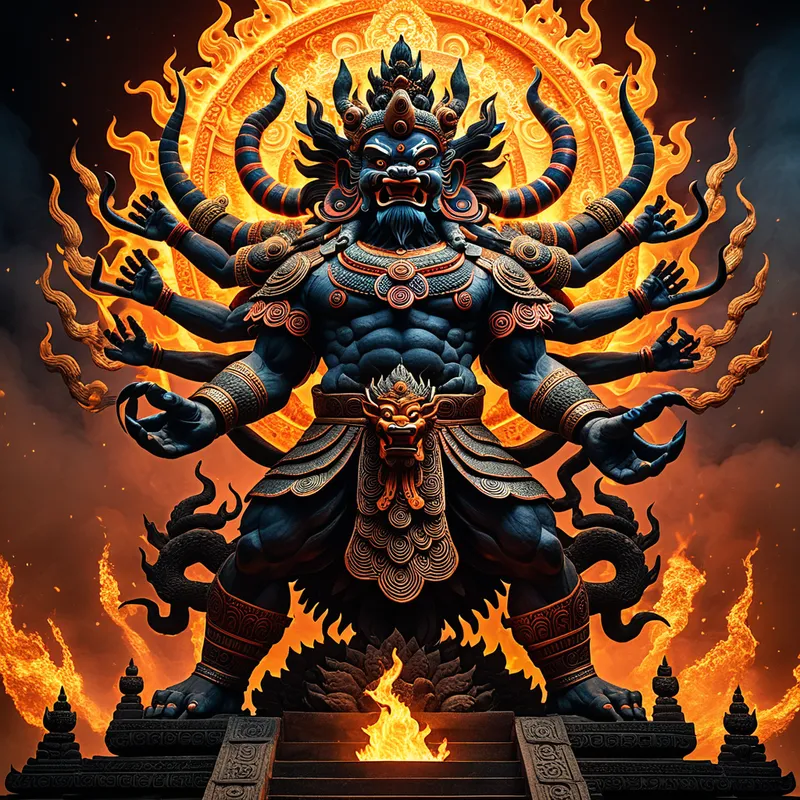
The story of the bodhisattva Manjushri assuming the terrifying form of Yamantaka to subdue the lord of death, Yama, and liberate beings from fear.
The Tale of Yamantaka
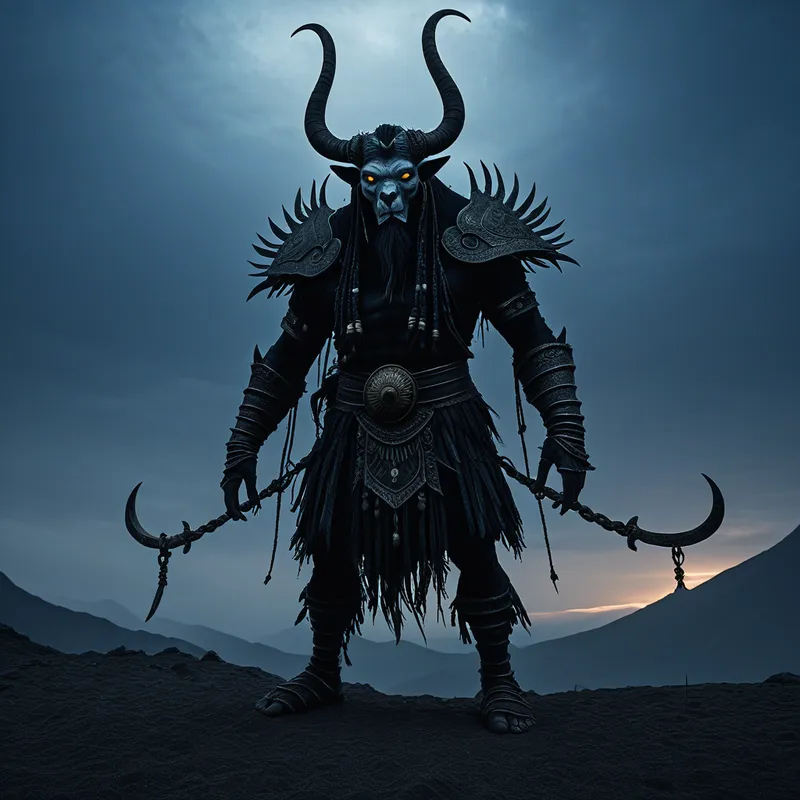
Listen. In the time before time, in a place that is no place, a shadow grew so vast it drank the light from the world. This was not a shadow of mere absence, but a presence—the Lord of Death, Yama. He dwelt in the charnel grounds, where the winds carry the whispers of the departed and the earth is fed by memory. His form was terrible: the head of a raging buffalo, eyes like burning coals, in his hand a noose to snare the life-force, a club to shatter hope. His dominion was absolute. He measured the length of every life, and his law was the unyielding law of endings. All beings, from the highest god to the smallest insect, trembled at the echo of his breath. The universe was bound in a silent scream, trapped in the wheel of his making.
But in the heart of this terror, a different kind of fire was kindled. It was the fire of wisdom, boundless and clear. The great bodhisattva of discerning wisdom, Manjushri, beheld the suffering. He saw not just the fact of death, but the paralysis it wrought—the fear that poisoned life at its source. To teach, to reason, to show a peaceful face would not reach into this primal darkness. The shadow demanded a shadow; the terror required a greater terror, one forged not from ignorance, but from ultimate compassion.
Thus, Manjushri undertook the supreme alchemy. From the molten core of his unwavering vow to liberate all beings, he manifested a form of unimaginable power. He became Yamantaka—the Destroyer of Death. Where Yama had one buffalo head, Yamantaka erupted with nine, the central one a furious bull, surrounded by faces of wrath and wisdom. Where Yama had two arms, Yamantaka blazed with thirty-four, each hand gripping a weapon of transcendental purpose: the phurba, the lotus, the vajra, the sword of prajna that cuts through delusion. His sixteen legs stamped upon a tableau of beasts and gods, and beneath his primary right foot, he pressed down upon the buffalo of Yama himself. And beneath that buffalo, prostrate and subdued, lay the human-form of Yama, the Lord of Death, finally overcome.
The confrontation was not a battle of annihilation, but of integration. Yamantaka, the wrathful face of Manjushri’s wisdom, did not slay Yama. He confronted him, overwhelmed him, and in doing so, revealed Yama’s true nature: not as an external tyrant, but as a projection of the mind’s own attachment and fear. In that moment of cosmic subjugation, the noose of death became a garland of liberation. The terror was transformed into a protector; the end became a gate.
Cultural Origins & Context
The myth of Yamantaka is not a folktale but a core mandala of Vajrayana Buddhism, particularly central to the Gelug and Sakya schools of Tibet. It arrived from the mystical universities of India like Nalanda, carried by great mahāsiddhas and translators. This is a teaching preserved and transmitted with extreme precision through unbroken oral lineages (ear-whispered transmission) and elaborate textual cycles.
Its societal function is multifaceted. On an exoteric level, Yamantaka is a dharmapāla, a protector against outer and inner obstacles. More profoundly, the practice of the Yamantaka mandala is a complete tantric path. It is a sophisticated psycho-cosmology given form, a map for advanced practitioners to navigate the most subtle territories of consciousness. The myth is enacted internally through visualization, mantra, and ritual, where the practitioner becomes Yamantaka to confront and transform their own inner Yama—the ego-clinging that births the fear of mortality. It is a technology of enlightenment, using the raw material of primal fear as the fuel for transcendence.
Symbolic Architecture
The myth is a dense symbolic [architecture](/symbols/architecture “Symbol: Architecture in dreams often signifies structure, stability, and the framing of personal identity or life’s journey.”/) of psychic [integration](/symbols/integration “Symbol: The process of unifying disparate parts of the self or experience into a cohesive whole, often representing psychological wholeness or resolution of internal conflict.”/). Yama represents the ultimate neurosis: the ego’s terrified rebellion against impermanence. He is the tyrant we ourselves empower, the [shadow](/symbols/shadow “Symbol: The ‘shadow’ embodies the unconscious, repressed aspects of the self and often represents fears or hidden emotions.”/) of our own denial.
To face death in its most literal form is to confront the architect of all limitation. Yamantaka is the psyche’s revolutionary act of turning the force of the complex back upon itself.
Manjushri’s transformation into Yamantaka symbolizes that wisdom (prajñā) alone is not enough to dismantle deep, affective knots; it must take on a form commensurate with the power of the [knot](/symbols/knot “Symbol: A knot symbolizes connections, commitments, complications, and the binding or untying of relationships and situations.”/). The nine heads see in all directions, representing the omniscience of wisdom. The multitude of arms signify the infinite skillful means (upāya) employed by [compassion](/symbols/compassion “Symbol: A deep feeling of empathy and concern for others’ suffering, often involving a desire to help or alleviate their pain.”/). The subjugation of Yama is not a victory over an external [enemy](/symbols/enemy “Symbol: An enemy in dreams often symbolizes an internal conflict, self-doubt, or an aspect of oneself that one struggles to accept.”/), but the reintegration of the [death](/symbols/death “Symbol: Symbolizes transformation, endings, and new beginnings; often associated with fear of the unknown.”/)-drive into the [mandala](/symbols/mandala “Symbol: A sacred geometric circle representing wholeness, the cosmos, and the journey toward spiritual integration.”/) of wholeness. The practitioner does not flee from the [image](/symbols/image “Symbol: An image represents perception, memories, and the visual narratives we create in our minds.”/) of their own [mortality](/symbols/mortality “Symbol: The awareness of life’s finitude, often representing transitions, impermanence, or existential reflection in dreams.”/); they stand upon it, using its [energy](/symbols/energy “Symbol: Energy symbolizes vitality, motivation, and the drive that fuels actions and ambitions.”/) as the [foundation](/symbols/foundation “Symbol: A foundation symbolizes the underlying support systems, values, and beliefs that shape one’s life, serving as the bedrock for growth and development.”/) for enlightenment.
The Dreamer’s Resonance
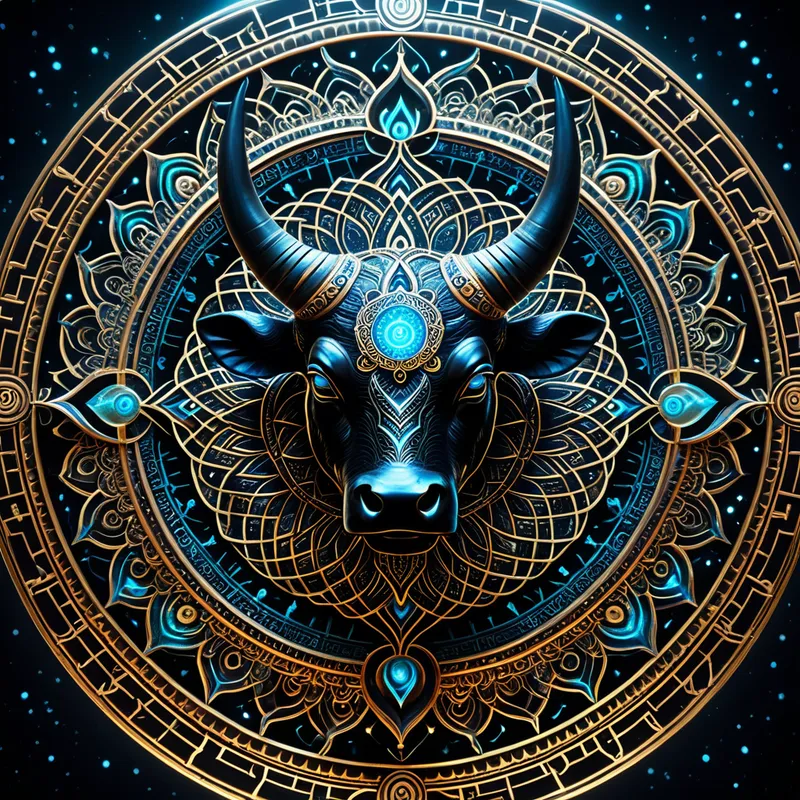
When this myth stirs in the modern dreamer, it signals a profound encounter with the Shadow in its most potent form. It is not a dream of mild anxiety, but of existential confrontation. One might dream of being pursued by an unstoppable, buffalo-headed force, or of standing in a desolate landscape (the charnel ground of old identities) facing a monstrous embodiment of a life-crushing fear—failure, annihilation, meaninglessness.
The somatic experience is often one of paralysis giving way to a surge of fierce, unfamiliar energy. The psychological process is the ego’s recognition of a power greater than itself, not from above, but from within the depths of its own terror. The dream-Yamantaka emerges not as a savior from the sky, but as a transformation of the dreamer’s own stance. It is the moment the dream-ego stops running and turns, finding its own form morphing into something capable of the confrontation. This is the psyche initiating its own tantric rite: using the imagery of the nightmare as the raw material for a breakthrough.

Alchemical Translation
The alchemy of Yamantaka is a master template for individuation. It models the process of psychic transmutation where the lead of our most fundamental fear is turned into the gold of liberated consciousness.
The first step is honest recognition: naming the personal “Yama.” What is the ultimate inner tyrant? The voice of irreversible failure? The specter of abandonment? The conviction of one’s own unworthiness? This tyrant holds a noose, constricting life into a narrow, defensive pattern.
The second step is the heroic, compassionate wrath of Manjushri. This is not anger, but an absolute, unwavering refusal to let this tyrant govern one’s inner kingdom. It is the decision, born of self-compassion, to fight for one’s own psychic freedom.
The transmutation occurs when we stop seeing the inner demon as an alien to be expelled and begin to see it as a disowned power to be reclaimed and redirected.
The final, alchemical stage is the assumption of the Yamantaka form. This is the integration. The practitioner—the individual on the path of wholeness—must “become” the solution. They must develop the “multiple arms” of new skills, perspectives, and actions. They must cultivate the “nine heads” of broader awareness. They must stand firmly upon the subdued form of their fear, not by pretending it doesn’t exist, but by fully acknowledging its presence and using its very energy as the platform for their empowered life. The conquered fear becomes the foundation of unwavering courage. The destroyer of death becomes, paradoxically, the great affirmation of life.
Associated Symbols
Explore related symbols from the CaleaDream lexicon:
- Death — The central antagonist of the myth, representing not just physical cessation but the psychological tyranny of impermanence and ending that Yamantaka confronts and transforms.
- Shadow — Yama embodies the ultimate Shadow—the repressed fear of non-existence that Yamantaka, as an aspect of the enlightened mind, must integrate and overcome.
- Ritual — The entire myth is encoded in elaborate Vajrayana rituals where practitioners visually and energetically enact the transformation of Yama into a protector.
- Hero — Manjushri, in his manifestation as Yamantaka, performs the ultimate heroic act: confronting the universal fear of death itself for the liberation of all beings.
- Fear — The raw material of the myth; the primal, paralyzing terror that Yamantaka’s fierce compassion metabolizes into wisdom and power.
- Transformation — The core action of the narrative, depicting the alchemical change of a bodhisattva into a wrathful deity and of death’s lord into a subdued foundation.
- Lightning — Symbolizes the sudden, piercing insight of wisdom (prajna) that cuts through the darkness of ignorance and fear, akin to the swords held by Yamantaka.
- Dragon — In a broader symbolic sense, represents the powerful, primal energy of the unconscious that Yamantaka harnesses and rides, rather than being consumed by it.
- Mirror — Represents the wisdom that reflects reality perfectly, showing Yama that his power is a reflection of the mind’s own projections, which Yamantaka’s realization shatters.
- Circle — Evokes the mandala of Yamantaka, a complete, encircled cosmos where all forces, including death, are integrated into a sacred totality.
- Buddhist Stupa — A symbol of the enlightened mind; the Yamantaka practice aims to build such an indestructible, luminous structure within the practitioner’s consciousness.
- Key — Yamantaka is the key that unlocks the prison of cyclic existence (samsara) governed by the fear of death, opening the gate to liberation.