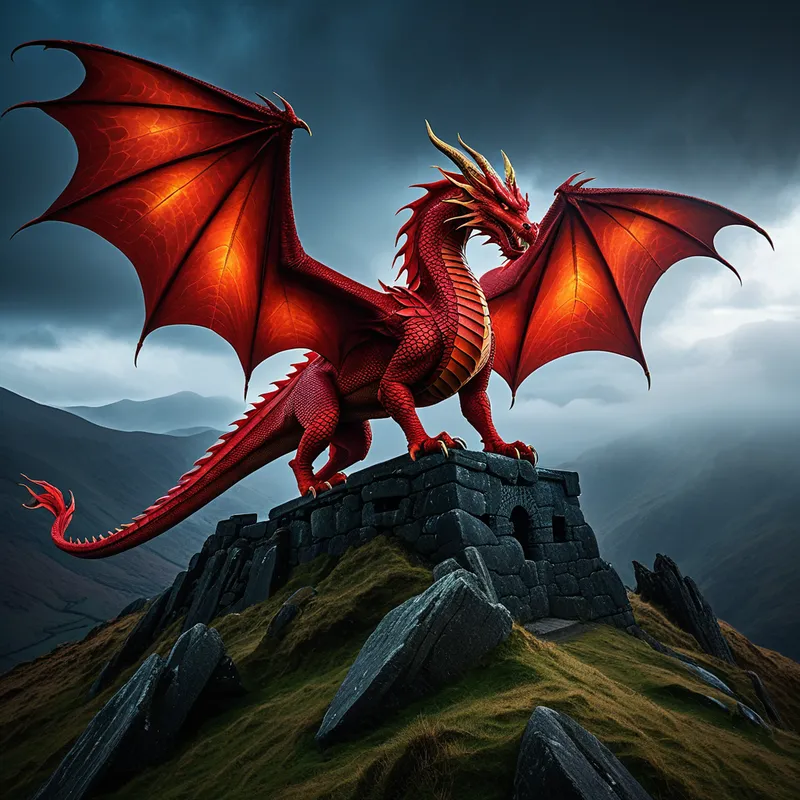
Y Ddraig Goch Myth Meaning & Symbolism
A prophecy of two dragons, one red and one white, battling beneath a mountain, foretelling the enduring spirit and sovereignty of a people.
The Tale of Y Ddraig Goch
Hear now, and listen well, for I sing of a time when the land itself was a dream, and kings were but shadows cast by a greater fire. In the mist-cloaked hills of Gwynedd, where the stones remember the footsteps of giants, there stood a fortress called Dinas Emrys. Its walls were meant to stand forever, but each night, as the sun fled and the stars pricked the velvet dark, the masons’ work would crumble into dust and scattered rubble. No mortar could hold, no foundation could settle. A deep, silent sickness gnawed at the roots of the hill.
To this cursed place came Vortigern, a king without a throne, fleeing the winds of fate. Desperate, his druids whispered a grim remedy: the fortress must be founded on the blood of a fatherless child. And so they scoured the land until they found a boy named Myrddin Emrys. His eyes held not fear, but a deep, still pool of knowing.
Brought before the king, the boy did not plead. He spoke, and his voice was the sound of a distant spring breaking through winter ice. “Your wise men are fools,” he said. “Dig. Let your men delve deep beneath this hill, and you will find a lake. And in that lake, you will find your answer.”
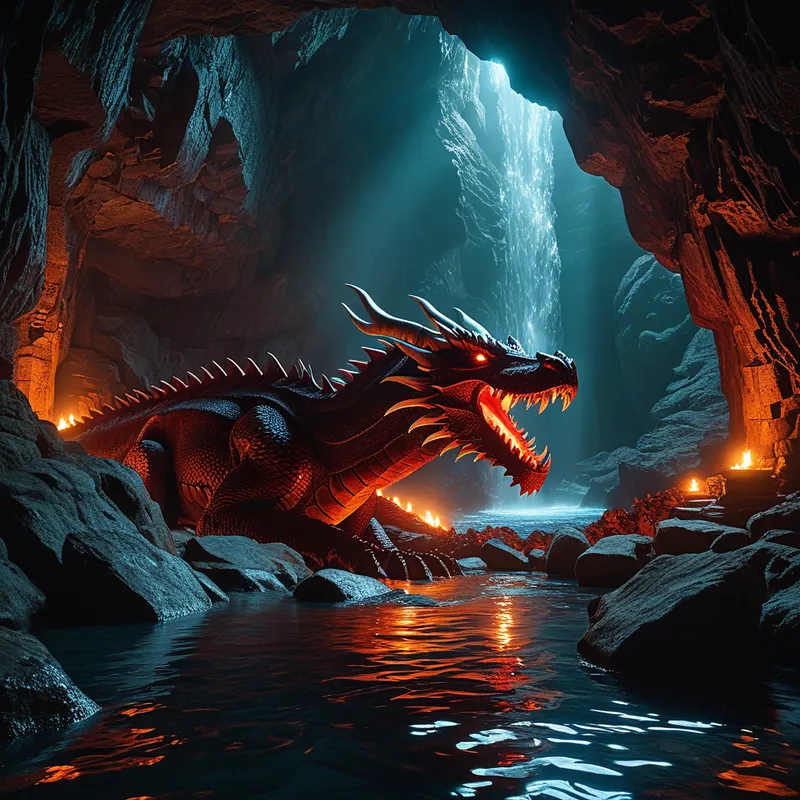
Driven by a hope born of despair, Vortigern’s men dug. Their spades bit into the cold earth, past roots and worms, until they broke through into a vast, hidden cavern. There, in the absolute black, water gleamed—a still, subterranean mere. And as they watched, holding their breath in the damp air, the water began to churn.
From the depths came a roar that shook the very bones of the mountain. A colossal, scaled form erupted, scales the colour of freshly spilled blood, eyes like molten gold. It was Y Ddraig Goch, a creature of primordial fire and fury. But it was not alone. A second beast surged forth, its hide pale as bleached bone, its roar a shriek of icy wind. The White Dragon.
And so, beneath the weight of the world, they fought. The cavern became a hell of clashing scale, of searing flame and freezing mist. The red dragon would rise, its fire lighting the stone vault, only to be dragged down by coils of pale, relentless strength. The white would ascend, only to be met by crimson talons and jaws of flame. The earth trembled; the waters boiled. It was a battle without beginning, without end—an eternal conflict buried in the dark heart of the land.
Then Myrddin spoke again, his words cutting through the din. “Behold the prophecy! The red dragon is the people of this island, the Cymry. The white dragon is the Saxons, who have come across the sea. For now, the white dragon seems to have the upper hand, and the people of the red dragon suffer. But look! See now!”
As he spoke, the red dragon, battered and bleeding, found a reserve of fury deeper than the mountain’s roots. With a final, earth-shattering roar, it turned its fire inward, a purifying blaze, and then outward in a conquering wave. It seized the white dragon, and with a crack that echoed like the breaking of a world, it cast its pale foe down, defeated. The waters stilled. The red dragon, sovereign of the deep, lifted its head in triumphant silence.
“The time will come,” the boy-prophet said, his gaze seeing centuries unfold, “when the red dragon will rise, and its people will reclaim this land.”
Cultural Origins & Context
The prophecy of the dragons is not a mere fireside fancy. It is the foundational mythos of Welsh identity, first recorded in the 9th-century Historia Brittonum and later woven into the grand tapestry of Geoffrey of Monmouth’s work. It emerged from a culture under immense pressure, a people—the Brittonic kingdoms—watching their world shrink before the advancing Anglo-Saxon settlements. The myth served as a profound act of cultural resilience.
It was a story told by bards in the halls of princes facing defeat, a narrative seed of hope planted in the soil of despair. By locating the struggle not on a battlefield, but in the very bedrock of the homeland (Dinas Emrys), the myth asserted an unbreakable connection between the people and the land. Their spirit was not a flag to be captured, but a dragon sleeping in the mountain, an indomitable force of nature itself. The prophecy provided a framework to understand historical catastrophe not as an end, but as a painful phase in a longer, destined cycle of awakening and return. It transformed military loss into spiritual latency.
Symbolic Architecture
At its core, the myth is a masterful depiction of the archetypal struggle for sovereignty. The dragons are not merely opposing armies; they are primal psychological forces.
The battle is not won on the surface, in the daylight world of kings and walls, but in the subterranean realm of collective psyche and fate.
The Red Dragon symbolizes the deep, instinctual, chthonic spirit—the hiraeth—of a people. It is passion, connection to the land, and the will to exist. Its red is the colour of blood-ties, of life-force, and of sacred rage. The White Dragon represents the opposing force: not pure evil, but often the alien, the rationalizing, the disconnecting power that seeks to overwrite an existing order. It is the colour of bone, of pallor, of a spirit divorced from its native soil.
Their eternal battle beneath the lake speaks to conflicts that define an identity. The lake is the unconscious, both personal and collective. The fact that the fortress above cannot be built until this conflict is witnessed and understood is the central lesson: no lasting structure of the self or the state can be erected on unexamined, buried conflict. The prophecy of eventual victory is the promise that the core, authentic self (the red dragon), though long suppressed, holds an indestructible potency that will, in its own season, reassert its sovereignty.
The Dreamer's Resonance
When this myth stirs in the modern dreamer, it signals a profound process of inner realignment. To dream of two great beasts fighting in a cavern, or of a red serpent/dragon emerging from water or earth, is to dream of a foundational conflict rising from the personal unconscious.
Somatically, this may manifest as a feeling of deep, internal trembling—anxiety that seems to come from the very core, not the mind. Psychologically, it is the experience of a long-buried aspect of the self (a native passion, a cultural inheritance, a core value) beginning to struggle against a dominant, perhaps internalized, “foreign” force (a demanding persona, a conditioning voice, an alienating belief system). The dreamer is the hill of Dinas Emrys; their conscious life feels unstable because something essential is fighting for recognition in the depths. The dream is an invitation to “dig,” to engage in the shadow-work of descending into one’s own hidden cavern to witness the battle, rather than continuing to build on a shaky, unexamined foundation.
Alchemical Translation
The myth of Y Ddraig Goch is a perfect allegory for the alchemical and Jungian process of individuation. The initial state is one of nigredo—the blackening. This is Vortigern’s despair, the crumbling fortress, the dark, unresolved conflict causing all conscious efforts to fail.
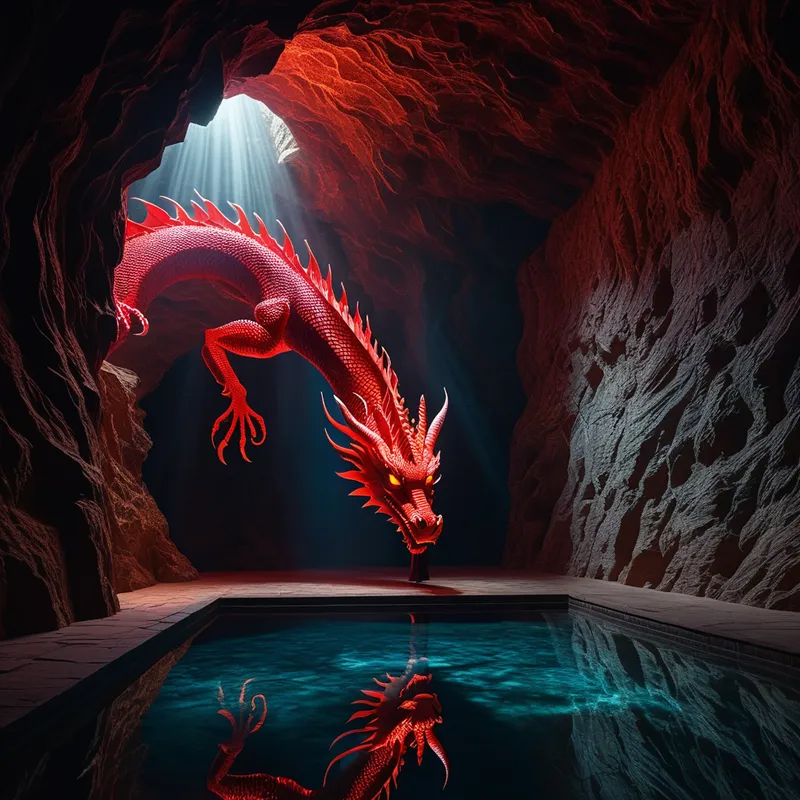
The command to dig is the beginning of the work—the katabasis. One must voluntarily go down into the dark, moist, chaotic realm of the unconscious (the cavern lake). There, one encounters the paired opposites in their raw, animalistic form: the red dragon (the libidinal, feeling, instinctual function) and the white dragon (the spiritual, thinking, perhaps overly spiritualized function). In the personal psyche, these might be passion versus reason, tradition versus innovation, aggression versus passivity.
The transmutation occurs not by choosing one dragon over the other, but by witnessing their struggle until the red—the deeply rooted, life-affirming Self—integrates the energy of its opponent and achieves a new, sovereign wholeness.
The prophecy is the promise of the rubedo—the reddening. It is the emergence of the true, integrated Self, crowned and sovereign. The red dragon’s final victory is not the annihilation of the white, but its subjugation and integration into a new hierarchy where the core Self rules. For the modern individual, this translates to the hard-won moment when one’s authentic nature, long at war with internalized critics or false personas, finally rises, claims its territory, and allows for the building of a life that is truly, unshakably one’s own. The dragon is no longer a buried conflict, but the emblem on the shield—the conscious symbol of a hard-fought and enduring sovereignty of spirit.
Associated Symbols
Explore related symbols from the CaleaDream lexicon: