Xango in Candomble Myth Meaning & Symbolism
The myth of Xango, the thunder king, is a story of divine justice, fiery sovereignty, and the transformative power of confronting one's own destructive potential.
The Tale of Xango in Candomble
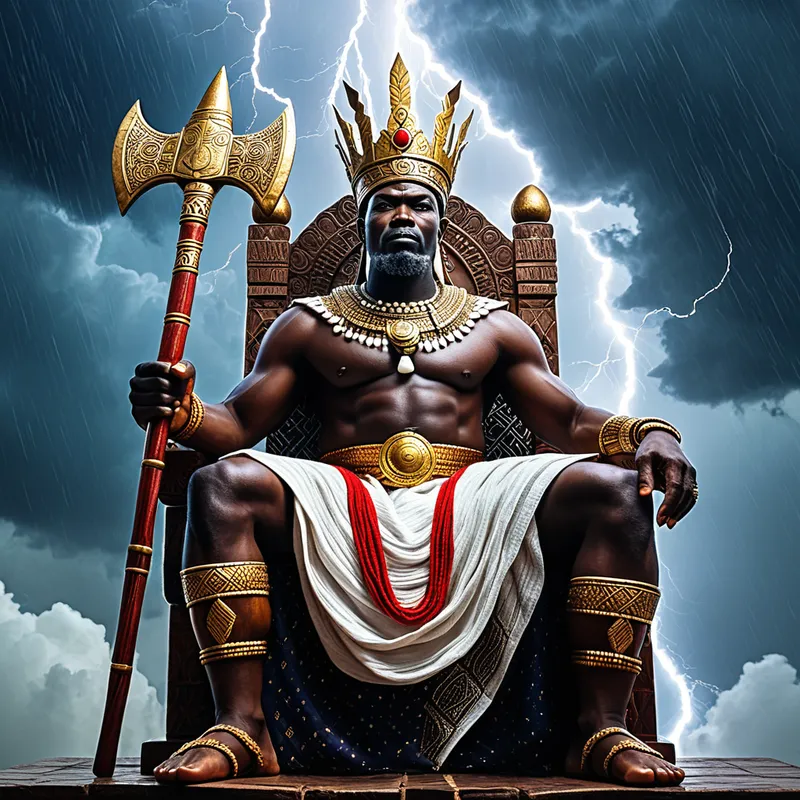
Hear now the tale that rides the storm wind, the story written in lightning and carved in stone. In the time when the world was young and the Ase of creation still hummed close to the skin of the earth, there was a king. Not just a king of men, but a king whose soul was twin to the fury of the heavens. His name was Xango.
He ruled the great city of Oyo, a kingdom of order and strength. His palace was not of mere wood and mud, but of the people’s awe, built upon the unshakable foundation of his word. When Xango spoke, his voice did not whisper; it was the low rumble that precedes the deluge, a sound that settled in the chest like a promise or a threat. In his right hand, he carried the Ose, an axe that could cleave falsehood from truth. His colors were the white of purity and the red of fire—and of life’s vital blood.
Yet, within this king lived a terrible hunger, a fire that warmed his people but could also consume. He desired a power known only to his wife, Oya, the mistress of the cemetery gates and the whirlwind. She possessed a mighty incantation, a secret oriki that could call down lightning from the sky itself. Xango, in his sovereign passion, demanded it of her. Love, fear, and duty warred within Oya, but she yielded, whispering the potent words into her husband’s ear.
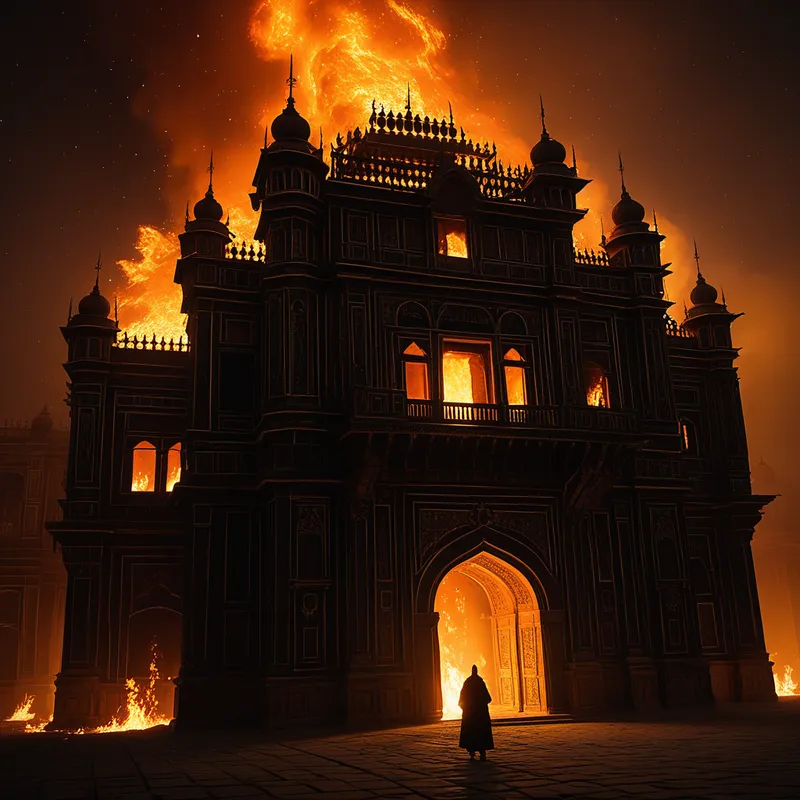
The power flowed into Xango, and it was glorious. He stood on his balcony and called, and the sky answered with jagged veins of light, with earth-shaking applause. But the fire in him grew wild, untamed by the wisdom that Oya’s long companionship with the spirit world had granted her. In a moment of royal rage, a fit of passion sparked by a slight, Xango invoked the new spell. Lightning struck—not the barren earth, but the very heart of his palace.
Fire, born of heaven’s fury, took hold of his own home. The red and white tapestries became fuel; the proud pillars groaned as they blackened. His people, his children, his other wives fled from the wrath of their own king. Xango watched, the Ose falling from his grasp, as his justice turned to chaos, his power to ash. The blaze reflected in his eyes, not as triumph, but as a horrifying revelation.
When the smoke cleared, only ruin remained. The king who commanded the sky could not command the consequences of his own unleashed spirit. In that ash-strewn silence, faced with the devastation of his own hand, Xango made a choice that would echo through eternity. He did not flee into exile as a broken man. Instead, he walked away from the smoldering ruins of his earthly kingdom and, in an act of ultimate sovereignty, hanged himself upon a sacred tree. It was not an end, but a profound transformation. From that moment, he was no longer merely a king of Oyo. He ascended, transcending mortal failure to become the eternal Orisha of Thunder, his justice tempered by the memory of his own fall, his power forever linked to the necessary, destructive storm that clears the air for new growth.
Cultural Origins & Context
This myth of Xango is not a mere folktale; it is a living pillar of spiritual and social memory, carried across the Atlantic in the minds and hearts of enslaved Yoruba people. Transplanted to Brazil, particularly in the northeastern state of Bahia, the story found new soil in the rich, syncretic tradition of Candomble. Here, the orishas were preserved under immense persecution, their identities sometimes hidden behind the visage of Catholic saints—Xango often associated with Saint Jerome or Saint Barbara.
The myth was passed down not through written texts, but through the sacred oral traditions of the terreiro. It was told by ialorixas and babalorixas to initiates, woven into the rhythms of the toques and the movements of the dances. Its societal function was multifaceted: it explained the nature of thunder and lightning, it established a model of kingship that was powerful yet fallible, and it served as a profound ethical lesson on the double-edged nature of power, justice, and anger. In the context of the diaspora, where communities faced brutal injustice, the story of a god who wielded ultimate justice and who understood catastrophic failure from within provided a complex narrative of resilience, accountability, and transcendent strength.
Symbolic Architecture
At its core, the myth of Xango is an archetypal [drama](/symbols/drama “Symbol: Drama signifies narratives, emotional expression, and the exploration of human experiences.”/) of the Ruler confronting his own [shadow](/symbols/shadow “Symbol: The ‘shadow’ embodies the unconscious, repressed aspects of the self and often represents fears or hidden emotions.”/). The [lightning](/symbols/lightning “Symbol: Lightning symbolizes sudden insights or revelations, often accompanied by powerful emotions or disruptive change.”/) is not merely a meteorological [symbol](/symbols/symbol “Symbol: A symbol can represent an idea, concept, or belief, serving as a powerful tool for communication and understanding.”/); it is the brilliant, dangerous flash of [insight](/symbols/insight “Symbol: A sudden, deep understanding of a complex situation or truth, often arriving unexpectedly and illuminating hidden connections.”/), will, and raw psychic [energy](/symbols/energy “Symbol: Energy symbolizes vitality, motivation, and the drive that fuels actions and ambitions.”/). Xango’s desire for Oya’s secret represents the [soul](/symbols/soul “Symbol: The soul represents the essence of a person, encompassing their spirit, identity, and connection to the universe.”/)’s [hunger](/symbols/hunger “Symbol: A primal bodily sensation symbolizing unmet needs, desires, or emotional voids. It represents craving for fulfillment beyond physical nourishment.”/) for integrated power—the masculine [consciousness](/symbols/consciousness “Symbol: Consciousness represents the state of awareness and perception, encompassing thoughts, feelings, and experiences.”/) seeking the transformative, wild wisdom often symbolized by the feminine (Oya, who rules winds and cemeteries, is change and the unknown).
The king’s fire must first warm the hearth before it can be thrown at the enemy, lest it burn down the palace.
The catastrophic fire is the inevitable result when a potent force is acquired without the corresponding inner [vessel](/symbols/vessel “Symbol: A container or structure that holds, transports, or protects something essential, representing the self, emotions, or life journey.”/) to hold it. It is the [eruption](/symbols/eruption “Symbol: A sudden, violent release of pent-up energy or emotion from beneath the surface, often representing transformation or crisis.”/) of the unconscious, the rage or pride that, when unleashed untempered, destroys what one holds most dear. Xango’s subsequent transformation—his self-hanging and [apotheosis](/symbols/apotheosis “Symbol: The transformation of a mortal into a divine or godlike state, representing ultimate spiritual elevation and transcendence of human limitations.”/)—is the critical alchemical [moment](/symbols/moment “Symbol: The symbol of a ‘moment’ embodies the significance of transient experiences that encapsulate emotional depth or pivotal transformations in life.”/). It symbolizes the [death](/symbols/death “Symbol: Symbolizes transformation, endings, and new beginnings; often associated with fear of the unknown.”/) of the purely egoic ruler, the mortal [identity](/symbols/identity “Symbol: Identity represents the sense of self, encompassing personal beliefs, cultural background, and social roles.”/) consumed by its own flames, to be reborn as a divine principle. His justice is now infallible because it is informed by the [memory](/symbols/memory “Symbol: Memory symbolizes the past, lessons learned, and the narratives we construct about our identities.”/) of his own catastrophic [error](/symbols/error “Symbol: A dream symbol representing internal conflict, perceived failure, or a mismatch between expectations and reality.”/). He becomes the [archetype](/symbols/archetype “Symbol: A universal, primordial pattern or prototype in the collective unconscious that shapes human experience, behavior, and creative expression.”/) of [authority](/symbols/authority “Symbol: A symbol representing power structures, rules, and control, often reflecting one’s relationship with societal or personal governance.”/) that has integrated its [capacity](/symbols/capacity “Symbol: A measure of one’s potential, limits, or ability to contain, process, or achieve something, often reflecting self-assessment or external demands.”/) for destruction.
The Dreamer’s Resonance
When this myth stirs in the modern dreamer, it often signals a profound confrontation with one’s own “kingly” or “queenly” power. To dream of uncontrollable fire following a moment of triumph or righteous anger is to touch Xango’s narrative. The somatic experience may be one of heat, tension in the jaw and shoulders (the seat of carrying burdens), or a racing heart—the body’s lightning.
Psychologically, this is the process of the ego facing the autonomous complex of the “tyrant” or the “unconscious sovereign.” The dreamer may be in a position of leadership, parental authority, or creative power where their will has had unintended destructive consequences. The myth does not manifest to punish, but to initiate. It asks: What have you, in your passion or your principle, accidentally set ablaze? A relationship? A project? Your own health? The dream invites a terrifying but necessary inventory of the damage, not to wallow in guilt, but to begin the transformation from a mortal who makes catastrophic errors into a consciousness that governs with humility-born wisdom.

Alchemical Translation
The individuation journey modeled by Xango is not one of avoiding failure, but of incorporating a monumental one into the foundation of the Self. The process follows a stark formula: Acquisition → Inflation → Conflagration → Humbling → Apotheosis.
First, we acquire a new power—a promotion, a talent, a profound insight (Oya’s secret). This leads to inflation, a identification with the power (“I am this thunder”). The conflagration is the necessary, painful correction from the psyche, the burning down of the inflated identity. The critical, alchemical step is Xango’s choice at the tree. This is the active, conscious submission to the process. It is the moment we say, “My old way of being this ‘ruler’ is dead. I must let it go.”
Transformation is not sparked by the lightning, but forged in the ashes it leaves behind.
From this surrender, not to defeat but to a higher order, the new form emerges. The integrated individual no longer merely wields justice, authority, or creative fire; they embody it as a principle tempered by compassion and self-knowledge. Their power is now reliable because it remembers its own capacity for ruin. They become a conduit for a force greater than personal will—a calm center within the storm they have learned to respect, a true sovereign of their own inner kingdom.
Associated Symbols
Explore related symbols from the CaleaDream lexicon:
- Fire — The primal energy of Xango, representing both creative life-force and destructive, untamed power that can forge or consume.
- Lightning — The sudden, brilliant flash of divine justice, insight, and the dangerous, transformative power of truth that splits the sky of ignorance.
- Thunder — The commanding voice of authority, the inevitable consequence that follows the flash of insight, and the powerful, rumbling presence of the sacred.
- Crown — The symbol of Xango’s sovereignty, kingship, and the burden of ultimate responsibility that comes with wielded power.
- Tree — The sacred site of Xango’s self-hanging and transformation, representing the axis between heaven and earth, death and divine rebirth.
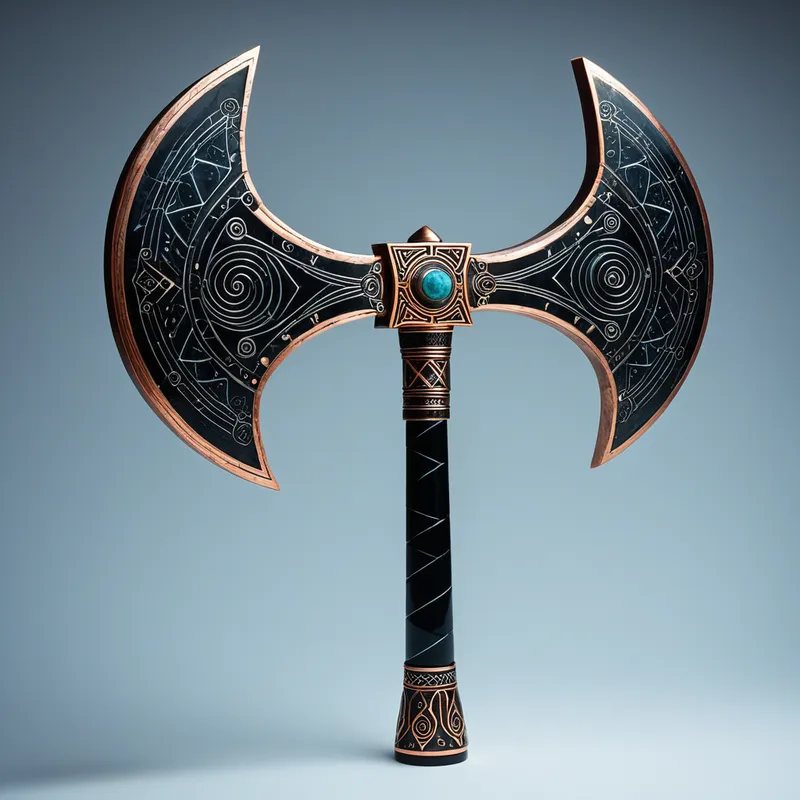
- Axe — Xango’s double-headed axe (Ose), a symbol of decisive justice that cuts both ways, capable of defending order or enacting severe retribution.
- Stone — Often associated with Xango’s thunderstones (edun ara), representing the solidified, enduring power of the orisha and the foundation of law.
- Dance — The physical manifestation of Xango’s energy in Candomble ritual, a powerful, stomping, masculine dance that channels his fiery, regal spirit.
- Rage — The untamed, volcanic emotion that Xango must ultimately confront and integrate, transforming raw fury into the focused force of justice.
- Rebirth — The core promise of Xango’s myth; the phoenix-like ascent from the ashes of personal failure to a higher, more conscious state of being.
- Justice — The central theme of Xango’s domain, a complex justice informed by the memory of error, balancing power with accountability.
- Order — The principle Xango ultimately serves, the cosmic and social balance that his thunder both protects and, through storm, restores.