Womba the Mad Moon Myth Meaning & Symbolism
A myth of the Moon Ancestor Womba, driven mad by grief, whose fractured light and erratic path teach of loss, ritual, and the mending of the world.
The Tale of Womba the Mad Moon
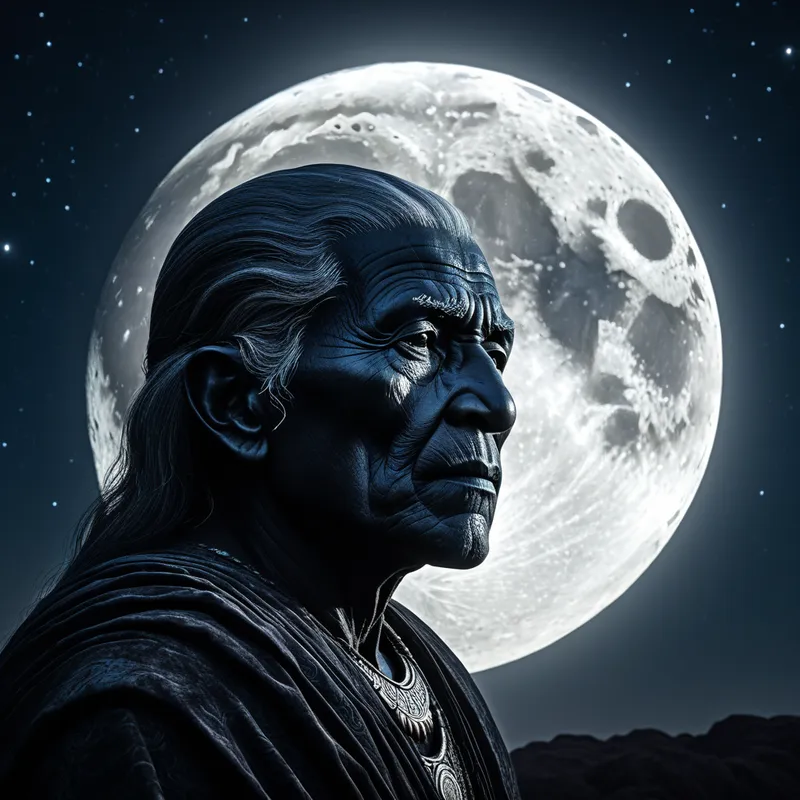
Listen. Before the rivers knew their course and the trees remembered their shape, the sky was a different country. In that time, the Moon was not a silent wanderer. It was a person, a great Ancestor named Womba. Womba was the keeper of the rhythm, the pulse of the tides in the Ocean, the gentle light for the night-blooming Flower. His path across the Sky was as steady as a heartbeat, a silver road that guided the Bird and soothed the dreaming Earth.
Womba had a beloved, a spirit of the shimmering Water who danced in the billabongs and sang in the rain. Their love was a covenant between sky and land, a promise that the world would always turn towards balance. But from the deep places, from the chaotic under-Root of creation, a great Serpent of forgetting rose. It did not attack with tooth or claw, but with a breath of absolute silence. It swallowed the song of the water spirit whole.
When Womba next looked down to see his beloved’s reflection, he saw only a still, dark Mirror. Her song was gone. The silence that followed was not empty; it was a solid, screaming thing. And Womba’s heart, which was the moon’s own light, broke.
He did not weep gentle tears. He screamed. A soundless, cosmic scream that cracked his luminous face. The steady silver road of his path shattered. He began to run—a frantic, lurching dash across the night. He would plunge towards the horizon, then stagger back, then spin in dizzy, grief-stricken circles. He grew thin as a Sickle, then bloated and heavy with sorrow, his light flaring wildly. The tides, once a gentle breath, became violent, unpredictable gasps. The night animals hid in confusion. The world’s rhythm was undone. This was the birth of the Mad Moon.
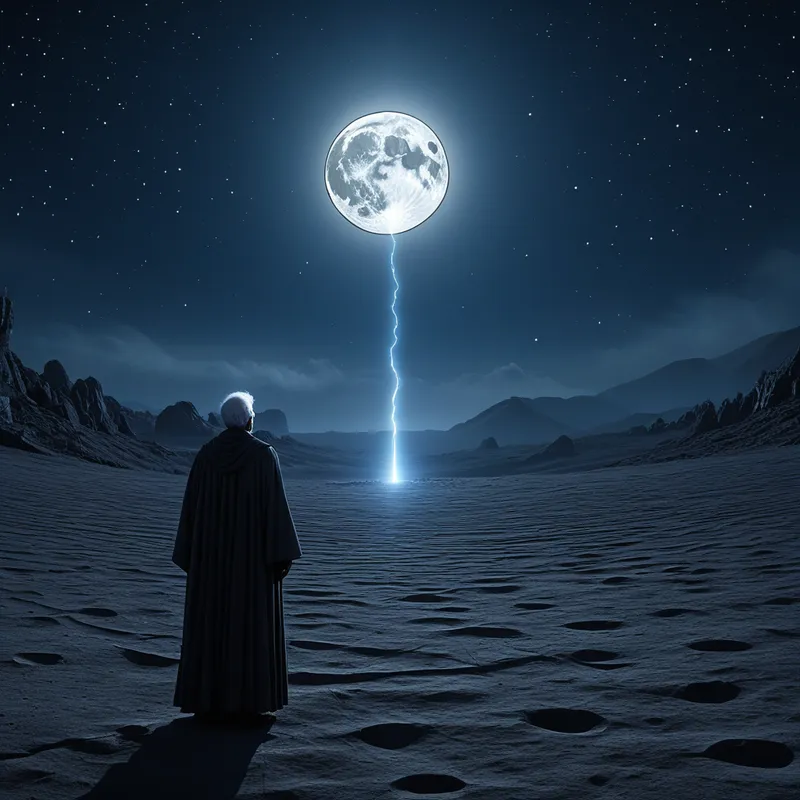
The people below felt this madness in their bones. Their sleep was filled with terrifying Dreams. The seasons whispered of discord. An elder, her hair white as Moonbeams, sat in a Clearing. She listened to the land’s distress. She took a sacred, milky Moonstone and polished it with her breath and her tears. She did not try to command Womba. Instead, she began to sing. Not the water spirit’s song, which was lost, but a new song—a song of witnessing. A song that named the Grief, that traced the cracks in the light, that remembered the lost beloved’s name.
One by one, others joined her. They built no Temple, but stood on the bare Earth. They lifted their own stones, their voices, their memories. They created a Circle of shared remembrance beneath the chaotic sky. They did not heal Womba’s broken heart. They held it. They mirrored his madness with their steady, mournful Ritual.
And Womba, in his wild flight, saw it. A tiny, fragile constellation of memory glowing on the dark land. He did not stop being mad. But for a moment, his flight would slow. His fractured light would soften, just a little, as it touched that circle below. He saw that his grief was not alone in the universe. And in that recognition, a new rhythm was born—not the old, perfect rhythm, but a true one, woven from brokenness and remembrance. The madness became a dance, and the dance became the law.
Cultural Origins & Context
This story belongs to the vast, interconnected narrative system of the Aboriginal Australian Dreamtime. It is not a singular, fixed text but a living narrative pattern found, with local variations, among several language groups, particularly in regions where the moon’s influence on tides and cycles is profoundly observed. As an oral tradition, it was and is the province of knowledge-keepers and elders, passed down not as mere entertainment but as a foundational Songline. Its telling was often tied to specific ceremonial times, lunar observations, and initiatory teachings about loss, responsibility, and communal resilience.
Its societal function was multifaceted. On a practical level, it explained the observable, irregular motions of the moon and the sometimes-violent tidal behaviors. On a deeper, pedagogical level, it served as a profound container for discussing uncontrollable change, catastrophic grief, and the non-linear path of Healing. It taught that not all cosmic disorders can be “fixed” by a Hero’s might, but some must be integrated through collective witnessing and sacred ceremony. The myth models how a community holds the psyche of one who is shattered—even a celestial one—without abandoning them to their chaos.
Symbolic Architecture
At its core, Womba is the [archetype](/symbols/archetype “Symbol: A universal, primordial pattern or prototype in the collective unconscious that shapes human experience, behavior, and creative expression.”/) of the [Shadow](/symbols/shadow “Symbol: The ‘shadow’ embodies the unconscious, repressed aspects of the self and often represents fears or hidden emotions.”/) made cosmic. He represents the part of the self—or the [community](/symbols/community “Symbol: Community in dreams symbolizes connection, support, and the need for belonging.”/), or the [cosmos](/symbols/cosmos “Symbol: The entire universe as an ordered, harmonious system, often representing the totality of existence, spiritual connection, and the unknown.”/) itself—that breaks under the [weight](/symbols/weight “Symbol: Weight symbolizes burdens, responsibilities, and emotional loads one carries in life.”/) of unbearable [loss](/symbols/loss “Symbol: Loss often symbolizes change, grief, and transformation in dreams, representing the emotional or psychological detachment from something or someone significant.”/). His “madness” is not insanity, but the total, legitimate [disintegration](/symbols/disintegration “Symbol: A symbol of breakdown, loss of form, or fragmentation, often reflecting anxiety about personal identity, control, or stability.”/) of a known world-order.
The broken moon does not fall; it charts a new, more terrifying constellation. This is the first law of transformative grief.
The steady lunar [path](/symbols/path “Symbol: The ‘path’ symbolizes a journey, choices, and the direction one’s life is taking, often representing individual growth and exploration.”/) symbolizes the ego’s illusion of control and predictable order. The [Serpent](/symbols/serpent “Symbol: A powerful symbol of transformation, wisdom, and primal energy, often representing hidden knowledge, healing, or temptation.”/) of forgetting represents the traumatic [event](/symbols/event “Symbol: An event within dreams often signifies significant life changes, transitions, or emotional milestones.”/) that shatters meaning itself, swallowing not just a loved one, but the entire narrative that made [life](/symbols/life “Symbol: The symbol of ‘Life’ represents a journey of growth, interconnectedness, and existential meaning, encompassing both the joys and challenges that define human experience.”/) coherent. Womba’s erratic phases—now a [Crescent](/symbols/crescent “Symbol: The crescent shape often symbolizes growth, transformation, and the cyclical nature of existence, emphasizing the dualities of light and dark.”/) [Moon](/symbols/moon “Symbol: The Moon symbolizes intuition, emotional depth, and the cyclical nature of life, often reflecting the inner self and subconscious desires.”/), now a full, bloated orb of pain—mirror the unpredictable stages of profound mourning: denial, anger, bargaining, depression, but in a non-[linear](/symbols/linear “Symbol: Represents order, predictability, and a direct, step-by-step progression. It symbolizes a clear path from cause to effect.”/), cyclical storm.
The elder’s Moonstone is the [symbol](/symbols/symbol “Symbol: A symbol can represent an idea, concept, or belief, serving as a powerful tool for communication and understanding.”/) of the conscious ego or the mediating function of the psyche. It does not possess its own light but can reflect and focus the light of the other. Her [ritual](/symbols/ritual “Symbol: Rituals signify structured, meaningful actions carried out regularly, reflecting cultural beliefs and emotional needs.”/) is the act of making meaning. She does not replace the lost song; she creates a new song about the loss. This is the [alchemy](/symbols/alchemy “Symbol: A transformative process of purification and creation, often symbolizing personal or spiritual evolution through difficult stages.”/) of [memory](/symbols/memory “Symbol: Memory symbolizes the past, lessons learned, and the narratives we construct about our identities.”/) transforming paralyzing [grief](/symbols/grief “Symbol: A profound emotional response to loss, often manifesting as deep sorrow, yearning, and a sense of emptiness.”/) into sacred [story](/symbols/story “Symbol: The symbol of ‘Story’ represents the narrative woven through our lives, embodying experiences, lessons, and emotions that shape our identities.”/).
The Dreamer’s Resonance
When this myth stirs in the modern Dream, it often manifests as dreams of celestial disaster, erratic tides flooding one’s home, or trying to follow a path that keeps violently shifting. The dreamer may find themselves in a Forest under a spinning, cracked moon, feeling a somatic sense of vertigo and profound disorientation.
Psychologically, this indicates the dreamer is experiencing a “shattering of the lunar principle”—the intuitive, rhythmic, receptive, and containing aspect of the psyche has been traumatized. This could relate to the loss of a primary relationship (the Water spirit), the collapse of a carefully maintained emotional container, or a betrayal by something that was supposed to provide cyclical security. The dream is not diagnosing madness, but honoring the legitimate, world-breaking quality of true grief. The somatic feeling is one of rhythmic collapse—the heartbeat of life itself feels erratic and untrustworthy.
Alchemical Translation
The individuation process modeled here is not one of heroic conquest, but of sacred accompaniment of one’s own shattered parts. Womba is the orphaned, grief-stricken complex within us that we are often tempted to exile because its pain is too chaotic and disruptive to our desired order.
The work is not to cure the madness, but to sing to it. To build a circle of conscious attention around the wound, and to let that attention be the first, fragile bridge back to a world that will forever after be bittersweet.
The first step is to allow the “mad flight”—to stop insisting on the old, steady path. This is the acceptance of the breakdown. The second is the role of the elder: to cultivate a conscious, witnessing part of the self (the Moonstone) that does not try to argue with the grief, but simply acknowledges it, names it, and begins the ritual of remembrance. This is the internal act of journaling, therapy, art, or meditation—creating a “songline” for the pain.
Finally, the myth teaches that the healed state is not a return to the old self. Womba never regains his perfect, pre-trauma orbit. Instead, his madness is incorporated into a new, more complex cosmic order. The individuated self that emerges from such a Journey is one that holds its own fractures within a wider, more compassionate awareness. It has made a Covenant with its own broken light, and in doing so, can hold space for the brokenness of others. The rhythm that returns is deeper, woven with threads of darkness and memory, and infinitely more resilient because it has admitted Chaos into its design.
Associated Symbols
Explore related symbols from the CaleaDream lexicon:
- Moon — The central entity, representing the cyclical, receptive, and emotional psyche, which here undergoes a catastrophic fracture and transformation.
- Water — Symbolizes the anima or soul-connection that is lost, the deep well of feeling that is silenced, triggering the cosmic crisis.
- Grief — The core emotional state that shatters order; not a passive sadness but an active, world-altering force of disintegration.
- Ritual — The conscious, repeated act of witnessing and remembering, which builds a container strong enough to hold chaotic pain and begin its integration.
- Circle — Represents the communal and psychic container created by ritual, a sacred space that mirrors wholeness to the fractured self.
- Mirror — The reflective surface that shows the absence of the beloved, representing the moment of traumatic realization that shatters the self-image.
- Serpent — The primordial force of chaos and forgetting that instigates the loss, representing the unpredictable, traumatic event that swallows meaning.
- Dream — The realm where this mythic pattern becomes active in the modern psyche, a space of non-linear truth and ancestral memory.
- Earth — The grounded, physical reality upon which the healing ritual must be performed, connecting the cosmic drama to somatic, lived experience.
- Healing — The process modeled here, which is not a cure but a transmutation of raw, chaotic pain into a structured, sacred narrative.
- Chaos — The necessary, destructive phase of the cycle, the fertile void from which a new, more conscious order must be born.
- Journey — The erratic, non-linear path of the Mad Moon, which becomes the map for the psyche’s voyage through profound loss and back to a renewed, if scarred, wholeness.