Whirlwind Spirit Myth Meaning & Symbolism
A mythic being of pure motion teaches that within life's most chaotic storms lies the sacred pattern and the power to find one's true center.
The Tale of Whirlwind Spirit
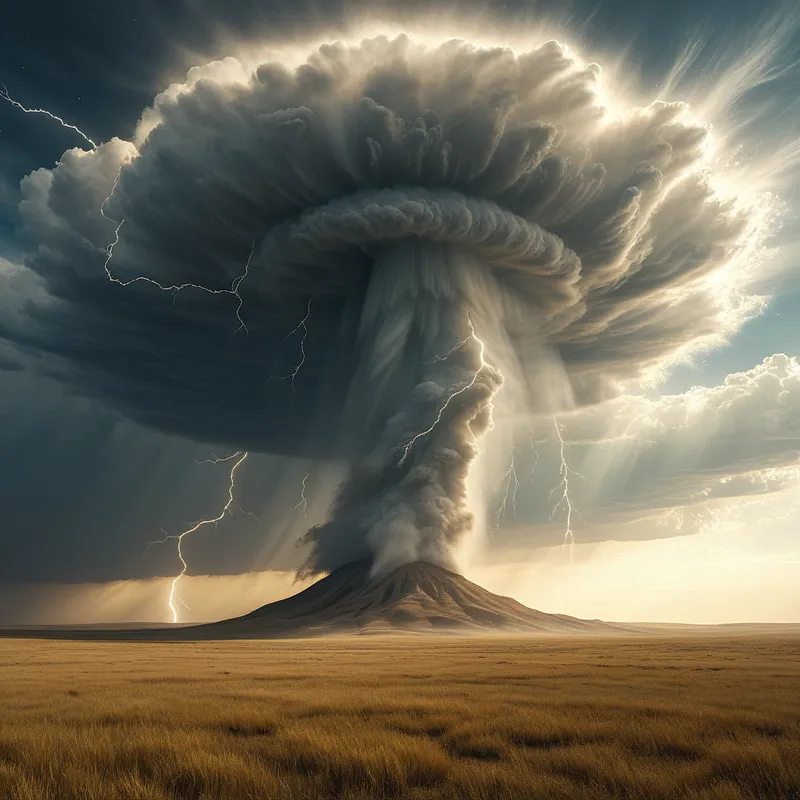
Listen. The story does not begin with a person, but with a Presence. On the great, sun-baked plains where the grass whispers to the sky, there is a moment when the world holds its breath. The air grows heavy, still. Then, from the meeting of the hot earth and the restless wind, a dance is born. Not a gentle dance, but a furious one. Dust rises, not in a cloud, but in a column—a spinning, hungry column that tears at the grass and screams with the voice of a thousand directions. This is Whirlwind Spirit.
To the people, it was a sign of profound disturbance. Where it walked, it was said, disorder followed. It scattered carefully laid drying racks, confused the trails of hunters, and brought a taste of grit and madness. It was the breath of Coyote left unchecked, pure potential without purpose. The elders would watch its path and speak in low tones, for the Whirlwind was not evil, but it was untamed. It was the world’s raw energy, beautiful and terrifying, and it answered to no one.
The tale is told of a young person, a seeker troubled by a restless spirit within that mirrored the chaos without. Their thoughts were scattered like leaves, their heart pulled in many directions. One day, driven by a compulsion they could not name, they walked out to meet a great Whirlwind that had appeared on the horizon. The air crackled. The sound was a roar that swallowed all other sound. The seeker stood their ground as the wall of spinning dust and debris advanced, feeling their very self begin to unravel in the face of such absolute motion.
But instead of fleeing, they did something foolish, something sacred. They closed their eyes. And they began to sing. Not a song of defiance, but a song of acknowledgment—a simple, steady melody that spoke of the center of things, of the still point. They sang to the heart of the storm.
And the Whirlwind Spirit enveloped them. The world became a blur of brown and gold and screaming wind. Yet, within the chaos, the seeker felt a strange pattern. The spinning was not random; it was a fierce, focused spiral, drawing everything toward a central axis of profound silence. In that eye, there was no sound, only a clear, knowing presence. It was not a monster, but a teacher made of motion. A voice, not in words but in pure knowing, imparted a truth: To be scattered is not to be lost. Every spiral must have a center. Find yours, and the wind becomes your dance, not your prison.
As suddenly as it came, the Whirlwind departed, depositing the seeker gently back onto the earth, covered in dust but with eyes clear. They returned to the people not with a trophy, but with a stillness. They had met the chaos and learned its secret name: it was also a form of order, waiting to be understood.

Cultural Origins & Context
The Whirlwind Spirit is a powerful figure in the oral traditions of many Plains tribes, including the Lakota, Cheyenne, and Pawnee. Unlike the highly structured pantheons of some mythologies, entities like the Whirlwind Spirit exist in a more animistic and phenomenological framework. They are not distant gods but immediate, potent manifestations of the living world’s personality. Stories of the Whirlwind were not mere entertainment; they were ontological guides, explaining the nature of chaotic forces and how to relate to them.
These narratives were typically shared by elders and storytellers, often during the winter months or in teaching moments. Their function was multifaceted: to explain a dramatic and potentially dangerous natural phenomenon, to instill respect for the power of the world, and to encode psychological wisdom. The myth served as a map for navigating internal turmoil, teaching that what appears as destructive external chaos often mirrors an internal state, and that confrontation and understanding, not mere avoidance, are the paths to wisdom. The Whirlwind was a reminder that the cosmos includes frenzy as well as peace, and that human beings must learn to find their orientation within both.
Symbolic Architecture
At its core, the Whirlwind Spirit symbolizes the archetypal force of undifferentiated energy. It is potential in its raw, uncontained state—the swirling mass of thoughts, emotions, drives, and possibilities that precede conscious formation. It represents the psychic material that must be organized to create a coherent self.
The whirlwind is the psyche’s prima materia—the chaotic "first matter" that holds all possibilities and none, demanding a conscious center to give it meaningful form.
Psychologically, the Whirlwind is the shadow of our own unintegrated complexity. The seeker in the story represents the nascent ego, the part of the psyche that feels overwhelmed by the unconscious's sheer volume and force. The heroic act is not to slay the whirlwind, but to face it and sing to its center. This is the act of applying consciousness—the "song"—to chaos. The discovery of the silent axis within the storm is the revelation of the Self. The storm does not cease to exist; rather, the individual learns they contain both the storm and the still point from which it can be witnessed and understood.
The Dreamer's Resonance
When the Whirlwind Spirit visits a modern dream, it rarely appears as a literal tornado. Its presence is felt in the texture of the dreamscape: a overwhelming sense of being pulled in multiple directions, scenes that shift and dissolve without logic, or a feeling of frantic, pointless activity. You may dream of losing vital papers in a sudden gust, of trying to run through air thick as syrup, or of watching your own home being rearranged by an invisible, chaotic force.
Somatically, this dream pattern often accompanies periods of intense stress, life transition, or creative ferment—when the psyche is actively deconstructing old patterns to make way for the new. The psychological process is one of disorientation preceding reorientation. The whirlwind dream is the unconscious communicating the sheer scale of the psychic energy currently in motion. It is not a nightmare to be dismissed, but a signal that the dreamer is in the midst of a profound inner reorganization. The task, as in the myth, is not to panic and flee, but to find a way to "close the eyes" of the frantic ego and listen for the steady song beneath the noise—the core intention or truth that can anchor the self.

Alchemical Translation
The myth of the Whirlwind Spirit is a perfect allegory for the alchemical and Jungian process of individuation. The first stage, nigredo or the blackening, is represented by the seeker’s initial state of confusion and the overwhelming approach of the chaotic whirlwind—a descent into the messy, shadowy material of the unconscious.
The confrontation is the crucial separatio and coniunctio. One must separate from the naive idea of a peaceful, ordered life by facing the chaos (separatio), and then consciously unite with it by recognizing it as part of one’s own substance (coniunctio). The singing is the act of active imagination or conscious reflection applied to the unconscious material.
The goal is not to stop the spinning, but to become the axis around which it spins. In doing so, chaotic energy is transmuted into directed vitality.
The resolution—emerging dust-covered but clear-eyed—symbolizes the albedo, the whitening. A new clarity is born from the confrontation. The chaotic energy of the Whirlwind has not been destroyed; it has been related to. It becomes a source of power rather than a threat. The individual who has undergone this process carries an inner stillness that allows them to engage with life’s turbulence without being shattered by it. They have performed the ultimate alchemy: turning the leaden confusion of scattered potential into the gold of integrated, purposeful being. They have learned that the spirit of the whirlwind is not an enemy to be feared, but a fierce aspect of their own soul, waiting to be met, heard, and woven into the greater pattern of who they are.
Associated Symbols
Explore related symbols from the CaleaDream lexicon: