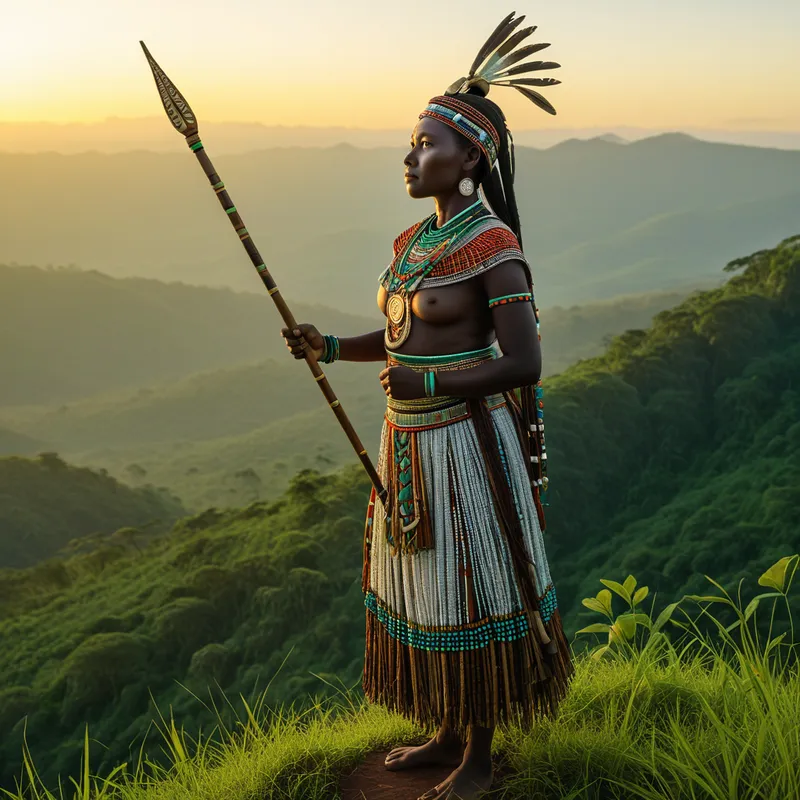
Wangu wa Makeri Kikuyu Legend Myth Meaning & Symbolism
The story of a revered female leader whose fall from grace established a new social order, exploring the cost of power and cultural transformation.
The Tale of Wangu wa Makeri
Listen, and let the story settle in your bones. It is a tale from a time when the world was younger, when the people of the Kikuyu lived under the watchful gaze of Kirinyaga and the land was rich with promise.
In those days, the people were led by a council of elders, men of wisdom and age. But a change stirred in the heart of the community. They chose a ruler, a mũthamaki, to guide them with a single, strong voice. And the one they chose was not a man. She was Wangu wa Makeri. Her name carried the weight of her mother, Makeri, and her presence carried the authority of the land itself. She was a leader of profound capability, a ruler who brought order and prosperity. Under her reign, the harvests were bountiful, the rains came in their season, and peace was a cloak worn by all.
Yet, power is a complex spirit. To govern effectively, Wangu formed a council. But she did not call upon the grey-bearded elders. She summoned the women. Young, strong, unmarried women—the anake—became her advisors and enforcers. They were her shield and her spear. The traditional order, where age and masculinity conferred authority, was set aside. A new mĩgĩro was woven, one where the vitality and insight of women held the central staff of power.
For a time, the system worked. But whispers began to travel on the night wind, like smoke from a hidden fire. The elders, once respected, now felt sidelined. The young men, who saw the anake wielding power they themselves coveted, grew restless with a simmering jealousy. The community’s unity, once felt in the rhythm of shared labor, began to develop a fault line.
Then came the transgression that would echo through generations. The sacred laws of the people forbade the anake—the young, unmarried warriors—from marrying until a certain age, a rule that preserved social structure. It is said that Wangu and her council of women broke this most fundamental covenant. They took husbands in secret. This was not merely a personal choice; it was a profound rupture of the social and spiritual contract. The secret, however, could not be contained.
The discovery was a thunderclap. Whether through vigilance or betrayal, the elders and the young men learned of it. The betrayal they felt was twofold: the breaking of the law, and the consolidation of power within a closed circle. Their rage was not mere anger; it was the fury of a cultural cosmos being overturned. Confrontation was inevitable.
Wangu wa Makeri, the ruler who had led from the front, faced the united wrath of the men she had displaced. There was no battle of spears, but a battle of will and custom. Her authority, derived from the people’s mandate, was dissolved by their collective judgment. She was deposed. The experiment of female rule, born of practical need, ended in cultural revolt.
From that day forward, the story says, a new and immutable law was etched into the heart of Kikuyu society: never again would a woman rule as mũthamaki. The council of elders was restored. The path to leadership once more passed through the gate of age and masculinity. Wangu faded from the seat of power, her name becoming a legend—a cautionary tale about the limits of authority, the weight of tradition, and the price of transgressing the deep, unseen roots of social order.
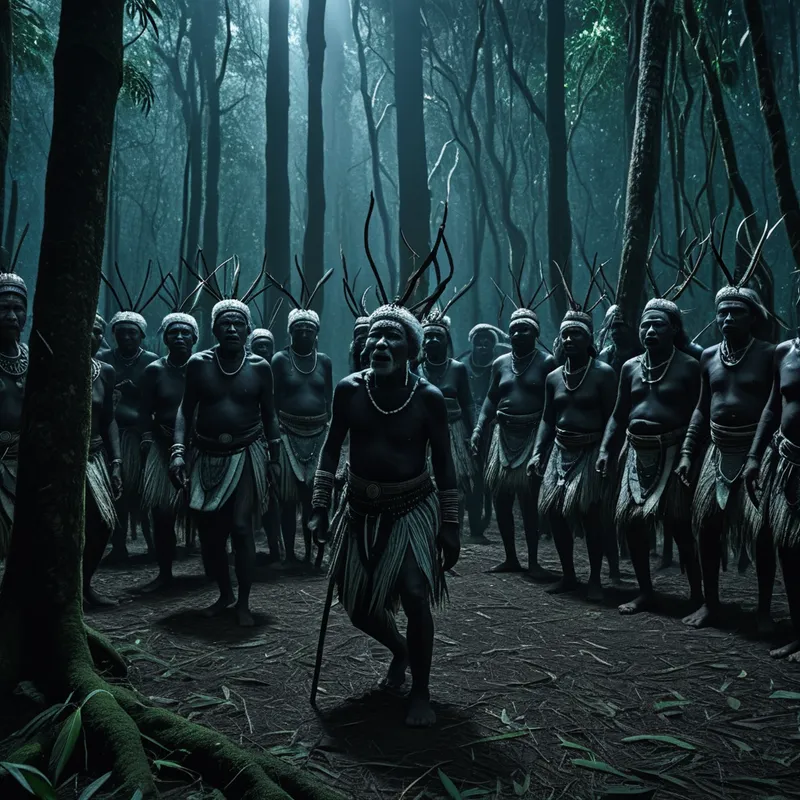
Cultural Origins & Context
This narrative originates from the Kikuyu (Gĩkũyũ) people of central Kenya, one of the largest ethnic groups in the country. It is a foundational political myth, not merely a folktale. Passed down orally through generations by elders—athuri—around evening fires, its primary function was etiological: to explain and justify the patriarchal structure of Kikuyu governance. The story served as the “charter myth” for a socio-political system where leadership (ũthamaki) was the exclusive domain of male elders who had passed through specific age-grade rituals.
The telling of Wangu’s story was a pedagogical tool. It reinforced social norms, delineated gender roles, and warned of the chaos that could ensue from inverting the established mĩgĩro. It answered the implicit question, “Why do we do things this way?” with a dramatic, memorable narrative. The myth also reflects a historical moment of societal negotiation, possibly encoding a memory of a time when matrilineal or female-centric power structures were more prominent before being superseded. It is a story told from the perspective of the order that ultimately prevailed, making Wangu a complex figure—both a capable ruler and a tragic transgressor.
Symbolic Architecture
At its core, the myth of Wangu wa Makeri is a profound [drama](/symbols/drama “Symbol: Drama signifies narratives, emotional expression, and the exploration of human experiences.”/) about the containers of power and the inevitable [tension](/symbols/tension “Symbol: A state of mental or emotional strain, often manifesting physically as tightness, pressure, or unease, signaling unresolved conflict or anticipation.”/) between innovation and tradition.
The throne is not merely a seat; it is the visible apex of an invisible, root-like network of covenants that bind the individual to the collective soul.
Wangu symbolizes the Innovator, the Potent Feminine, and the Sovereign Self that seeks to rule by its own inner [council](/symbols/council “Symbol: A council represents collective decision-making and guidance, embodying communal wisdom and authority.”/). Her all-female council of anake represents a new psychic [hierarchy](/symbols/hierarchy “Symbol: A structured system of ranking or authority, often representing social order, power dynamics, and one’s position within groups or institutions.”/)—[intuition](/symbols/intuition “Symbol: The immediate, non-rational understanding of truth or insight, often described as a ‘gut feeling’ or inner knowing that bypasses conscious reasoning.”/), relational intelligence, and unencumbered vitality—usurping the old hierarchy of accrued experience (the elders) and raw, untested masculine potential (the young men). The broken [marriage](/symbols/marriage “Symbol: Marriage symbolizes commitment, partnership, and the merging of two identities, often reflecting one’s feelings about relationships and social obligations.”/) law is the critical [symbol](/symbols/symbol “Symbol: A symbol can represent an idea, concept, or belief, serving as a powerful tool for communication and understanding.”/). It is not merely a social rule but represents the sacred [boundary](/symbols/boundary “Symbol: A conceptual or physical limit defining separation, protection, or identity between entities, spaces, or states of being.”/) between the personal desires of the ruling ego (Wangu and her circle) and the impersonal, transpersonal laws of the cultural super-ego. To break this law is to confuse personal [privilege](/symbols/privilege “Symbol: Unearned advantages or rights granted by social systems, often tied to identity, wealth, or status, creating power imbalances.”/) with structural [authority](/symbols/authority “Symbol: A symbol representing power structures, rules, and control, often reflecting one’s relationship with societal or personal governance.”/).
The ensuing rebellion led by the elders and young men embodies the psyche’s Self-regulating function. When one complex (the ruling feminine) becomes too dominant and severs its [connection](/symbols/connection “Symbol: Connection symbolizes relationships, communication, and bonds among individuals.”/) to the whole, the other complexes unite to restore balance, however brutally. The [deposition](/symbols/deposition “Symbol: A formal act of removing or setting down something or someone, often from a position of authority or height, representing transition, testimony, or release.”/) is not just a political act but a psychic correction.

The Dreamer’s Resonance
When this myth pattern stirs in the modern dreamer, it often manifests as dreams of untenable leadership. You may dream of being promoted to a position for which you are competent, yet feel a profound, unspoken hostility from colleagues or family. You may dream of founding a new project or community based on idealistic, egalitarian principles, only to have the original members turn against you in accusation. Somatic sensations might include a tightness in the throat (the unspoken law), a heavy weight on the shoulders (the burden of authority), or a feeling of being watched and judged by a faceless crowd.
Psychologically, this signals a crucial phase where an emerging part of the personality—a new skill, a hard-won confidence, a feminine or masculine principle asserting itself—has taken executive control. However, it has done so by ignoring or repressing other vital internal voices (the “inner elders” of wisdom and tradition, the “inner young men” of ambition and instinct). The dream is the psyche’s council chamber, where these deposed factions are uniting to stage a revolt. The process is one of confronting shadow integration—the realization that your newfound power may carry an arrogance that alienates your own internal community.
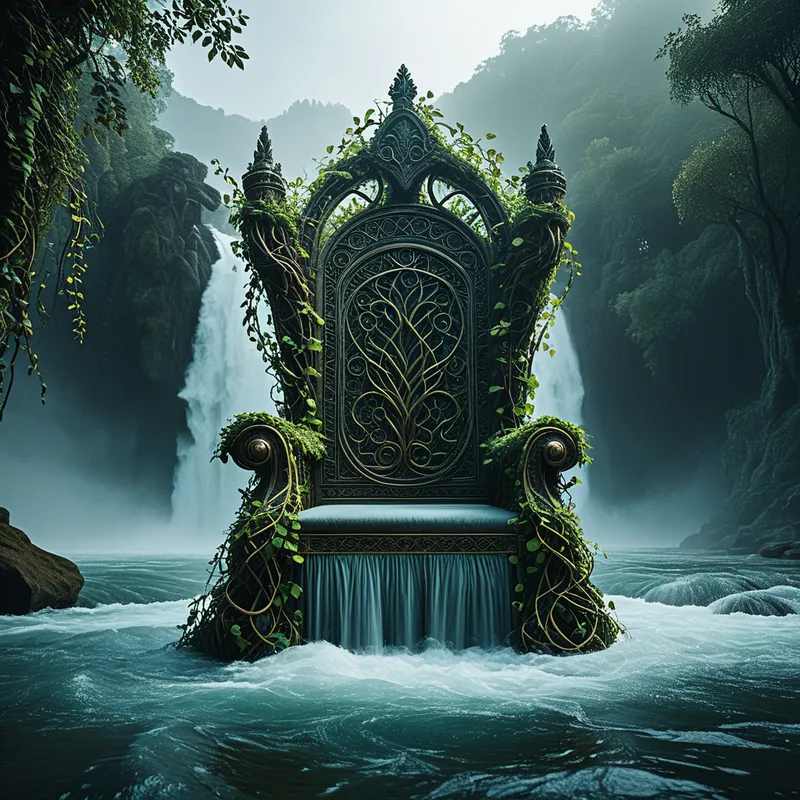
Alchemical Translation
The alchemical journey modeled here is not of the hero who slays the dragon, but of the ruler who is deposed by their own kingdom. It is the process of Individuation through Demotion.
The first stage, Rule, corresponds to the Nigredo. The dreamer identifies completely with a powerful new role or attitude (the conscious ego as Wangu). This brings initial order and success. The second stage, Transgression, is the Albedo—a whitening that is also a separating. Here, the ruling consciousness, in its brilliance, breaks a sacred inner covenant. It acts in its own interest, severing its service to the greater Self. It says, “My law is the only law.”
The ensuing Revolt is the fierce Citrinitas, a yellowing that is a burning. The neglected and wounded parts of the psyche rise up in righteous anger. This is a necessary, purgative crisis. The old, wise structures (elders) and the raw, instinctual energies (young men) form an unlikely alliance to dismantle the tyrannical monarchy of a single complex.
The true alchemical gold is not forged in maintaining power, but in surrendering it to a wisdom greater than the ego’s design.
Finally, the Deposition leads to the Rubedo, the reddening. This is not a failure, but a profound integration. The ego-complex that was Wangu is not destroyed; it is humbled and re-contextualized. It is reintegrated into the internal community not as a sole ruler, but as a respected voice within a restored, more complete inner council. The new law that emerges—“never again shall this one aspect rule alone”—is the birth of a more democratic psyche. The individual learns to lead from a place of dialogue with all inner factions, transforming autocracy into a mindful, collective sovereignty. The fall of the ruler gives way to the rise of the integrated Self.
Associated Symbols
Explore related symbols from the CaleaDream lexicon:
- Crown — The symbol of sovereign authority and rulership that Wangu wa Makeri embodied, representing both legitimate power and the isolation it can bring.
- Ritual — The sacred dances and customs broken by Wangu and her council, representing the structured, ceremonial laws that bind a society and psyche together.
- Shadow — The repressed discontent of the elders and young men, which eventually rises up to confront the ruling consciousness in a necessary, if painful, integration.
- Betrayal — The core emotional wound of the myth, felt by all parties: the people betrayed by their ruler’s transgression, and Wangu betrayed by the withdrawal of communal mandate.
- Order — The central theme of the myth, depicting the violent, cyclical process by which one social or psychic order is overthrown to establish another.
- Woman — Wangu as the archetypal powerful feminine, representing intuitive leadership, generative power, and the challenge to patriarchal structures.
- Elder — The deposed council of wise men, symbolizing tradition, accrued wisdom, and the established laws of the cultural super-ego.
- Law — The sacred covenant of marriage and social structure that was broken, representing the non-negotiable boundaries that maintain collective integrity.
- Thunder — The sudden, disruptive revelation of the transgression and the collective outrage that follows, symbolizing a shocking, world-altering truth.
- Goddess — The numinous, sovereign feminine principle that Wangu channels, which is both creative and, when unbalanced, capable of provoking a systemic crisis.